

Macronix International Co (旺宏), the world’s biggest supplier of NOR flash memory chips, yesterday posted its best April revenue, at NT$3.81 billion (US$136.52 million), lending support to its optimistic forecast about customer demand amid a persistent chip shortage.
Last month’s revenue rose 5.6 percent from NT$3.61 billion in March and 11.2 percent from NT$3.43 billion a year earlier, the company said in a statement.
Macronix has forecast a gradual growth in quarterly revenue through the end of the year, as customers scramble to secure chip supply, boosting its book-to-bill ratio to “a stunning level.”
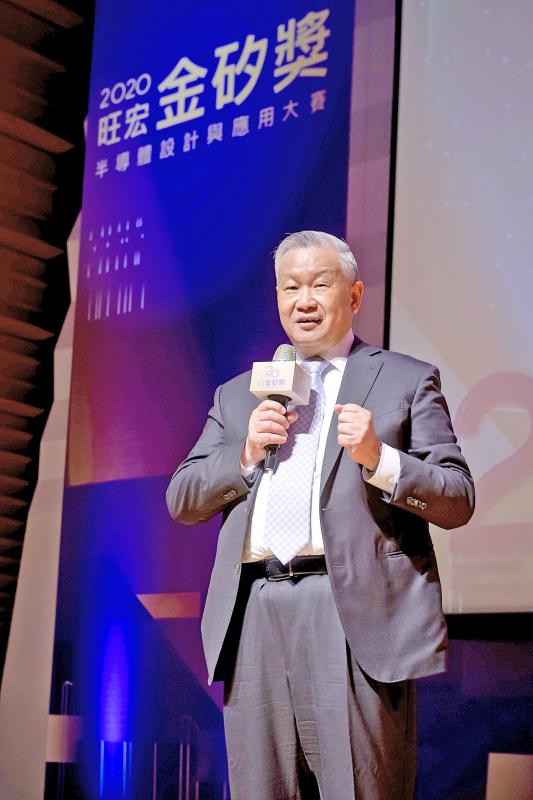
Photo courtesy of Macronix Education Foundation
The chip supply crunch is expected to extend into next year, and chip prices are reflecting this tight market situation, company chairman Miin Wu (吳敏求) told a virtual investors’ conference last month.
Macronix saw aggregate revenue in the first four months of this year grow 4.6 percent to NT$13.44 billion, from NT$12.84 billion a year earlier.
Winbond Electronics Corp (華邦電子), another NOR flash memorychip maker, swung into a net profit of NT$1.71 billion last quarter, from losses of NT$86.65 million in the same period last year.
Gross margin jumped to 37.55 percent last quarter from 24.16 percent in the prior quarter, company data showed.
Winbond told investors that it expected price hikes to boost its revenue, leading to a further improvement in gross margin this quarter.
Earlier this week, DRAM chipmaker Nanya Technology Corp (南亞科技) reported that its revenue last month soared 31.58 percent year-on-year to a 31-month high of NT$7.39 billion. That also represented sequential growth of 15.4 percent from NT$6.41 billion.
Nanya Technology attributed last month’s growth to a 15 percent increase in prices from a quarter earlier.
Shipments were flat last month from the previous month, as it has been running at full capacity.
Adata Technology Co (威剛), a supplier of memory modules and solid-state drives (SSDs), yesterday said that revenue last month hit an 11-year high of NT$3.6 billion, up 70 percent annually from NT$2.07 billion.
On a monthly basis, revenue rose 7.43 percent from NT$3.35 billion in March, which the company attributed to robust SSD demand and higher NAND flash module prices.
Adata is bullish about demand for memory chips used in computers, servers, smartphones and cars for the rest of the year, chairman Simon Chen (陳立白) said in a statement yesterday.
As a result, the chip shortage is expected to deepen, supporting upticks in DRAM product prices until the end of this year, he said.

Bankers in Hong Kong skipped the summer break as an artificial intelligence (AI)-fueled rush for capital sent share sales to a record, defying a bruising selloff in the city’s stocks. Initial public offerings (IPOs), placements and block trades raised US$47.5 billion in July to last month, the biggest haul ever for the period, data compiled by Bloomberg showed. That pushed fundraising this year above US$92 billion and within reach of the US$112.5 billion record set in 2021. AI has been at the heart of Hong Kong’s deal revival, but this summer brought a new level of intensity. Chinese companies raised ever-larger sums

SILICON ISLAND: When asked about geopolitical tensions, Lisa Su said that ‘Taiwan is absolutely critical to the semiconductor supply chain, and very, very critical for AMD’ Advanced Micro Devices Inc (AMD) CEO Lisa Su (蘇姿丰) yesterday said the company plans to “substantially” increase manufacturing capacity next year through its Taiwanese supply chain, particularly with Taiwan Semiconductor Manufacturing Co (TSMC, 台積電), as surging demand for artificial intelligence (AI)-related processors continues to outstrip supply. “It is a very exciting time right now for all kinds of compute, and especially on the CPU [central processing unit] side,” Su said during a visit to Taiwan. “The overall market has increased a lot in 2026, and so we have also increased our own supply and capacity in 2026, but I can

Sea levels in California are set to rise by as much as a foot (30cm) in the coming days as an enormous wave washes up the US West Coast. The huge surge of energy, known as a “coastal trapped wave” or a “Kelvin wave,” is part of El Nino, a months-long phenomenon in the Pacific Ocean that scientists say could generate powerful storms and floods in some parts of the world, while leaving others in drought. The Kelvin wave is not anything like a tsunami; nor does it crash on beaches. Rather it is a sustained bulge of excess water up to
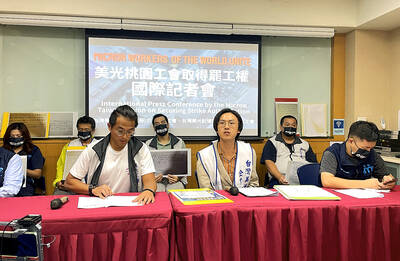
INDUSTRY STANDARD: Most global semiconductor companies have tied employee bonuses directly to corporate profits, the union said, urging Micron to do the same Micron Memory Taiwan Co’s (台灣美光) Taoyuan union secured strike authorization yesterday after a six-day vote, ramping up pressure on management to build a reasonable profit-sharing mechanism. Before the strike, the Taoyuan union “encourages” members to join a protest in Taipei on Oct. 19, union chairman Jerry Lin (林哲瑞) told a news conference in Taipei. The union did not rule out staging a snap strike, Lin said. The union has 2,258 registered members, with 88.3 percent backing the strike, he said. The vote comes as Micron’s board of directors is meeting today and tomorrow in the US. The union expects the board to respond


 RSS
RSS