


China’s move to tighten control of crude steel production, coupled with continued strong demand from downstream industries, is expected to have a positive effect on major players in the local steel industry this year, Yuanta Securities Investment Consulting Co (元大投顧) said.
Steel prices are also expected to remain robust on tight supply, despite a likely decline in iron ore prices in the second half of this year after the easing of a shortage in key raw materials for making steel, Yuanta analysts led by Leo Lee (李侃奇) said in a report on Wednesday last week.
The improving supply-demand dynamics come at a time when China is attempting to reduce crude steel production so that it can meet a carbon neutrality target that it set as part of its 14th Five-Year Plan released in October last year.
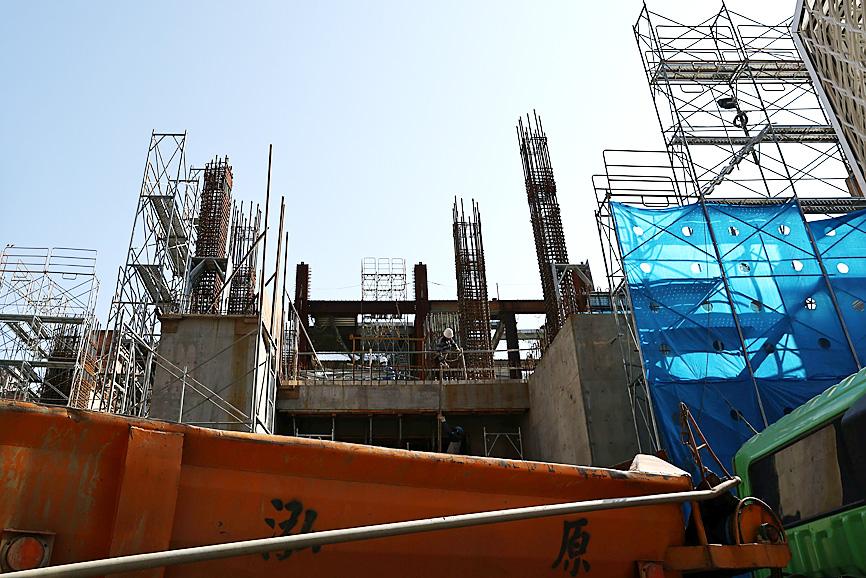
Photo: Ann Wang, Reuters
For example, Tangshan, China’s top steelmaking city, plans to reduce capacity by 30 to 50 percent by the end of this year, Yuanta said.
Japan’s green energy development has prompted Nippon Steel & Sumitomo Metal Corp to shut down 20 percent of its blast furnace capacity by 2025, leading to a continuously tight supply, the report said.
“We expect supply-demand dynamics in the steel industry to be similar to those seen in the cement industry in the past two to three years — that is, tight supply, strong demand and low inventory levels. Thus, we expect a strong upside for steel mills’ earnings,” Yuanta analysts said.
The World Steel Association forecast that global steel demand this year would increase 4.1 percent to 1.79 billion tonnes year-on-year, following a 2.4 percent decline to 1.72 billion tonnes last year amid the COVID-19 pandemic.
The recovery in demand is supported by increased investment in infrastructure in China, the US’ eight-year US$2.3 trillion stimulus package, a global recovery in the auto market and a robust demand for machine tools, Yuanta said.
In Taiwan, the positive momentum is supported by a strong real-estate market, construction of infrastructure and manufacturers returning home, which especially support a demand for rebar and section steel, they said.
Given the market environment, China Steel (中鋼), Taiwan’s largest steelmaker, would benefit the most, while other downstream companies, such as hot-rolled coil maker Chung Hung Steel Corp (中鴻鋼鐵), re-rollers such as Yieh Phui Enterprise Co (燁輝企業) and Sheng Yu Steel Co (盛餘鋼鐵), and secondary processor Hsin Kuang Steel Co (新光鋼鐵), would also benefit from hikes in steel prices, the report said.
Electric furnace operators Tung Ho Steel Enterprise Corp (東和鋼鐵), Feng Hsin Steel Co (豐興鋼鐵), Wei Chih Steel Industrial Co (威致鋼鐵) and Hai Kwang Enterprise Co (海光企業) are likely to benefit from robust demand in domestic construction, with earnings to remain high as the price of rebar and section steel would reflect hikes in scrap steel prices, it said.
Hikes in scrap steel prices are driven by a rising demand for scrap steel amid China’s effort to increase production at electric furnaces, which emit less carbon dioxide and greenhouse gases during coking than blast furnaces, it added.

Singapore-based ride-hailing and delivery giant Grab Holdings Ltd has applied for regulatory approval to acquire the Taiwan operations of Germany-based Delivery Hero SE's Foodpanda in a deal valued at about US$600 million. Grab submitted the filing to the Fair Trade Commission on Friday last week, with the transaction subject to regulatory review and approval, the company said in a statement yesterday. Its independent governance structure would help foster a healthy and competitive market in Taiwan if the deal is approved, Grab said. Grab, which is listed on the NASDAQ, said in the filing that US-based Uber Technologies Inc holds about 13 percent of

The domestic unit of the Chinese-owned, Dutch-headquartered chipmaker Nexperia BV will soon be able to produce semiconductors locally within China, according to two company sources. Nexperia is at the center of a global tug-of-war over critical semiconductor technology, with a Dutch court in February ordering a probe into alleged mismanagement at the company. The geopolitical tussle has disrupted supply chains, with some carmakers reportedly forced to cut production due to chip shortages. Local production would allow Nexperia’s domestic arm, Nexperia Semiconductors (China) Ltd (安世半導體中國), to bypass restrictions in place since October on the supply of silicon wafers — etched with tiny components to

Taiwan Semiconductor Manufacturing Co (TSMC, 台積電) yesterday received government approval to deploy its advanced 3-nanometer (3nm) process at its second fab currently under construction in Japan, the Ministry of Economic Affairs said in a news release. The ministry green-lit the plan for the facility in Kumamoto, which is scheduled to start installing equipment and come online in 2028 with a monthly production capacity of 15,000 12-inch wafers, the ministry said. The Department of Investment Review in June 2024 authorized a US$5.26 billion investment for the facility, slated to manufacture 6- to 12nm chips, significantly less advanced than 3nm process. At a meeting with

Taiwan’s food delivery market could undergo a major shift if Singapore-based Grab Holdings Ltd completes its planned acquisition of Delivery Hero SE’s Foodpanda business in Taiwan, industry experts said. Grab on Monday last week announced it would acquire Foodpanda’s Taiwan operations for US$600 million. The deal is expected to be finalized in the second half of this year, with Grab aiming to complete user migration to its platform by the first half of next year. A duopoly between Uber Eats and Foodpanda dominates Taiwan’s delivery market, a structure that has remained intact since the Fair Trade Commission (FTC) blocked Uber Technologies Inc’s


 RSS
RSS