


The combined turnover of the Taiwan Stock Exchange (TWSE) and the Taipei Exchange on Friday reached NT$563.42 billion (US$19.84 billion) — a new high — as investors rushed to pocket earlier gains.
The TAIEX on Friday closed down 72.34 points, or 0.43 percent, at 16,854.10, after coming off an all-time intraday high of 17,016.13, market data showed.
Turnover on the TWSE, including after-hours transactions, was NT$439.53 billion — the fourth-largest trading volume in the exchange’s history.
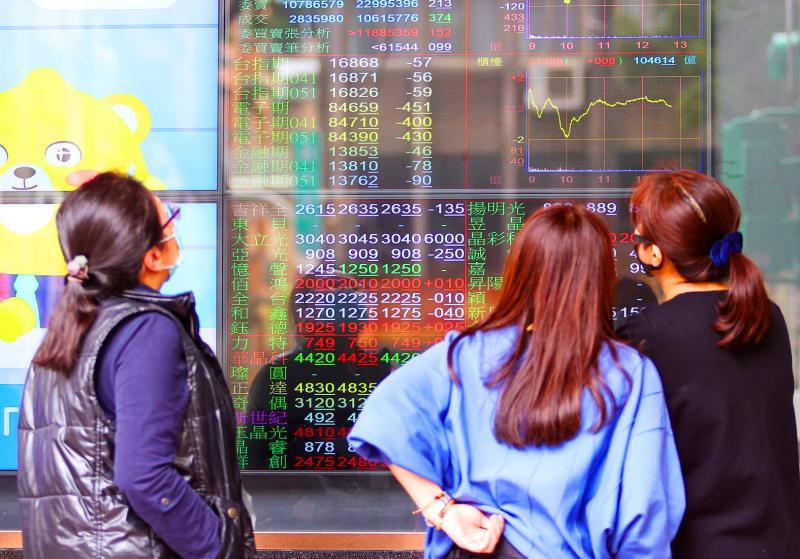
Photo: CNA
A similar story was seen on the Taipei Exchange, which ended down 0.49 points, or 0.23 percent, at 213.31, off an earlier high of 215.12.
Turnover was NT$123.88 billion, the second-highest in the exchange’s history.
Taishin Securities Investment Advisory Co (台新投顧) vice president Tony Huang (黃文清) said that large-cap tech stocks encountered downward pressure when the TAIEX hit the intraday high on Friday, but with plenty of liquidity in the market, buying rotated to select petrochemical stocks to support the index.
Despite the profit-taking, the TAIEX closed above the nearest technical support at about 16,781 points, the five-day moving average, indicating that the market’s upward trend remained unchanged, Mega International Investment Services Corp (兆豐國際投顧) manager Alex Huang (黃國偉) said.
Last week, the TAIEX closed up 282.82 points, or 1.71 percent, with the steel sector gaining 10.07 percent — the best of any sector.
The financial and insurance sector lost 0.72 percent during the week, lagging behind all of the other sectors.
The semiconductor sector remained the focus of investors on the TWSE, accounting for 35.61 percent of total turnover for the week, ahead of the optoelectronics sector (13.22 percent) and the electronics component sector (10.3 percent), exchange data showed.
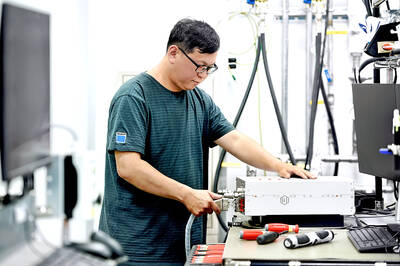
SEMICONDUCTORS: The German laser and plasma generator company will expand its local services as its specialized offerings support Taiwan’s semiconductor industries Trumpf SE + Co KG, a global leader in supplying laser technology and plasma generators used in chip production, is expanding its investments in Taiwan in an effort to deeply integrate into the global semiconductor supply chain in the pursuit of growth. The company, headquartered in Ditzingen, Germany, has invested significantly in a newly inaugurated regional technical center for plasma generators in Taoyuan, its latest expansion in Taiwan after being engaged in various industries for more than 25 years. The center, the first of its kind Trumpf built outside Germany, aims to serve customers from Taiwan, Japan, Southeast Asia and South Korea,

Gasoline and diesel prices at domestic fuel stations are to fall NT$0.2 per liter this week, down for a second consecutive week, CPC Corp, Taiwan (台灣中油) and Formosa Petrochemical Corp (台塑石化) announced yesterday. Effective today, gasoline prices at CPC and Formosa stations are to drop to NT$26.4, NT$27.9 and NT$29.9 per liter for 92, 95 and 98-octane unleaded gasoline respectively, the companies said in separate statements. The price of premium diesel is to fall to NT$24.8 per liter at CPC stations and NT$24.6 at Formosa pumps, they said. The price adjustments came even as international crude oil prices rose last week, as traders
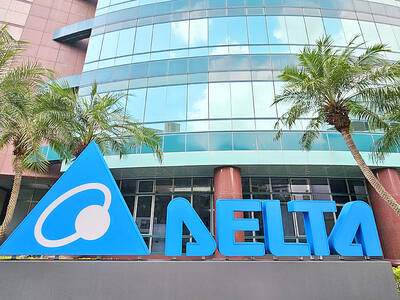
POWERING UP: PSUs for AI servers made up about 50% of Delta’s total server PSU revenue during the first three quarters of last year, the company said Power supply and electronic components maker Delta Electronics Inc (台達電) reported record-high revenue of NT$161.61 billion (US$5.11 billion) for last quarter and said it remains positive about this quarter. Last quarter’s figure was up 7.6 percent from the previous quarter and 41.51 percent higher than a year earlier, and largely in line with Yuanta Securities Investment Consulting Co’s (元大投顧) forecast of NT$160 billion. Delta’s annual revenue last year rose 31.76 percent year-on-year to NT$554.89 billion, also a record high for the company. Its strong performance reflected continued demand for high-performance power solutions and advanced liquid-cooling products used in artificial intelligence (AI) data centers,
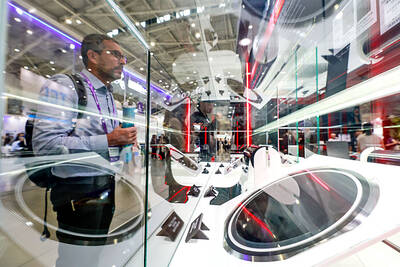
SIZE MATTERS: TSMC started phasing out 8-inch wafer production last year, while Samsung is more aggressively retiring 8-inch capacity, TrendForce said Chipmakers are expected to raise prices of 8-inch wafers by up to 20 percent this year on concern over supply constraints as major contract chipmakers Taiwan Semiconductor Manufacturing Co (TSMC, 台積電) and Samsung Electronics Co gradually retire less advanced wafer capacity, TrendForce Corp (集邦科技) said yesterday. It is the first significant across-the-board price hike since a global semiconductor correction in 2023, the Taipei-based market researcher said in a report. Global 8-inch wafer capacity slid 0.3 percent year-on-year last year, although 8-inch wafer prices still hovered at relatively stable levels throughout the year, TrendForce said. The downward trend is expected to continue this year,


 RSS
RSS