


Lotus Pharmaceutical Co (美時化學製藥), one of the nation’s leading specialty generic drug developers, yesterday said revenue last year hit a record NT$10.58 billion (US$371.4 million) on the back of robust exports.
Revenue last year rose 15 percent annually, despite plummeting 41.7 percent last month to NT$1.01 billion, which could be attributed to a high comparison base in 2019 due to higher sales of gSuboxone, a company official said by telephone.
GSuboxone is the generic version of Indivior Inc’s Suboxone used in the treatment of opioid use disorder, company data showed.
“Although falling annually, December’s revenue still stood at a comparatively high level. It was the fifth month with revenue of more than NT$1 billion last year,” Lotus Pharmaceutical director of corporate finance and investor relations Angela Luan (欒君儀) said.
The company’s exports grew steadily last quarter, albeit at a lower rate than the annual rise of 192 percent in the third quarter, driven by sales of oncology products and gSuboxone, and licensing fees, Luan said.
“Overall, exports made up more than 35 percent of our total revenue last year, hitting a new high. Strong sales of gSuboxone played an important role as we steadily seized a market share of 35 percent in the US,” she said.
As the price of its generic drug is more competitive than the branded drug, many physicians have prescribed gSuboxone to their patients, which boosted the drug’s market position, Luan said.
The company’s sales of gSuboxone were not affected by the COVID-19 pandemic, as people with prescription from their doctors could buy the drug at pharmacies, she said.
Lotus Pharmaceutical’s two markets in East Asia — Taiwan and South Korea — reported decent annual growth in revenue in light of the addition of acquired or licensed-in brand products, Luan said.
New revenue streams from Southeast Asian countries, such as Thailand and Vietnam, contributed about 5 percent of total sales, she said.
Uncertainty over whether the pandemic would end this year and whether governments would tighten lockdowns continue to cloud the company’s outlook, as the distribution of some of its drugs would be affected if patients could not visit hospitals, Luan said.
Separately yesterday, Dr Wu Skincare Co (達爾膚生醫科技) reported revenue of NT$62.15 million for last month, up 3.6 percent year-on-year, while its full-year sales for last year slid 24.6 percent annually to NT$765 million, according to a regulatory filing.
The company attributed the annual decline to lower demand at its physical stores after the number of foreign tourists to Taiwan plummeted amid the pandemic.
The firm would focus on e-commerce operations to attract more local consumers, it said in a statement.
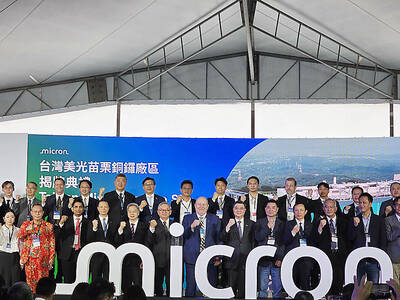
UNPRECEDENTED PACE: Micron Technology has announced plans to expand manufacturing capabilities with the acquisition of a new chip plant in Miaoli Micron Technology Inc unveiled a newly acquired chip plant in Miaoli County yesterday, as the company expands capacity to meet growing demand for advanced DRAM chips, including high-bandwidth memory chips amid the artificial intelligence boom. The plant in Miaoli County’s Tongluo Township (銅鑼), which Micron acquired from Powerchip Semiconductor Manufacturing Corp (力積電) for US$1.8 billion, is expected to make a sizeable capacity contribution to the company from fiscal 2028, the company said in a statement. It would be an extended production site of Micron’s large-scale manufacturing hub in Taichung, the company said. As the global semiconductor industry is racing to reach US$1 trillion

Singapore-based ride-hailing and delivery giant Grab Holdings Ltd has applied for regulatory approval to acquire the Taiwan operations of Germany-based Delivery Hero SE's Foodpanda in a deal valued at about US$600 million. Grab submitted the filing to the Fair Trade Commission on Friday last week, with the transaction subject to regulatory review and approval, the company said in a statement yesterday. Its independent governance structure would help foster a healthy and competitive market in Taiwan if the deal is approved, Grab said. Grab, which is listed on the NASDAQ, said in the filing that US-based Uber Technologies Inc holds about 13 percent of

Taiwan’s food delivery market could undergo a major shift if Singapore-based Grab Holdings Ltd completes its planned acquisition of Delivery Hero SE’s Foodpanda business in Taiwan, industry experts said. Grab on Monday last week announced it would acquire Foodpanda’s Taiwan operations for US$600 million. The deal is expected to be finalized in the second half of this year, with Grab aiming to complete user migration to its platform by the first half of next year. A duopoly between Uber Eats and Foodpanda dominates Taiwan’s delivery market, a structure that has remained intact since the Fair Trade Commission (FTC) blocked Uber Technologies Inc’s

Memory chip stocks extended their losses yesterday after Alphabet Inc’s Google publicized research that could allow more efficient use of the storage needed for artificial intelligence (AI) development. SK Hynix Inc and Samsung Electronics Co, South Korean leaders in the market, fell more than 6 percent and about 5 percent respectively in Seoul. In the US, Micron Technology Inc, Western Digital Corp and Sandisk Corp slid more than 2 percent in pre-market trading, after they all closed lower on Wednesday. Memory companies have been on a tear in recent months as the rapid development of AI infrastructure triggered a spike in chip


 RSS
RSS