

Two key Republican lawmakers on Tuesday urged US President Donald Trump’s administration to bolster new rules adopted on Friday last week aimed at preventing China’s biggest chipmaker, Semiconductor Manufacturing International Corp (SMIC, 中芯國際), from gaining access to advanced US technology.
US Senator Marco Rubio and US Representative Michael McCaul wrote in a letter that the Entity List designation by the US Department of Commerce was not strict enough and should be rewritten to close “dangerous loopholes that would allow nearly all sales to SMIC to continue without restriction and support the [Chinese Communist Party’s] stated goal of military preeminence.”
They said that they were concerned that without changes the rules would be “utterly ineffective in addressing this growing national security threat.”
The department declined to comment, but US Secretary of Commerce Wilbur Ross on Friday last week said the designation was a “necessary measure to ensure that China, through its national champion SMIC, is not able to leverage US technologies to enable indigenous advanced technology levels to support its destabilizing military activities.”
The lawmakers are concerned because the restrictions apply only to technology “uniquely” required to produce semiconductors at 10-nanometers and below.
Washington “seems to be allowing SMIC access to nearly all semiconductor manufacturing equipment,” the lawmakers wrote.
They said that they were concerned the new rules were “done for show and parochial commercial interests at the expense of US national security.”
SMIC on Sunday said being put on a US trade blacklist would significantly affect research and development in its 10-nanometer and more advanced chip technology, but said that it did not expect the US decision to have a major negative impact on its short-term operations and finances.


INFRINGEMENT: The investigation comes after a complaint from Vicor Corp, with the company seeking a limited exclusion order as well as cease-and-desist orders, the ITA said The US International Trade Commission (USITC) has launched a Section 337 investigation naming Taiwanese technology companies, including Hon Hai Precision Industry Co (鴻海), Delta Electronics Inc (台達電) and Quanta Computer Inc (廣達), as respondents. The Ministry of Economic Affairs (MOEA) pledged assistance if needed. The USITC said on Friday in a statement that it had voted to institute an investigation under Section 337 of the US Tariff Act of 1930 into certain vertical power delivery systems, related components and computing devices incorporating such systems. The investigation covers 20 companies from Taiwan, China, Germany and the US, the commission said, adding that it
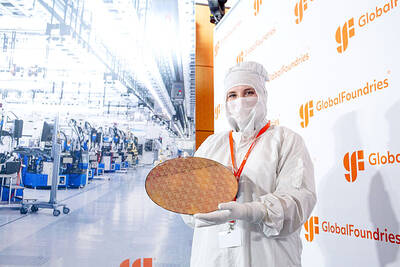
PACKAGING PUSH: The chipmaker said that it would begin ramping up silicon interposer production in New York in the first half of 2028 to support AI systems GlobalFoundries Inc shares gained as much as 7 percent after the chip manufacturer announced a five-year, US$2 billion deal to provide US production capacity to Taiwan Semiconductor Manufacturing Co (TSMC, 台積電). Under the agreement, announced on Thursday, GlobalFoundries is to help supply components known as silicon interposers. The US company is to rely on manufacturing at its facility in Malta, New York, and said it has the option to expand capacity “as customer demand grows.” An interposer is a small layer of silicon that sits between a chip and its packaging. It is home to the wires that carry electronic signals and
A man charged along with Super Micro Computer Inc co-founder Yih-Shyan “Wally” Liaw (廖益賢) of conspiring to send cutting-edge chips to China in violation of US export controls pleaded guilty, court documents said. Ting-Wei “Willy” Sun (孫廷瑋), a former outside contractor described by US authorities as a “fixer” who allegedly aided in the sales, pleaded guilty on Thursday at a hearing in federal court in New York as part of an agreement with prosecutors, court filings showed. Prosecutors claimed the men were part of a scheme to send Nvidia Corp-powered servers to an unnamed Southeast Asian company and then divert them to
SECOND-TOP MONTH: September revenue was 0.6 percent lower month-on-month, but despite the drop, it was the firm’s highest-ever sales report for the month Taiwan Semiconductor Manufacturing Co (TSMC, 台積電) yesterday reported record quarterly revenue for last quarter, after sales last month hit the second-highest monthly level in the company’s history. Revenue in the quarter ended last month was NT$1.49 trillion (US$46.75 billion), up 17 percent from NT$1.27 trillion in the second quarter and exceeding the combined prediction of 19 LSEG SmartEstimate analysts of NT$1.46 trillion. Last quarter’s figure — which was up 12 percent from the midpoint of last year — also surpassed the company’s July estimates of US$44.6 billion to US$45.8 billion amid surging demand for the ramp-up of its advanced 2-nanometer technology, artificial


 RSS
RSS