


Hon Hai Precision Industry Co (鴻海精密) and Adlink Technology Inc (凌華科技) have formed a robotic venture that aims to use “swarm technology” to create robots that can communicate with one another on the factory floor to optimize production efficiency.
Hon Hai is Apple Inc’s leading iPhone assembler and the world’s largest contract electronics maker, while Adlink supplies industrial computers and Internet of Things solutions.
Through a subsidiary, Hyield Venture Capital Co (鴻揚創投), Hon Hai holds a 51 percent stake in autonomous mobile robot (AMR) developer FARobot (法博智能移動), while Adlink owns the remaining 49 percent. Together, the two companies put up NT$200 million (US$6.82 million) in capital for the new venture, which opened its doors on Wednesday.
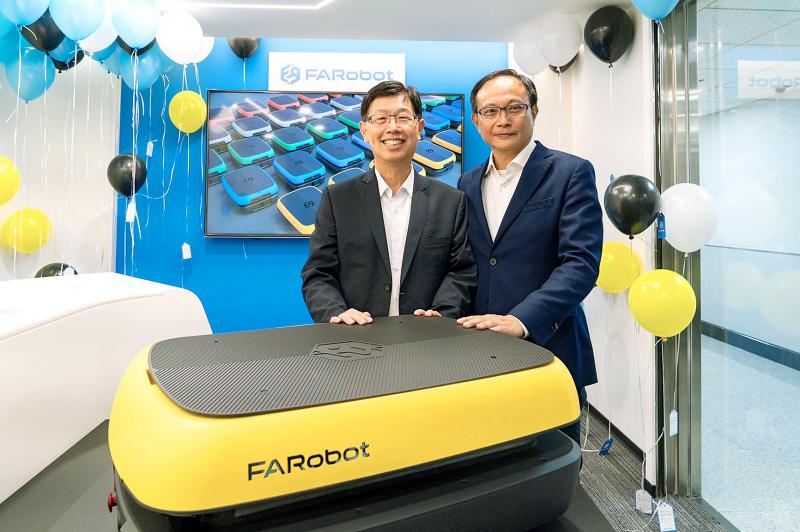
Photo courtesy of Hon Hai Precision Industry Co
FARobot general manager Ryan Chen (陳家榜) told the Taipei Times via telephone yesterday that “swarm autonomy” is a concept from the field of robotics.
It utilizes data distribution service technology to enable robots to share information with each other in a decentralized manner, he said.
“They are like ants or bees, and each individual unit is getting constant feedback from the others so they can work as a team,” he said.
This ability to adapt to change in real time is key to optimizing productivity, he said.
“The factory of the future is very fast-moving and full of changes,” he said. “The same production line could be making one product in the morning and another in the afternoon.”
“Our biggest challenge is to deliver the right raw material or components at the right time to the right place,” Chen said. “This will reduce the amount of time spent waiting rather than in operation.”
FARobot’s AMRs are to be deployed in Hon Hai factories within three years, he said.
“Hon Hai is the factory of the world so we can prove our concept there first, but of course we would want to expand our market after that,” he said.
At the opening ceremony at FARobot headquarters in New Taipei City’s Jhonghe District (中和), Hon Hai chairman Young Liu (劉揚偉) said the collaboration capitalizes on the strengths of each partner.
“With FARobot’s swarm technology and the respective domain knowledge of Hon Hai and Adlink, we can hope to build the foundation of a robotic business that will reach many industries,” Liu said.
Adlink chairman Jim Liu (劉鈞) said that FARobot would provide “smart factories with smart logistic solutions.”
“It is not enough just to make one machine, we must make a group of machines that can communicate with each other and cooperate,” he said.

Cairo’s new monorail slices across the city skyline, running above the familiar chaos of blaring horns and aging buses’ exhaust fumes that mark rush hour below. The US$4.5 billion monorail, opened this month, is among Egypt’s most prominent new transport projects, part of a debt-funded infrastructure drive criticized for sapping state finances while bringing limited benefits to most of the country’s 109 million people. “It feels like you’re in a different country,” said Ramy Sayed, a restaurant manager, aboard a driverless Innovia 300 train. “No noise, no traffic, we’re not used to this.” The eastern line runs 56km from the bustling middle-class

Taiwanese firms have increased investment in the Philippines in recent years as Manila’s ties with Washington deepen and global supply chains continue to shift away from China, an expert at the Chung-Hua Institution for Economic Research (CIER, 中華經濟研究院) said yesterday. The Philippines had not been among Taiwanese investors’ top choices in Southeast Asia, CIER Taiwan ASEAN Studies Center director Kristy Hsu (徐遵慈) said at a seminar in Taipei. However, Taiwan’s investment in the country has grown significantly since the COVID-19 pandemic, reaching US $257 million last year, a high in recent years, she said. Although Taiwan’s total investment in the Philippines still lags

Intel Corp regards Taiwan Semiconductor Manufacturing Co (TSMC, 台積電) as a longstanding partner, as the US chipmaker would continue outsourcing production of advanced chips to TSMC, Intel chief executive officer Lip-Bu Tan (陳立武) said yesterday. “I don’t look at people as competitors. I look at the collaboration... Nvidia is also, you know, a good friend,” Tan told a news conference following his keynote speech at the Computex trade show in Taipei. “It’s a very trusted partnership for us... We are a big, top customer for them, and we’re going to continue doing that,” he said, referring to TSMC, the world’s largest foundry

Artificial intelligence (AI) agents would supplant smartphones as the center of people’s digital lives, fundamentally reshaping personal devices and driving a major computing upgrade cycle, Qualcomm Inc CEO Cristiano Amon said yesterday. In his keynote speech for this year’s Computex trade show in Taipei, Amon said that the rise of "agentic AI" — AI systems capable of reasoning, planning and carrying out tasks autonomously — would transform how people interact with technology across phones, PCs, vehicles and wearable devices. Describing the technology as the next major evolution in computing, Amon said that "2026 is the year of agents.” For decades, smartphones have sat


 RSS
RSS