

Nylon composite specialist Nytex Composites Co (耐特科技) is to invest nearly NT$300 million (US$10.24 million) to develop its production capacities in Taiwan as part of the government’s Invest in Taiwan initiative, the Ministry of Economic Affairs said in a statement yesterday.
Eyeing the 5G and green energy-related markets, Nytex is planning a factory in Changhua County with a smart production center and a technical service center, the ministry said.
The company is the leading nylon composite material maker in Taiwan, supplying the automotive, medical, heat diffusion, sports and leisure, high-end office furniture, and bicycle sectors, making it “an important part of the supply chain” for those products, the ministry said.
The firm has production bases in Changhua and Shanghai, it said.
However, with more customers demanding products made outside of China because of concerns over tariffs, Nytex is to increase production in Taiwan, the ministry said.
Nytex has pledged to step up research and development on high-performance composite materials, while increasing the percentage of recycled materials it uses, the statement said.
THREE PROGRAMS
The Invest in Taiwan initiative assists small and medium-sized enterprises, as well as returning Taiwanese businesses, through three programs that provide favorable loan terms, talent and location scouting, and other assistance to attract investment back home, the ministry said.
To be eligible for the programs, projects must be high-value-added and non-polluting, it said.
So far, 651 companies have participated in the programs, pledging a combined NT$1.1 trillion in investments and creating an estimated 92,871 jobs, the ministry said.
READJUSTMENT? Despite the rumors, a senior Google official said that the company plans to expand its AI research center in Taipei’s Shilin District Google Taiwan is reducing its workforce as the company continues to adjust operations to improve efficiency and focus resources on core goals, the Chinese-language Liberty Times (sister paper of the Taipei Times) reported yesterday. The Alphabet Inc unit said the organizational adjustments have begun and would continue, even though it did not put a figure on the number of potential job cuts or specify the affected departments in its Taiwan operations. The company’s response came after rumors circulated on social media about major job cuts at Google Taiwan. Some posts said the downsizing would target the company’s consumer electronics-related departments
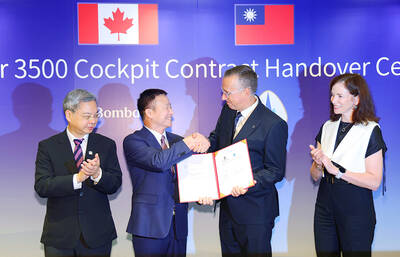
Taiwanese aircraft maker Aerospace Industrial Development Corp (AIDC, 漢翔航空) yesterday announced that it has secured a 20-year partnership agreement with Canada-based Bombardier Inc. The two companies held a ceremony in Taipei yesterday to exchange signed copies of the agreement, launching the 20-year partnership under which AIDC would supply cockpit and forward fuselage structural components for Bombardier’s super-midsize Challenger 3500 business jets, the Taiwanese company said. The agreement represents a new milestone in cooperation between the two companies, which dates back to 1999, with the Taiwanese supplier having provided rear fuselage structural components for more than 1,000 Challenger 3500 aircraft, it
FOUNDRY DATA: Demand pushed production on some TSMC lines to full utilization, while Samsung’s market share of 5.9 percent dropped, TrendForce said Taiwan Semiconductor Manufacturing Co’s (TSMC, 台積電) foundry market share edged up to 72.5 percent in the second quarter from 72.3 percent in the previous quarter, propelled by robust artificial intelligence (AI) and smartphone chip revenue, data compiled by market researcher TrendForce Corp (集邦科技) showed yesterday. TSMC’s revenue last quarter grew 12 percent sequentially to US$40.2 billion, outpacing the 11.5 percent average growth among the world’s top 10 foundry companies, the researcher said. Combined revenue of the top 10 is expected to grow further this quarter from US$53.49 billion last quarter, supported by strong demand and price hikes, it said. The increased demand has

Global notebook computer shipments are expected to fall 8 percent year-on-year to 167.9 million units this year, dragged by weak demand, high component prices and supply constraints, the Market Intelligence and Consulting Institute (MIC) said on Tuesday. Next year, shipments are expected to decline by a further 4.7 percent to 160 million units as higher retail prices weigh on consumption, MIC deputy director-general Edward Lin (林柏齊) told a news conference in Taipei. The downtrend is expected to extend into 2028, with replacement demand unlikely to recover before supplies of key components rebound and costs decline, Lin said. Surging demand for artificial intelligence (AI)


 RSS
RSS