


Another Chinese company has said that a major shareholder accidentally sold its shares, increasing speculation that insiders could be testing the market before they offload their stakes.
Shenzhen Changfang Group Co (長方集團) said that Nie Xianghong (聶向紅), a shareholder acting in accord with top investor Li Dichu (李迪初), accidentally sold 16,000 shares on Friday last week by inputting the wrong ticker symbol.
The shares, which rose by the 20 percent limit for a fourth day yesterday, have more than doubled in price this month. Li owned more than 11 percent of the company before the sale.
Sany Heavy Industry Co (三一重工) on Thursday last week said that its board would fine shareholder Mao Zhongwu (毛中吾) after an unspecified “trading error” led to him offloading 96,700 more shares than he had intended to.
Days earlier, TCL Technology Group Corp TCL (科技) chairman Li Dongsheng (李東生) said that a trader accidentally sold 5 million of the company’s shares from his account.
At least three other companies, including Liqun Commercial Group Co (利群商業集團), have disclosed and apologized since late last month for executives selling shares by mistake.
The sudden wave of erroneous trades is putting the spotlight on insider dealings at Chinese firms.
Selling by major shareholders is often taken as a negative signal in China — suggesting executives are losing confidence in a firm’s prospects — and can lead to the shares declining once they are disclosed.
“The way I picture this happened was that these executives wanted to test whether it was possible to sell their shares in the open market,” Beijing Zhonghe Yingtai Management Consultant Co (北京中和應泰財顧) analyst Lu Changshun (呂長順) said. “Call them mistakes, but they were done on purpose. The executives naturally have an urge to take profit.”
Shenzhen Changfang has publicly warned investors of abnormal fluctuations in its shares. The firm, which makes LED lighting products, is among Shenzhen’s best-performing shares for this month, despite saying it suffered a net loss of 33.8 million yuan (US$4.95 million) in the first half of this year.
The Shenzhen Stock Exchange on Friday last week said that it is monitoring the shares due to the significant gains.
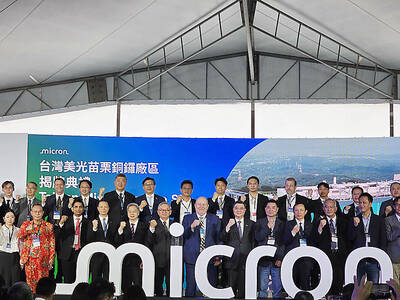
UNPRECEDENTED PACE: Micron Technology has announced plans to expand manufacturing capabilities with the acquisition of a new chip plant in Miaoli Micron Technology Inc unveiled a newly acquired chip plant in Miaoli County yesterday, as the company expands capacity to meet growing demand for advanced DRAM chips, including high-bandwidth memory chips amid the artificial intelligence boom. The plant in Miaoli County’s Tongluo Township (銅鑼), which Micron acquired from Powerchip Semiconductor Manufacturing Corp (力積電) for US$1.8 billion, is expected to make a sizeable capacity contribution to the company from fiscal 2028, the company said in a statement. It would be an extended production site of Micron’s large-scale manufacturing hub in Taichung, the company said. As the global semiconductor industry is racing to reach US$1 trillion

Singapore-based ride-hailing and delivery giant Grab Holdings Ltd has applied for regulatory approval to acquire the Taiwan operations of Germany-based Delivery Hero SE's Foodpanda in a deal valued at about US$600 million. Grab submitted the filing to the Fair Trade Commission on Friday last week, with the transaction subject to regulatory review and approval, the company said in a statement yesterday. Its independent governance structure would help foster a healthy and competitive market in Taiwan if the deal is approved, Grab said. Grab, which is listed on the NASDAQ, said in the filing that US-based Uber Technologies Inc holds about 13 percent of

Taiwan’s food delivery market could undergo a major shift if Singapore-based Grab Holdings Ltd completes its planned acquisition of Delivery Hero SE’s Foodpanda business in Taiwan, industry experts said. Grab on Monday last week announced it would acquire Foodpanda’s Taiwan operations for US$600 million. The deal is expected to be finalized in the second half of this year, with Grab aiming to complete user migration to its platform by the first half of next year. A duopoly between Uber Eats and Foodpanda dominates Taiwan’s delivery market, a structure that has remained intact since the Fair Trade Commission (FTC) blocked Uber Technologies Inc’s

Memory chip stocks extended their losses yesterday after Alphabet Inc’s Google publicized research that could allow more efficient use of the storage needed for artificial intelligence (AI) development. SK Hynix Inc and Samsung Electronics Co, South Korean leaders in the market, fell more than 6 percent and about 5 percent respectively in Seoul. In the US, Micron Technology Inc, Western Digital Corp and Sandisk Corp slid more than 2 percent in pre-market trading, after they all closed lower on Wednesday. Memory companies have been on a tear in recent months as the rapid development of AI infrastructure triggered a spike in chip


 RSS
RSS