

A group led by North Asia-focused private equity firm MBK Partners is in talks to take Car Inc (神州租車) private, according to four people with knowledge of plans to buy China’s leading auto rental company
The consortium plans to offer more than HK$3.10 per share to take Car Inc private, two of the people said, representing a premium of at least 28 percent to the HK$2.43 average of the company’s share price over the past month.
While a full take-up at that price would raise Car Inc’s market value to about US$850 million, as the talks proceed, some existing shareholders might opt to retain stakes, one of the people said.
The talks come after Car Inc shares tumbled more than 50 percent this year, hit by fallout from an accounting scandal at the fast-growing Luckin Coffee chain (瑞幸咖啡) with which it shares a cofounder, Charles Zhengyao Lu (陸正耀).
The plan is also among the latest to emerge as global private equity investors seek take-private opportunities, hoping to snap up bargains with share prices around the world squeezed lower amid recessions triggered by the COVID-19 pandemic.
According to bourse filings, Lu, also Car Inc’s chairman, owns 21 percent of the auto rental firm, whose market value has dropped to about US$700 million, and investors have been circling the shares held by the entrepreneur, sources said.
Earlier this year, a company controlled by Lu’s family defaulted on a margin loan of more than US$500 million.
The MBK consortium, which also includes Chinese PE firm Boyu Capital (博裕資本), has been in talks mainly with state-owned Beijing Automotive Group Co (BAIC, 北京汽車), which became Car Inc’s biggest shareholder with a 29 percent interest last month, two of the people said.
All four sources declined to be identified as the deal talks were confidential.
Interest in Car Inc, No. 1 in China’s lucrative, but fragmented auto leasing market, has rocketed since the woes at Luckin Coffee.
The once-hot coffee start-up saw its shares plunge to an all-time low in April after it disclosed the accounting scandal.
BAIC acquired its stake just last month from ride-hailing services provider UCar (神州優車)— also founded by Lu — and private equity firm Warburg Pincus at the same HK$3.10 per share price.
The move also comes as the consortium looks to consolidate the rapidly growing auto rental market, where it sees strong growth because of low penetration and increasing mobility needs, two of the sources said.
MBK already controls the No. 2 player in the market, eHi Car Services (上海一嗨汽車租賃), together with its chairman.
While the market was forecast to grow 60 percent to nearly 150 billion yuan (US$21.7 billion) in 2023 from 92 billion yuan last year, the top three players’ combined market share is below 30 percent, according to domestic consulting firm Zhiyan (智研諮詢) and ratings agency S&P.
If the deal is completed, the consortium would count on eHi Car Service, to run Car Inc, two of the sources said, pushing out a management team close to Lu, as well as buying his stake.
However, eHi said it had “no knowledge about the consortium nor plans to participate in any possible post-transaction operation.”


INFRINGEMENT: The investigation comes after a complaint from Vicor Corp, with the company seeking a limited exclusion order as well as cease-and-desist orders, the ITA said The US International Trade Commission (USITC) has launched a Section 337 investigation naming Taiwanese technology companies, including Hon Hai Precision Industry Co (鴻海), Delta Electronics Inc (台達電) and Quanta Computer Inc (廣達), as respondents. The Ministry of Economic Affairs (MOEA) pledged assistance if needed. The USITC said on Friday in a statement that it had voted to institute an investigation under Section 337 of the US Tariff Act of 1930 into certain vertical power delivery systems, related components and computing devices incorporating such systems. The investigation covers 20 companies from Taiwan, China, Germany and the US, the commission said, adding that it
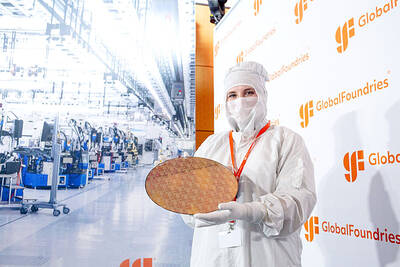
PACKAGING PUSH: The chipmaker said that it would begin ramping up silicon interposer production in New York in the first half of 2028 to support AI systems GlobalFoundries Inc shares gained as much as 7 percent after the chip manufacturer announced a five-year, US$2 billion deal to provide US production capacity to Taiwan Semiconductor Manufacturing Co (TSMC, 台積電). Under the agreement, announced on Thursday, GlobalFoundries is to help supply components known as silicon interposers. The US company is to rely on manufacturing at its facility in Malta, New York, and said it has the option to expand capacity “as customer demand grows.” An interposer is a small layer of silicon that sits between a chip and its packaging. It is home to the wires that carry electronic signals and
A man charged along with Super Micro Computer Inc co-founder Yih-Shyan “Wally” Liaw (廖益賢) of conspiring to send cutting-edge chips to China in violation of US export controls pleaded guilty, court documents said. Ting-Wei “Willy” Sun (孫廷瑋), a former outside contractor described by US authorities as a “fixer” who allegedly aided in the sales, pleaded guilty on Thursday at a hearing in federal court in New York as part of an agreement with prosecutors, court filings showed. Prosecutors claimed the men were part of a scheme to send Nvidia Corp-powered servers to an unnamed Southeast Asian company and then divert them to
SECOND-TOP MONTH: September revenue was 0.6 percent lower month-on-month, but despite the drop, it was the firm’s highest-ever sales report for the month Taiwan Semiconductor Manufacturing Co (TSMC, 台積電) yesterday reported record quarterly revenue for last quarter, after sales last month hit the second-highest monthly level in the company’s history. Revenue in the quarter ended last month was NT$1.49 trillion (US$46.75 billion), up 17 percent from NT$1.27 trillion in the second quarter and exceeding the combined prediction of 19 LSEG SmartEstimate analysts of NT$1.46 trillion. Last quarter’s figure — which was up 12 percent from the midpoint of last year — also surpassed the company’s July estimates of US$44.6 billion to US$45.8 billion amid surging demand for the ramp-up of its advanced 2-nanometer technology, artificial


 RSS