


A high-powered group of US regulators said stock exchanges should set new rules that could trigger the delisting of Chinese companies, following mounting concerns that investors are being exposed to frauds.
The President’s Working Group on Financial Markets on Thursday said that in order to trade on a US exchange, companies must grant US regulators access to their audit work papers.
The group has not determined how to enforce the guidelines, said a senior US Department of Treasury official who briefed reporters on the condition of anonymity.

Photo: EPA-EFE
While the final penalty would be removal from US exchanges, the Treasury and US Securities and Exchange Commission (SEC) would establish how binding the mandate is in implementing the rules, the official said.
The recommendations target a problem that has vexed US regulators for more than a decade: China’s refusal to allow inspectors from the Public Company Accounting Oversight Board to review audits of Alibaba Group Holding Ltd (阿里巴巴), Baidu Inc (百度) and other firms that trade on US markets.
The issue has gained added urgency due to rising tensions between Washington and Beijing and following this year’s high-profile accounting scandal at Luckin Coffee Inc.
The group of regulators, which includes the US Federal Reserve chair, made the recommendations unanimously, US Secretary of the Treasury Steven Mnuchin said in a statement.
Other suggestions include requiring “enhanced and prominent” disclosures by public companies of the risks tied to investing in China and new reports from fund managers about their exposure to such companies.
“The recommendations outlined in the report will increase investor protection and level the playing field for all companies listed on US exchanges,” Mnuchin said.
China’s accounting firms, including affiliates of giants like Deloitte, Ernst & Young, PwC and KPMG, have long argued that Chinese law bars them from sharing audit work papers with the accounting oversight board on the grounds that the documents might contain state secrets.
The President’s Working Group addresses that concern by advising a co-audit for companies that are unable to comply with US rules. The co-audit would be performed by an accounting firm that the board determines has sufficient access to the audit work papers.
In its report, the group acknowledged that Chinese companies could just bypass any new US rules by listing their shares in jurisdictions such as Hong Kong, Shanghai or London.
“US investors could purchase such securities on foreign exchanges, and these purchases may be subject to fewer investor protections than in the United States,” the regulators said in the report.
The issue of Chinese stock listings has attracted the attention of US President Donald Trump, who has ratcheted up his attacks on China over the COVID-19 pandemic and as friction mounts due to Beijing’s recent moves that chip away at Hong Kong’s political freedoms.
Trump in June asked for recommendations from the President’s Working Group on how to fix the problem.
Currently listed Chinese companies would have until Jan. 1, 2022, to come into compliance, while firms seeking a new listing will need to adhere to the new rules, the President’s Working Group said.
The specific regulations are still to be written, officials told reporters on Thursday.
US SEC Chairman Jay Clayton said in a statement that the recommendations are “common sense” and that he plans to work with regulators to implement them.
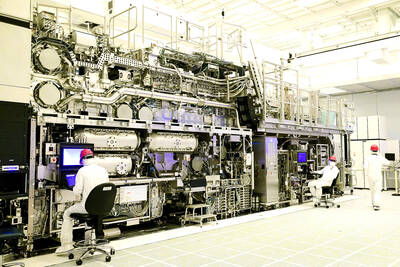
ASML Holding NV’s new advanced chip machines have a daunting price tag, said Taiwan Semiconductor Manufacturing Co (TSMC, 台積電), one of the Dutch company’s biggest clients. “The cost is very high,” TSMC senior vice president Kevin Zhang (張曉強) said at a technology symposium in Amsterdam on Tuesday, referring to ASML’s latest system known as high-NA extreme ultraviolet (EUV). “I like the high-NA EUV’s capability, but I don’t like the sticker price,” Zhang said. ASML’s new chip machine can imprint semiconductors with lines that are just 8 nanometers thick — 1.7 times smaller than the previous generation. The machines cost 350 million euros (US$378 million)
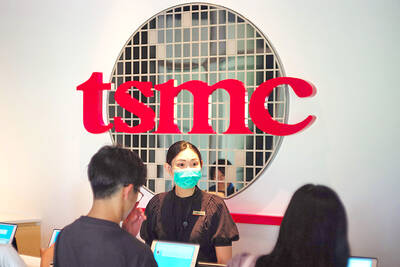
EXPLOSION: A driver who was transporting waste material from the site was hit by a blunt object after an uncontrolled pressure release and thrown 6m from the truck Taiwan Semiconductor Manufacturing Co (TSMC, 台積電) said yesterday there was no damage to its facilities after an incident at its Arizona factory construction site where a waste disposal truck driver was transported to hospital. Firefighters responded to an explosion on Wednesday afternoon at the TSMC plant in Phoenix, the Arizona Republic reported, citing the local fire department. Cesar Anguiano-Guitron, 41, was transporting waste material from the project site and stopped to inspect the tank when he was made aware of a potential problem, a police report seen by Bloomberg News showed. Following an “uncontrolled pressure release,” he was hit by a blunt

Quanta Computer Inc (廣達), which makes servers and laptop computers on a contract basis, yesterday said it expects artificial intelligence (AI) devices to bring explosive growth to Taiwan’s electronics industry, as AI applications are starting to run on edge devices such as AI PCs. Taiwanese electronics manufacturers such as chipmakers, component suppliers and hardware assemblers are likely to benefit from a rapid uptake of AI applications, Mike Yang (楊麒令), president of Quanta Cloud Technology Inc (雲達科技), a server manufacturing arm of Quanta, told reporters on the sidelines of a technology forum in Taipei yesterday. “I believe the growth potential is promising once
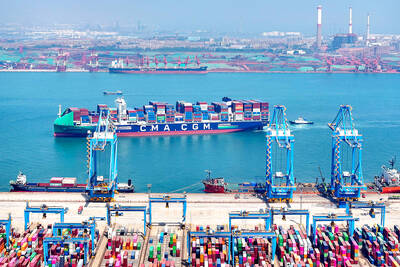
RETALIATION: Beijing is investigating Taiwan, the EU, the US and Japan for dumping, following probes of its market, as well as tariff hikes on its imports The Chinese Ministry of Commerce yesterday said it had launched a dumping investigation into imports of an important engineering chemical from Taiwan, the EU, the US and Japan. It would probe imports of polyoxymethylene copolymer, a thermoplastic used in many precision parts used in phones, auto parts and medical equipment, the Chinese commerce ministry said. The ministry is reviewing materials provided by six Chinese companies that applied for assistance on behalf of the industry on April 22, it said. The probe will target polyformaldehyde copolymer imported from suppliers in the EU, the US, Taiwan and Japan last year, and will assess any damage


 RSS
RSS