


Local shares yesterday came under heavy downward pressure, falling more than 1 percent as renewed fears over a possible increase in domestic COVID-19 infections hit market sentiment after the nation last week reported a case related to a Belgian national.
Selling focused on the bellwether electronics sector, led by contract chipmaker Taiwan Semiconductor Manufacturing Co (TSMC, 台積電), which pushed down the broader market as investors ignored gains posted by tech heavyweights on the US market at the end of last week, dealers said.
The TAIEX closed down 151.77 points, or 1.2 percent, at 12,513.03, on turnover of NT$231.43 billion (US$7.84 billion). Foreign institutional investors sold a net NT$30.4 billion worth of shares on the main board, Taiwan Stock Exchange data showed.
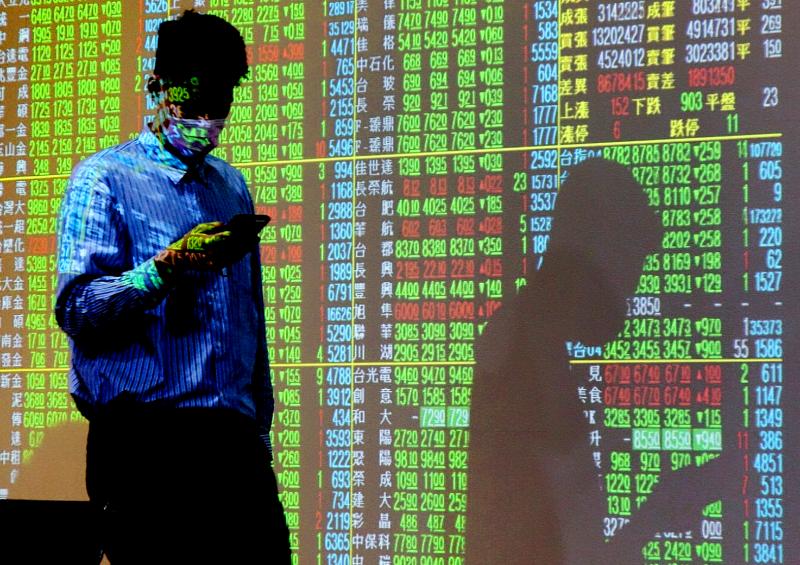
Photo: Chu Pei-hsiung, Taipei Times
On Saturday, the Central Epidemic Command Center (CECC) reported seven new COVID-19 infections, including one Belgian engineer who might have been infected in Taiwan, although the CECC has not yet confirmed it as a domestic case.
The weakness on the main board continued as downward pressure increased, starting in the late morning session, pushing the TAIEX below the nearest technical support at about the 10-day moving average of 12,520 points by the end of the session, dealers said.
Mega International Investment Services Corp (兆豐國際投顧) analyst Alex Huang (黃國偉) said the Belgian national case reminded many investors of earlier cases involving a Thai migrant worker and a Japanese student who tested positive for COVID-19 soon after returning from Taiwan.
“The infection sources of the three cases remain unknown, which raises fears over the domestic situation, although the nation has not officially reported any domestic cases” since April 12, Huang said.
“Local investors simply seized on the negative leads to cut their holdings by ignoring gains on the NASDAQ, and the electronics sector fell victim to such mentality,” Huang said.
“The TAIEX fell below the 10-day moving average today to make the main board technically weaker, and further selling could test the next technical support at about the 20-day moving average of 12,434,” he added.
TSMC shed 2.23 percent to close at NT$416 as investors rushed to lock in gains built in recent sessions. Led by TSMC, the electronics sector and the sub-index on the semiconductor industry were down 1.43 percent and 1.75 percent respectively.
“When investors sold TSMC, they shifted their buying to its smaller rival United Microelectronics Corp (UMC, 聯電) today, giving some support to the broader market,” Huang said.
UMC, also a large-cap stock, soared 6.49 percent.
Selling was also seen among many non-tech stocks, with Formosa Plastics Corp (台灣塑膠) down 1.4 percent, Formosa Petrochemical Corp (台塑石化) down 1.84 percent and food conglomerate Uni-President Enterprises Corp (統一企業) down 2.1 percent.
However, concerns over the spread of the virus boosted the biotech sector, where shares in Chunghwa Chemical Synthesis & Biotech Co (中化合成生技) rose 5.2 percent and Adimmune Corp (國光生技) soared 10 percent.

NEW IDENTITY: Known for its software, India has expanded into hardware, with its semiconductor industry growing from US$38bn in 2023 to US$45bn to US$50bn India on Saturday inaugurated its first semiconductor assembly and test facility, a milestone in the government’s push to reduce dependence on foreign chipmakers and stake a claim in a sector dominated by China. Indian Prime Minister Narendra Modi opened US firm Micron Technology Inc’s semiconductor assembly, test and packaging unit in his home state of Gujarat, hailing the “dawn of a new era” for India’s technology ambitions. “When young Indians look back in the future, they will see this decade as the turning point in our tech future,” Modi told the event, which was broadcast on his YouTube channel. The plant would convert

‘SEISMIC SHIFT’: The researcher forecast there would be about 1.1 billion mobile shipments this year, down from 1.26 billion the prior year and erasing years of gains The global smartphone market is expected to contract 12.9 percent this year due to the unprecedented memorychip shortage, marking “a crisis like no other,” researcher International Data Corp (IDC) said. The new forecast, a dramatic revision down from earlier estimates, gives the latest accounting of the ongoing memory crunch that is affecting every corner of the electronics industry. The demand for advanced memory to power artificial intelligence (AI) tasks has drained global supply until well into next year and jeopardizes the business model of many smartphone makers. IDC forecast about 1.1 billion mobile shipments this year, down from 1.26 billion the prior
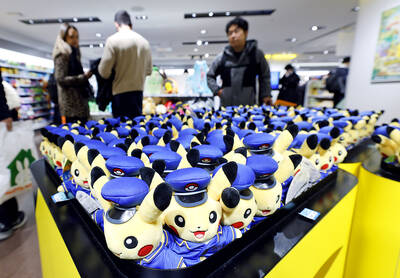
People stand in a Pokemon store in Tokyo on Thursday. One of the world highest-grossing franchises is celebrated its 30th anniversary yesterday.

Zimbabwe’s ban on raw lithium exports is forcing Chinese miners to rethink their strategy, speeding up plans to process the metal locally instead of shipping it to China’s vast rechargeable battery industry. The country is Africa’s largest lithium producer and has one of the world’s largest reserves, according to the US Geological Survey (USGS). Zimbabwe already banned the export of lithium ore in 2022 and last year announced it would halt exports of lithium concentrates from January next year. However, on Wednesday it imposed the ban with immediate effect, leaving unclear what the lithium mining sector would do in the


 RSS
RSS