


Wistron Corp (緯創), one of Apple Inc’s iPhone assemblers, yesterday said that it would subscribe to 3 billion yuan (US$429 million) of Luxshare Precision Industry Co (立訊精密) common shares to double down on its strategic partnerships with the maker of Apple’s iPod earbuds.
The announcement came after Wistron said on Friday last week that it would sell two of its Chinese subsidiaries — Wistron InfoComm Manufacturing (Kunshan) Co Ltd (緯新資通崑山) and Wistron Investment (Jiangsu) Co Ltd (緯創投資江蘇) — to Luxshare for 3.3 billion yuan.
The move came as a surprise to local electronics circles, as Luxshare has reportedly been seeking to share iPhone assembly orders with major assembler Hon Hai Precision Industries Co (鴻海精密).
“The [equity] investment is not directly tied to the sale of the Wistron subsidiaries,” a Wistron public relations official said by telephone. “These are two separate matters.”
The exact shape of the strategic partnership is still under discussion, the official said.
Wistron would hold a 0.81 percent stake in Luxshare after the transactions are completed via its four subsidaries, according to a company statement submitted to the Taiwan Stock Exchange.
Pegatron Corp (和碩), which also assembles iPhones, said in a filing with the Taiwan Stock Exchange that it would buy 11.38 million Luxshare shares for NT2.5 billion, with each share priced at NT$222.1.
Pegatron would see its holdings in the China-based firm rise to 0.57 percent once the transaction is completed.
Pegatron said the deal is just a financial investment.
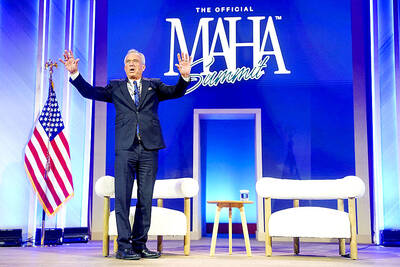
Sweeping policy changes under US Secretary of Health and Human Services Robert F. Kennedy Jr are having a chilling effect on vaccine makers as anti-vaccine rhetoric has turned into concrete changes in inoculation schedules and recommendations, investors and executives said. The administration of US President Donald Trump has in the past year upended vaccine recommendations, with the country last month ending its longstanding guidance that all children receive inoculations against flu, hepatitis A and other diseases. The unprecedented changes have led to diminished vaccine usage, hurt the investment case for some biotechs, and created a drag that would likely dent revenues and

Global semiconductor stocks advanced yesterday, as comments by Nvidia Corp chief executive officer Jensen Huang (黃仁勳) at Davos, Switzerland, helped reinforce investor enthusiasm for artificial intelligence (AI). Samsung Electronics Co gained as much as 5 percent to an all-time high, helping drive South Korea’s benchmark KOSPI above 5,000 for the first time. That came after the Philadelphia Semiconductor Index rose more than 3 percent to a fresh record on Wednesday, with a boost from Nvidia. The gains came amid broad risk-on trade after US President Donald Trump withdrew his threat of tariffs on some European nations over backing for Greenland. Huang further
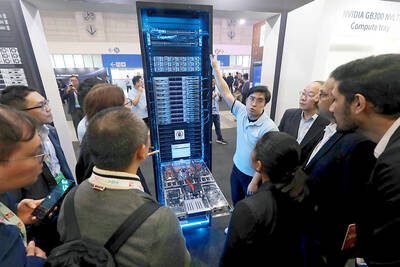
Nvidia Corp’s GB300 platform is expected to account for 70 to 80 percent of global artificial intelligence (AI) server rack shipments this year, while adoption of its next-generation Vera Rubin 200 platform is to gradually gain momentum after the third quarter of the year, TrendForce Corp (集邦科技) said. Servers based on Nvidia’s GB300 chips entered mass production last quarter and they are expected to become the mainstay models for Taiwanese server manufacturers this year, Trendforce analyst Frank Kung (龔明德) said in an interview. This year is expected to be a breakout year for AI servers based on a variety of chips, as
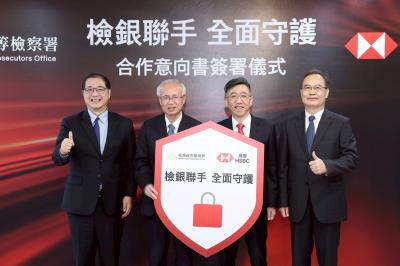
HSBC Bank Taiwan Ltd (匯豐台灣商銀) and the Taiwan High Prosecutors Office recently signed a memorandum of understanding (MOU) to enhance cooperation on the suspicious transaction analysis mechanism. This landmark agreement makes HSBC the first foreign bank in Taiwan to establish such a partnership with the High Prosecutors Office, underscoring its commitment to active anti-fraud initiatives, financial inclusion, and the “Treating Customers Fairly” principle. Through this deep public-private collaboration, both parties aim to co-create a secure financial ecosystem via early warning detection and precise fraud prevention technologies. At the signing ceremony, HSBC Taiwan CEO and head of banking Adam Chen (陳志堅)


 RSS
RSS