


Twenty thousand boxes of 50 masks each would be on sale at FamilyMart convenience stores starting tomorrow, Taiwan FamilyMart Co Ltd (全家便利商店) said yesterday.
A box of 50 masks would cost NT$249 for those with FamilyMart memberships and NT$299 for those without, with no limits placed on how many boxes a person can buy, the company said.
Convenience store chain operator Hi-Life International Co Ltd (萊爾富) said that it would also start selling masks from tomorrow.
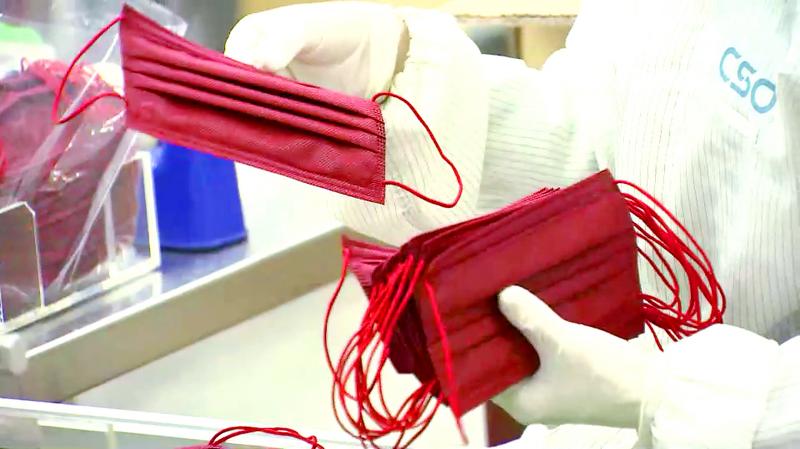
Photo: Chang Tsung-chiu, Taipei Times
It has yet to announce details about prices and quantity.
Hypermarket chain operator Carrefour Taiwan (家樂福) said that it would start selling packs of five and seven masks from today, with customers limited to one pack each.
Carrefour said that the 18,000 packs of masks it plans to sell are previously imported stock.
Cosmetics chain operator Poya International Co Ltd (寶雅國際) said that it has 1 million domestically produced masks to sell at its stores, with sales possibly starting as early as Thursday.
The masks would be sold in boxes of 50, as well as smaller numbers, and masks for adults and children would be available at NT$5 to NT$7 each, Poya said.
There would be no limit on the amount of masks a customer can purchase, Poya said.
Other retailers, including drugstore chain Cosmed (康是美), supermarket chain Simple Mart (美廉社), hypermarket chain A-Mart (愛買) and President Chain Store Corp’s (統一超商) 7-Eleven convenience store chain, all said that they are either waiting to judge consumer demand or are at different stages of ordering from domestic manufacturers.
After the nation’s first COVID-19 cases were confirmed, the government on Jan. 31 began requisitioning domestic masks, before launching a rationing system on Feb. 6 using National Health Insurance (NHI) cards.
Since then, daily production capacity has been increased from 1.88 million masks to about 20 million.
From today, the government is to requisition 8 million masks per day, while lifting sale and export restrictions on the remaining 60 percent of capacity.
If people struggle to buy masks on the open market, they would still be able to purchase nine adult masks or 10 children’s masks every two weeks using their NHI cards.
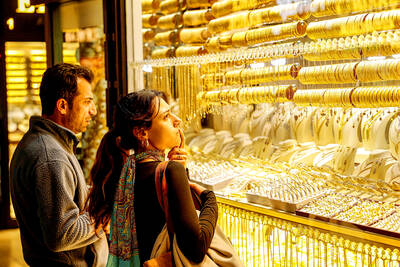
In Italy’s storied gold-making hubs, jewelers are reworking their designs to trim gold content as they race to blunt the effect of record prices and appeal to shoppers watching their budgets. Gold prices hit a record high on Thursday, surging near US$5,600 an ounce, more than double a year ago as geopolitical concerns and jitters over trade pushed investors toward the safe-haven asset. The rally is putting undue pressure on small artisans as they face mounting demands from customers, including international brands, to produce cheaper items, from signature pieces to wedding rings, according to interviews with four independent jewelers in Italy’s main

Japanese Prime Minister Sanae Takaichi has talked up the benefits of a weaker yen in a campaign speech, adopting a tone at odds with her finance ministry, which has refused to rule out any options to counter excessive foreign exchange volatility. Takaichi later softened her stance, saying she did not have a preference for the yen’s direction. “People say the weak yen is bad right now, but for export industries, it’s a major opportunity,” Takaichi said on Saturday at a rally for Liberal Democratic Party candidate Daishiro Yamagiwa in Kanagawa Prefecture ahead of a snap election on Sunday. “Whether it’s selling food or

CONCERNS: Tech companies investing in AI businesses that purchase their products have raised questions among investors that they are artificially propping up demand Nvidia Corp chief executive officer Jensen Huang (黃仁勳) on Saturday said that the company would be participating in OpenAI’s latest funding round, describing it as potentially “the largest investment we’ve ever made.” “We will invest a great deal of money,” Huang told reporters while visiting Taipei. “I believe in OpenAI. The work that they do is incredible. They’re one of the most consequential companies of our time.” Huang did not say exactly how much Nvidia might contribute, but described the investment as “huge.” “Let Sam announce how much he’s going to raise — it’s for him to decide,” Huang said, referring to OpenAI
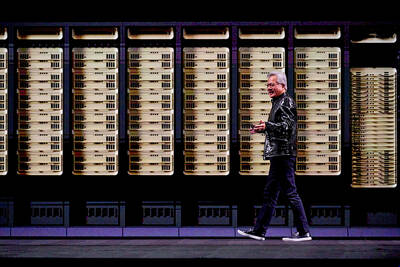
The global server market is expected to grow 12.8 percent annually this year, with artificial intelligence (AI) servers projected to account for 16.5 percent, driven by continued investment in AI infrastructure by major cloud service providers (CSPs), market researcher TrendForce Corp (集邦科技) said yesterday. Global AI server shipments this year are expected to increase 28 percent year-on-year to more than 2.7 million units, driven by sustained demand from CSPs and government sovereign cloud projects, TrendForce analyst Frank Kung (龔明德) told the Taipei Times. Demand for GPU-based AI servers, including Nvidia Corp’s GB and Vera Rubin rack systems, is expected to remain high,


 RSS
RSS