


The COVID-19 outbreak poses greater risks to Taiwan’s economic and consumer activity than SARS did in 2003, the central bank said yesterday in a written report, which indicated that there is room for policy action.
Bank Governor Yang Chin-long (楊金龍) is to discuss the risks today at a meeting of the Legislative Yuan’s Finance Committee on the effects of the coronavirus.
The report comes exactly one week before the central bank’s quarterly board meeting, at a time when fears over the outbreak have driven peers in the US, the UK and elsewhere to cut interest rates to support economic growth.
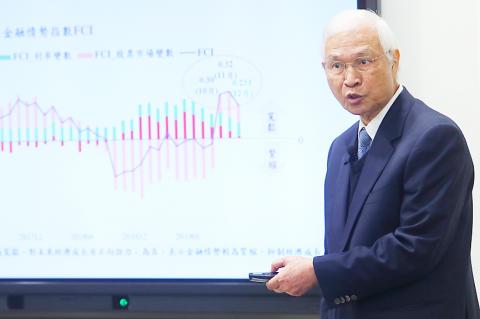
Photo: CNA
The central bank has left the benchmark rediscount rate unchanged at 1.375 percent for 14 consecutive quarters, even at the height of US-China trade tensions.
“COVID-19’s spread is far more serious than SARS’ and the spillover effect is casting a shadow over the global economic outlook,” the report said.
China, as the world’s second-largest economy, is both the main manufacturing and consumer market, contributing 1 percentage point of global GDP growth at 2.63 percent last year, Yang said.
Advanced nations rely heavily on imports of consumer goods from China, while Asian countries play an active part in offering intermediate products and services, he said.
The slow resumption of work in China would cause supply chain disruptions that would hurt both advanced and developing countries, the governor said.
That could mean significant order cancelations for Taiwanese manufacturers, as China accounts for 40 percent of outbound shipments and supplies materials used for producing electronic components, economic officials have said.
The outbreak is expected to dent Taiwan’s GDP growth by between 0.1 percentage points and 0.7 percentage points this year, with the pinch most evident in the first quarter, Yang said, citing research institutes at home and abroad.
Consumer prices might also fare softer in light of falling oil prices and subdued consumer sentiment, allowing room for policy easing, if necessary, the report said.
The central bank lowered borrowing costs by 25 basis points in June 2003 from 1.625 percent to 1.375 percent to help Taiwan emerge from the effects of SARS.
Last week’s surprising rate cut by the US Federal Reserve might be followed by more stimulus measures, which could drive money to Taiwan and push up the New Taiwan dollar, the bank said, adding that the scenario would be unfavorable for local exporters.
Yang said the bank would step in to stabilize the New Taiwan dollar and fend off speculation.
Toward that end, the bank bought US$5.5 billion net last year and its exchange position stood at US$99.1 billion last month, the report said.


ENERGY ISSUES: The TSIA urged the government to increase natural gas and helium reserves to reduce the impact of the Middle East war on semiconductor supply stability Chip testing and packaging service provider ASE Technology Holding Co (日月光投控) yesterday said it planned to invest more than NT$100 billion (US$3.15 billion) in building a new advanced chip testing facility in Kaohsiung to keep up with customer demand driven by the artificial intelligence (AI) boom. That would be included in the company’s capital expenditure budget next year, ASE said. There is also room to raise this year’s capital spending budget from a record-high US$7 billion estimated three months ago, it added. ASE would have six factories under construction this year, another record-breaking number, ASE chief operating officer Tien Wu

The EU and US are nearing an agreement to coordinate on producing and securing critical minerals, part of a push to break reliance on Chinese supplies. The potential deal would create incentives, such as minimum prices, that could advantage non-Chinese suppliers, according to a draft of an “action plan” seen by Bloomberg. The EU and US would also cooperate on standards, investments and joint projects, as well as coordinate on any supply disruptions by countries like China. The two sides are additionally seeking other “like-minded partners” to join a multicountry accord to help create these new critical mineral supply chains, which feed into

For weeks now, the global tech industry has been waiting for a major artificial intelligence (AI) launch from DeepSeek (深度求索), seen as a benchmark for China’s progress in the fast-moving field. More than a year has passed since the start-up put Chinese AI on the map in early last year with a low-cost chatbot that performed at a similar level to US rivals. However, despite reports and rumors about its imminent release, DeepSeek’s next-generation “V4” model is nowhere in sight. Speculation is also swirling over the geopolitical implications of which computer chips were chosen to train and power the new

Intel Corp is joining Elon Musk’s long-shot effort to develop semiconductors for Tesla Inc, Space Exploration Technologies Corp and xAI, marking a surprising twist in the chipmaker’s comeback bid. Intel would help the Terafab project “refactor” the technology in a chip factory, the company said on Tuesday in a post on X, Musk’s social media platform. That is a stage in the development process that typically helps make chips more powerful or reliable. The chipmaker’s shares jumped 4.2 percent to US$52.91 in New York trading on Tuesday. The Terafab project is a grand plan by Musk to eventually manufacture his own chips for


 RSS
RSS