


Amazon.com Inc on Thursday forecast first-quarter sales below Wall Street estimates, warning that new regulations in India had created uncertainty in one of its key growth markets and saying that it would step up investments this year.
Shares of the company fell 5 percent to US$1,635 after the bell.
The outlook overshadowed Amazon’s record sales and profit during the holiday season. Fast and free shipping helped the world’s largest online retailer boost revenue by 20 percent.
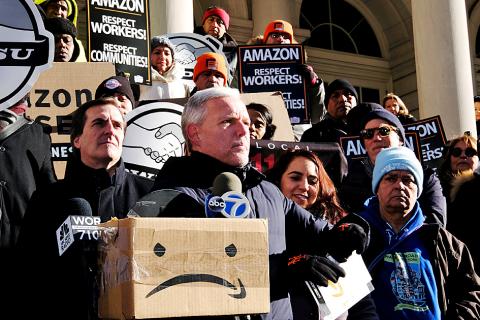
Photo: Bloomberg
A lucrative cloud computing business, and fees that merchants pay Amazon to ship and advertise their products have fattened the company’s once-thin profit margin.
Net income jumped 63 percent to US$3 billion in the fourth quarter, ahead of analysts’ estimates.
Yet investors focused their attention on Amazon’s international operation, where the company has long lost money in the hopes of future profit. Although its international operating loss shrunk to US$642 million in the quarter, from US$919 million in the fourth quarter of 2017, new regulations in India are poised to take a toll.
The rules seek to protect local businesses by prohibiting foreign e-commerce companies from selling products via vendors in which they have an equity interest.
The “situation in India is a bit fluid right now,” Amazon chief financial officer Brian Olsavsky said on a call with reporters.
The company began removing a wide array of products from its India Web site late on Thursday to comply with the new foreign investment curbs, which took effect yesterday, reports said.
However, “India remains a good long-term opportunity,” Olsavsky said
“The issues in India are taking a toll on the Q1 outlook, even as growth overall slows domestically,” said Colin Sebastian, an analyst at Baird Equity Research. “Not a bad report, but there are enough questions where [the] stock will likely be under pressure.”
The company predicted net sales of US$56 billion to US$60 billion in the first quarter of the year, missing analysts’ average estimate of US$60.77 billion, according to institutional brokers estimate system data from Refinitiv.
The guidance includes 2 percentage points of negative effects from changes in currency exchange rates.
Olsavsky said that investments would increase this year.
The company had little need to splurge last year, thanks to prior spending on warehouses, headcount and other areas, boosting profit.
However, this year, investments are to rise, even though Olsavsky did not say where or how much.
“As a result, the profit story in [2019] may not be as good as it was in [2018],” D.A. Davidson analyst Tom Forte said, adding that this might not be a bad thing.
“If they are stepping on the accelerator, that means they like what they’re seeing, and it’s worthy of more investment,” he said.
Amazon forecast that operating income would be between US$2.3 billion and US$3.3 billion this quarter, compared with US$1.9 billion in the same period last year.
A large chunk of the company’s hiring has gone to Amazon Web Services, its lucrative business selling data storage and computing power in the cloud. Revenue for the unit surged 45.3 percent to US$7.43 billion, beating an average estimate of US$7.26 billion.
Overall, net sales in the fourth quarter last year were US$72.38 billion and beat analysts’ average estimate of US$71.87 billion on the back of a strong holiday season, which included the major US shopping event Black Friday.
The results demonstrate that Amazon continued its “relentless assault” on other retailers over Christmas, Hargreaves Lansdown equity analyst Nicholas Hyett said.
Amazon said that tens of millions of shoppers signed up for its loyalty club Prime during the season — more than in any prior quarter — helping boost revenue from subscription fees by 25 percent to US$4.0 billion.
Last year, it had more than 100 million Prime members globally, the company said.
Amazon’s expansive customer base has lured merchants to sell goods on the company’s marketplace to the point where more than half of products sold on Amazon come from third parties.
Making Amazon more profitable still are advertisement sales. The company now ranks alongside Alphabet Inc’s Google and Facebook Inc as titans in marketing, letting these same merchants pay for high placement in Amazon’s search results.
Ad sales and “other” revenue jumped 95 percent to US$3.4 billion in the last three months of last year.

The Eurovision Song Contest has seen a surge in punter interest at the bookmakers, becoming a major betting event, experts said ahead of last night’s giant glamfest in Basel. “Eurovision has quietly become one of the biggest betting events of the year,” said Tomi Huttunen, senior manager of the Online Computer Finland (OCS) betting and casino platform. Betting sites have long been used to gauge which way voters might be leaning ahead of the world’s biggest televised live music event. However, bookmakers highlight a huge increase in engagement in recent years — and this year in particular. “We’ve already passed 2023’s total activity and

Nvidia Corp CEO Jensen Huang (黃仁勳) today announced that his company has selected "Beitou Shilin" in Taipei for its new Taiwan office, called Nvidia Constellation, putting an end to months of speculation. Industry sources have said that the tech giant has been eyeing the Beitou Shilin Science Park as the site of its new overseas headquarters, and speculated that the new headquarters would be built on two plots of land designated as "T17" and "T18," which span 3.89 hectares in the park. "I think it's time for us to reveal one of the largest products we've ever built," Huang said near the
China yesterday announced anti-dumping duties as high as 74.9 percent on imports of polyoxymethylene (POM) copolymers, a type of engineering plastic, from Taiwan, the US, the EU and Japan. The Chinese Ministry of Commerce’s findings conclude a probe launched in May last year, shortly after the US sharply increased tariffs on Chinese electric vehicles, computer chips and other imports. POM copolymers can partially replace metals such as copper and zinc, and have various applications, including in auto parts, electronics and medical equipment, the Chinese ministry has said. In January, it said initial investigations had determined that dumping was taking place, and implemented preliminary

Intel Corp yesterday reinforced its determination to strengthen its partnerships with Taiwan’s ecosystem partners including original-electronic-manufacturing (OEM) companies such as Hon Hai Precision Industry Co (鴻海精密) and chipmaker United Microelectronics Corp (UMC, 聯電). “Tonight marks a new beginning. We renew our new partnership with Taiwan ecosystem,” Intel new chief executive officer Tan Lip-bu (陳立武) said at a dinner with representatives from the company’s local partners, celebrating the 40th anniversary of the US chip giant’s presence in Taiwan. Tan took the reins at Intel six weeks ago aiming to reform the chipmaker and revive its past glory. This is the first time Tan


 RSS
RSS