


Chinese smartphone maker Xiaomi Corp (小米) yesterday said there is no time frame for a Chinese share offering, casting doubt on Beijing’s efforts to lure foreign-listed Chinese tech giants back home.
Xiaomi had been expected to raise up to US$10 billion, split between a Hong Kong and a Shanghai initial public offering (IPO). However, in a surprise move this week, it postponed its Shanghai share offering until after it completes its scheduled July 7 listing in Hong Kong.
It did not say when it would restart its China Depositary Receipts (CDR) issuance process, or why it was postponing the Shanghai offering.
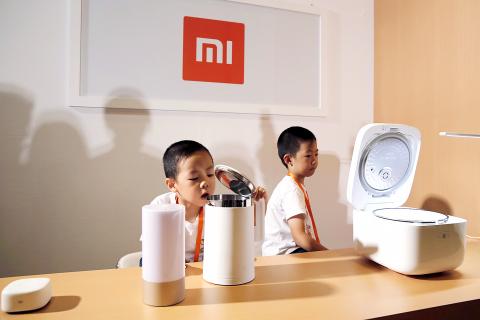
Photo: AP
Sources said the decision was mainly because of a dispute between the company and Chinese regulators over the valuation of its CDRs, but the company denied this.
“We’ve had many rounds of discussions with the regulators and reached a consensus that to ensure the quality of our CDR issuance, it’s better that we go public in Hong Kong first,” Xiaomi chief financial officer Chew Shou Zi (周受資) told a news conference in Hong Kong.
Xiaomi awarded its cofounder and chief executive Lei Jun (雷軍) about US$1.5 billion worth of shares for his contribution to the company, it said in an updated regulatory filing this week, in one of the largest one-off share-based corporate bonuses in years.
The US$1.5 billion stock, which has been awarded to Lei’s holding entity Smart Mobile Holdings Ltd, was recorded by Xiaomi as share-based compensation expenses on April 2, one month before it filed for its blockbuster Hong Kong IPO.
Xiaomi cofounder and president Lin Bin (林斌) defended the board’s decision on the stock compensation at a news conference.
“Many new-economy companies have compensated their chairmen or CEOs with stocks ahead of the IPOs. Xiaomi isn’t the first and won’t be the last to do so,” he said.
Xiaomi’s board unanimously agreed on the stock award to Lei, who “completely knew nothing about it,” Lin added.
Xiaomi has lined up US$548 million from seven cornerstone investors, including US chipmaker Qualcomm Inc, for its Hong Kong IPO, Reuters reported on Thursday.
The company is selling about 2.18 billion shares at a price range of HK$17 to HK$22 each, representing a multiple of 22.7 to 29.3 times next year’s earnings forecast by its underwriting syndicate.
Lei said he expects to expand the company’s product range and international market presence.
Xiaomi’s smartphones are sold in 74 countries worldwide.
“I agree the smartphone market in the next 10 years will grow slowly. But still, it is a giant market,” Lei told reporters.
Xiaomi also makes dozens of Internet-connected home appliances and gadgets, including scooters, fitness bands, air purifiers, robot vacuums, smart shoes and rice cookers.
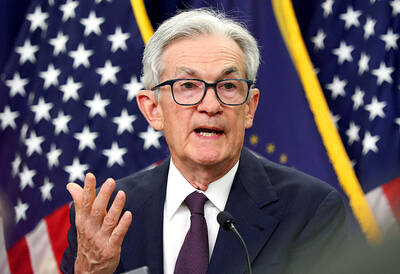
DIVIDED VIEWS: Although the Fed agreed on holding rates steady, some officials see no rate cuts for this year, while 10 policymakers foresee two or more cuts There are a lot of unknowns about the outlook for the economy and interest rates, but US Federal Reserve Chair Jerome Powell signaled at least one thing seems certain: Higher prices are coming. Fed policymakers voted unanimously to hold interest rates steady at a range of 4.25 percent to 4.50 percent for a fourth straight meeting on Wednesday, as they await clarity on whether tariffs would leave a one-time or more lasting mark on inflation. Powell said it is still unclear how much of the bill would fall on the shoulders of consumers, but he expects to learn more about tariffs
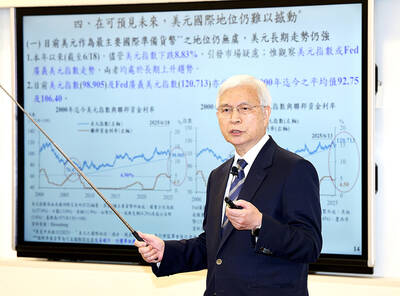
NOT JUSTIFIED: The bank’s governor said there would only be a rate cut if inflation falls below 1.5% and economic conditions deteriorate, which have not been detected The central bank yesterday kept its key interest rates unchanged for a fifth consecutive quarter, aligning with market expectations, while slightly lowering its inflation outlook amid signs of cooling price pressures. The move came after the US Federal Reserve held rates steady overnight, despite pressure from US President Donald Trump to cut borrowing costs. Central bank board members unanimously voted to maintain the discount rate at 2 percent, the secured loan rate at 2.375 percent and the overnight lending rate at 4.25 percent. “We consider the policy decision appropriate, although it suggests tightening leaning after factoring in slackening inflation and stable GDP growth,”
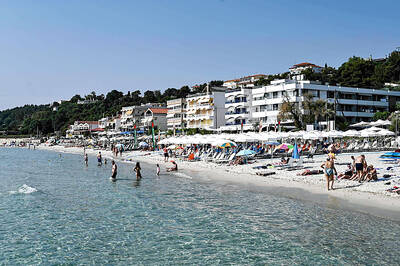
Greek tourism student Katerina quit within a month of starting work at a five-star hotel in Halkidiki, one of the country’s top destinations, because she said conditions were so dire. Beyond the bad pay, the 22-year-old said that her working and living conditions were “miserable and unacceptable.” Millions holiday in Greece every year, but its vital tourism industry is finding it harder and harder to recruit Greeks to look after them. “I was asked to work in any department of the hotel where there was a need, from service to cleaning,” said Katerina, a tourism and marketing student, who would
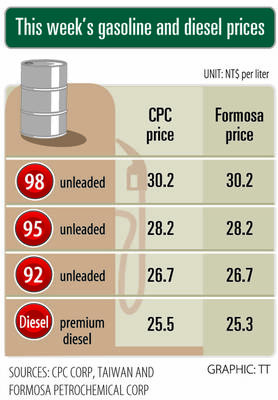
i Gasoline and diesel prices at fuel stations are this week to rise NT$0.1 per liter, as tensions in the Middle East pushed crude oil prices higher last week, CPC Corp, Taiwan (台灣中油) and Formosa Petrochemical Corp (台塑石化) said yesterday. International crude oil prices last week rose for the third consecutive week due to an escalating conflict between Israel and Iran, as the market is concerned that the situation in the Middle East might affect crude oil supply, CPC and Formosa said in separate statements. Front-month Brent crude oil futures — the international oil benchmark — rose 3.75 percent to settle at US$77.01


 RSS
RSS