


Facing extinction due to ubiquitous mobile phones, Britain’s classic red telephone boxes are being saved from death row by ingenious conversions into all sorts of new uses.
“It smells nice,” a passer-by said while sniffing the waft of hot stew steaming out of one phone box in the heart of London.
Every day, dozens of office workers come down to Bloomsbury Square to get their lunch at a phone box that has been converted to hold a tiny refrigerator and shelves to put the dishes on.
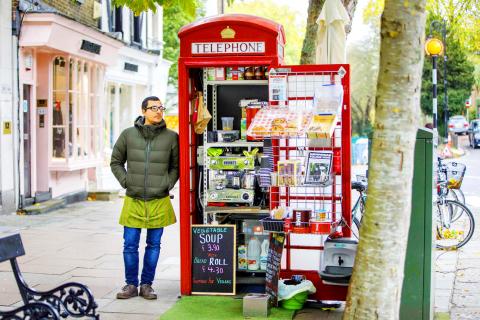
Photo: AFP
The generous salads — the house speciality — go down particularly well with customers who like to sit in the square’s gardens to enjoy their lunch.
It is one of thousands of phone boxes which are enjoying a new lease of life.
Often abandoned, vandalized or reeking of urine, some have been transformed into libraries, art galleries and information hubs; others into cafes, hat shops or even heart defibrillator points.
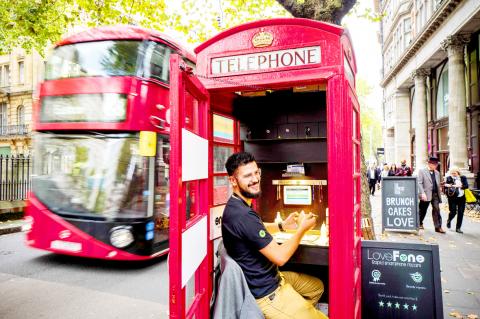
Photo: AFP
Since their numbers peaked at 92,000 across Britain in 2002, phone boxes have been in rapid decline.
There are 42,000 left, of which 7,000 are the classic red booths loved by tourists.
British telecoms giant BT Group PLC plans to remove 20,000 more by 2022.
It said most of its phone booths lose money, while maintaining them costs £5 million (US$6.7 million) a year.
Overall, 33,000 calls are made daily from phone boxes, a drop of 90 percent in 10 years.
The best-known model is the K6, in pillar-box red with a crown embossed on its curved roof. It was the first to be installed as a standard around the country.
It was designed by the British architect Giles Gilbert Scott for the silver jubilee of King George V in 1935, marking 25 years of his reign.
“We are looking for new alternatives to payphones,” BT head of payphone operations Mark Johnson told reporters.
Several hundred phone boxes house cash machines, while others are being turned into free and ultrafast Wi-Fi booths paid for by advertising
BT is also considering whether they could be turned into power points for electric vehicles.
Some are restored and sold via an authorized reseller, with prices starting at £750, excluding value added tax.
Others are sold for £1 to local communities or associations wanting to give them a new lease of life, part of BT’s Adopt a Kiosk scheme, which has already kept 5,000 of them standing.
“The whole idea of this is keep the heritage of the UK in place,” Johnson said.
The Red Kiosk Co, which donates a portion of its profits to charity, is one of the beneficiaries.
It has already bought 124 redundant phone boxes, which it rents out for £60 a month. It hopes to acquire 500 more over the next three years.
“You’re saving an historic structure, you’re creating employment and you’re regenerating an area,” founder Edward Ottewell told reporters.
Outside the costs of refitting them, which can be up to £6,000, local authority authorization can be difficult to obtain, Ottewell said.
The modest rental costs allows young entrepreneurs to get started, particularly in London, where commercial rents can be prohibitively high.
“It was the only place where we could afford the rent, because it’s only a square meter,” said Ben Spier, who founded the salad bar in Bloomsbury Square.
Red Kiosk also counts Lovefone, a mobile phone repair business, among its customers.
“A passer-by asked me: Don’t you feel claustrophobic?” Fouad Choaibi said, sitting in his kiosk equipped with a small table, storage for spare parts and a tiny heater.
“No. If it was bigger, you would have more distractions,” he said. “I just go outside to stretch my legs. I just go outside and I’m out of the office.”

Singapore-based ride-hailing and delivery giant Grab Holdings Ltd has applied for regulatory approval to acquire the Taiwan operations of Germany-based Delivery Hero SE's Foodpanda in a deal valued at about US$600 million. Grab submitted the filing to the Fair Trade Commission on Friday last week, with the transaction subject to regulatory review and approval, the company said in a statement yesterday. Its independent governance structure would help foster a healthy and competitive market in Taiwan if the deal is approved, Grab said. Grab, which is listed on the NASDAQ, said in the filing that US-based Uber Technologies Inc holds about 13 percent of

The domestic unit of the Chinese-owned, Dutch-headquartered chipmaker Nexperia BV will soon be able to produce semiconductors locally within China, according to two company sources. Nexperia is at the center of a global tug-of-war over critical semiconductor technology, with a Dutch court in February ordering a probe into alleged mismanagement at the company. The geopolitical tussle has disrupted supply chains, with some carmakers reportedly forced to cut production due to chip shortages. Local production would allow Nexperia’s domestic arm, Nexperia Semiconductors (China) Ltd (安世半導體中國), to bypass restrictions in place since October on the supply of silicon wafers — etched with tiny components to

Taiwan Semiconductor Manufacturing Co (TSMC, 台積電) yesterday received government approval to deploy its advanced 3-nanometer (3nm) process at its second fab currently under construction in Japan, the Ministry of Economic Affairs said in a news release. The ministry green-lit the plan for the facility in Kumamoto, which is scheduled to start installing equipment and come online in 2028 with a monthly production capacity of 15,000 12-inch wafers, the ministry said. The Department of Investment Review in June 2024 authorized a US$5.26 billion investment for the facility, slated to manufacture 6- to 12nm chips, significantly less advanced than 3nm process. At a meeting with
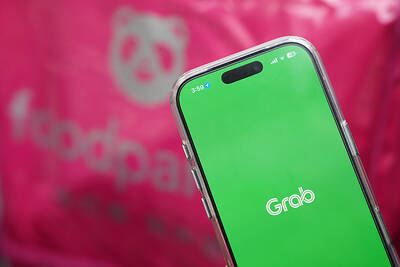
Taiwan’s food delivery market could undergo a major shift if Singapore-based Grab Holdings Ltd completes its planned acquisition of Delivery Hero SE’s Foodpanda business in Taiwan, industry experts said. Grab on Monday last week announced it would acquire Foodpanda’s Taiwan operations for US$600 million. The deal is expected to be finalized in the second half of this year, with Grab aiming to complete user migration to its platform by the first half of next year. A duopoly between Uber Eats and Foodpanda dominates Taiwan’s delivery market, a structure that has remained intact since the Fair Trade Commission (FTC) blocked Uber Technologies Inc’s


 RSS
RSS