


Chocolates are cheaper for Halloween, but prices are likely to rebound by Christmas thanks to rising demand for cocoa beans.
A global surplus sent cocoa prices plunging for most of the past two years, which helped to temper retail chocolate costs.
There are signs that the overhang is beginning to ebb as consumers eat away the excess.
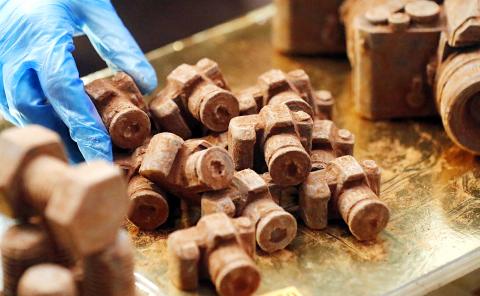
Photo: AP
Grindings, a measure of demand, have been climbing globally. That has caught the attention of hedge funds, who are finally starting to back away from bets that the commodity’s slump will continue.
“Low prices are the cure for low prices,” said Harish Sundaresh, a portfolio manager and commodities analyst in Boston for the Loomis Sayles Alpha Strategies team, which oversees US$5 billion. “A combination of improving grinding demand from chocolatiers ahead of the holiday season, over-crowded short positioning and persistently low prices over the past year has improved the price outlook.”
Cocoa futures traded in New York have erased this year’s losses. Prices that were down as much as 17 percent in late April on Friday settled at US$2,138 a tonne, up 0.6 percent since the end of December last year.
Hedge funds held a net-short position, or the difference between bets on a price increase and wagers on a decline, of 18,446 futures and options in the week that ended on Tuesday, according to US Commodity Futures Trading Commission data released on Friday.
That compares with 21,560 a week earlier and was a sixth straight contraction.
In the four-week period that ended on Oct. 8, average retail unit prices for chocolate were down 7.3 percent from the prior period, according to data from Chicago-based researcher IRI compiled by Bloomberg Intelligence.
Americans are expected to dole out US$2.7 billion on the treats, as total spending on Halloween climbs 8.3 percent to US$9.1 billion, the National Retail Federation estimated.
About 75 percent of US households hand out sweets to trick-or-treaters, and chocolate comes in as the clear favorite, according to the National Confectioners Association.
Ivory Coast, the world’s biggest cocoa grower, has tightened requirements to issue export licenses.
The nation is also in conversations with rival and No. 2 producer Ghana on how to boost earnings from the crop after the price slump cut government revenues and incomes for hundreds of thousands of small-scale farmers.
The World Bank has pledged its support for the nations’ plans to develop a coordinated strategy, which could include common policies on the marketing, storage and processing of cocoa.
The countries account for more than 60 percent of global supplies.
The revised export rules along with the possibility of more clampdown has “raised uncertainty about the speed of supplies reaching the market,” said Albert Scalla, senior vice president for INTL FCStone in Miami.
Cocoa inventories at warehouses monitored by ICE Futures US have fallen for 42 straight days, the longest slide since November 2014.
The drop comes partly amid the slowing pace of deliveries from Ecuador, the fourth-largest grower, after US officials rejected some shipments because of traces of a noxious weed in some cargoes.
The stockpiles are about 54 percent higher than a year earlier, though, helping to provide some cushion to the market.
Still, inventories could keep dropping because cash-market prices have gotten so high that it has become less attractive to deliver beans through the exchange, Scalla said.
If futures breach resistance above US$2,200, the next upside target sits at US$2,300, he said.
Other commodities:
Spot gold dipped 0.7 percent to US$1,281.52 an ounce. The precious metal lost 1.8 from last week’s US$1,304.60 an ounce.
Copper was on Friday little changed at US$3.17 a pound, up 1.2 percent from last week’s US$3.13 a pound.
Rhodium was at US$1,550 an ounce on Friday and reached the highest since early 2012.
Ruthenium climbed to US$85 an ounce, touching the highest since 2013.

MAJOR BENEFICIARY: The company benefits from TSMC’s advanced packaging scarcity, given robust demand for Nvidia AI chips, analysts said ASE Technology Holding Co (ASE, 日月光投控), the world’s biggest chip packaging and testing service provider, yesterday said it is raising its equipment capital expenditure budget by 10 percent this year to expand leading-edge and advanced packing and testing capacity amid strong artificial intelligence (AI) and high-performance computing chip demand. This is on top of the 40 to 50 percent annual increase in its capital spending budget to more than the US$1.7 billion to announced in February. About half of the equipment capital expenditure would be spent on leading-edge and advanced packaging and testing technology, the company said. ASE is considered by analysts

TRANSFORMATION: Taiwan is now home to the largest Google hardware research and development center outside of the US, thanks to the nation’s economic policies President Tsai Ing-wen (蔡英文) yesterday attended an event marking the opening of Google’s second hardware research and development (R&D) office in Taiwan, which was held at New Taipei City’s Banciao District (板橋). This signals Taiwan’s transformation into the world’s largest Google hardware research and development center outside of the US, validating the nation’s economic policy in the past eight years, she said. The “five plus two” innovative industries policy, “six core strategic industries” initiative and infrastructure projects have grown the national industry and established resilient supply chains that withstood the COVID-19 pandemic, Tsai said. Taiwan has improved investment conditions of the domestic economy
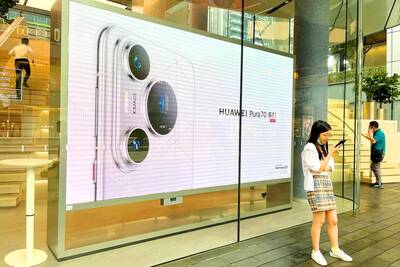
Huawei Technologies Co’s (華為) latest smartphones carry a version of the advanced made-in-China processor it revealed last year, results from an independent analysis showed. This underscored the Chinese company’s ability to sustain production of the controversial chip. The Pura 70 series unveiled last week sports the Kirin 9010 processor, research firm TechInsights found during a teardown of the device. This is a newer version of the Kirin 9000s, made by Semiconductor Manufacturing International Corp (SMIC, 中芯) for the Mate 60 Pro, which had alarmed officials in Washington who thought a 7-nanometer chip was beyond China’s capabilities. Huawei has enjoyed a resurgence since

purpose: Tesla’s CEO sought to meet senior Chinese officials to discuss the rollout of its ‘full self-driving’ software in China and approval to transfer data they had collected Tesla Inc CEO Elon Musk arrived in Beijing yesterday on an unannounced visit, where he is expected to meet senior officials to discuss the rollout of "full self-driving" (FSD) software and permission to transfer data overseas, according to a person with knowledge of the matter. Chinese state media reported that he met Premier Li Qiang (李強) in Beijing, during which Li told Musk that Tesla's development in China could be regarded as a successful example of US-China economic and trade cooperation. Musk confirmed his meeting with the premier yesterday with a post on social media platform X. "Honored to meet with Premier Li


 RSS
RSS