


US video game producer Activision Blizzard Inc late on Monday announced that it was buying King Digital Entertainment PLC, best known for its Candy Crush Saga mobile game, for US$5.9 billion.
Activision Blizzard, which produces such games as Call of Duty, said in a statement the purchase “will create one of the largest global entertainment networks with over half a billion combined monthly active users in 196 countries.”
California-based Activision Blizzard has some of the best known video game titles on the market, including World of Warcraft, Diablo, Guitar Hero, Skylander and most recently Destiny.

Photo: AFP
Activision Blizzard said it believes the addition of King’s business, which it called highly complementary, will position it “as a global leader in interactive entertainment across mobile, console and PC platforms.”
It added that the move “positions the company for future growth.”
Since 2003 King Digital has “built one of the largest player networks on mobile and Facebook, with 474 million monthly active users in the third quarter [of this year],” King Digital chief executive officer Riccardo Zacconi said in a joint statement.
The Call of Duty series is one of the best-selling console games in the world, while the addictive Candy Crush is among the most popular games on mobile devices.
The purchase, approved by the boards of directors of both companies, has King’s shareholders receiving US$18.00 in cash per share “comprising a total equity value of US$5.9 billion and an enterprise value of US$5.0 billion,” according to the statement.
That represents a 20 percent premium over King’s closing price on Friday, it added. The transaction should be completed by the second quarter of next year, assuming approval from regulators.
“The combined revenues and profits solidify our position as the largest, most profitable standalone company in interactive entertainment,” Activision Blizzard chief executive Bobby Kotick said. “With a combined global network of more than half a billion monthly active users, our potential to reach audiences around the world ... enables us to deliver great games to even bigger audiences than ever before.”
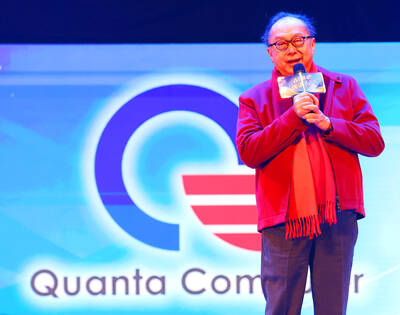
Quanta Computer Inc (廣達) chairman Barry Lam (林百里) is expected to share his views about the artificial intelligence (AI) industry’s prospects during his speech at the company’s 37th anniversary ceremony, as AI servers have become a new growth engine for the equipment manufacturing service provider. Lam’s speech is much anticipated, as Quanta has risen as one of the world’s major AI server suppliers. The company reported a 30 percent year-on-year growth in consolidated revenue to NT$1.41 trillion (US$43.35 billion) last year, thanks to fast-growing demand for servers, especially those with AI capabilities. The company told investors in November last year that
United Microelectronics Corp (UMC, 聯電) forecast that its wafer shipments this quarter would grow up to 7 percent sequentially and the factory utilization rate would rise to 75 percent, indicating that customers did not alter their ordering behavior due to the US President Donald Trump’s capricious US tariff policies. However, the uncertainty about US tariffs has weighed on the chipmaker’s business visibility for the second half of this year, UMC chief financial officer Liu Chi-tung (劉啟東) said at an online earnings conference yesterday. “Although the escalating trade tensions and global tariff policies have increased uncertainty in the semiconductor industry, we have not

Intel Corp has named Tasha Chuang (莊蓓瑜) to lead Intel Taiwan in a bid to reinforce relations between the company and its Taiwanese partners. The appointment of Chuang as general manager for Intel Taiwan takes effect on Thursday, the firm said in a statement yesterday. Chuang is to lead her team in Taiwan to pursue product development and sales growth in an effort to reinforce the company’s ties with its partners and clients, Intel said. Chuang was previously in charge of managing Intel’s ties with leading Taiwanese PC brand Asustek Computer Inc (華碩), which included helping Asustek strengthen its global businesses, the company

Power supply and electronic components maker Delta Electronics Inc (台達電) yesterday said it plans to ship its new 1 megawatt charging systems for electric trucks and buses in the first half of next year at the earliest. The new charging piles, which deliver up to 1 megawatt of charging power, are designed for heavy-duty electric vehicles, and support a maximum current of 1,500 amperes and output of 1,250 volts, Delta said in a news release. “If everything goes smoothly, we could begin shipping those new charging systems as early as in the first half of next year,” a company official said. The new


 RSS
RSS