


Car enthusiasts and professionals are headed to Frankfurt this week to the International Motor Show (IAA) as the industry emerges out of long crisis in Europe, but warily eyes slowing demand in China.
The organizers, Germany’s Verband der Automobilindustrie, said the IAA’s 66th edition promises 210 world premieres and an “amazing display of innovations” from 1,100 exhibitors from 39 countries,
The biennial event is held in Frankfurt’s gigantic trade fair exhibition, a space the size of 33 football pitches.
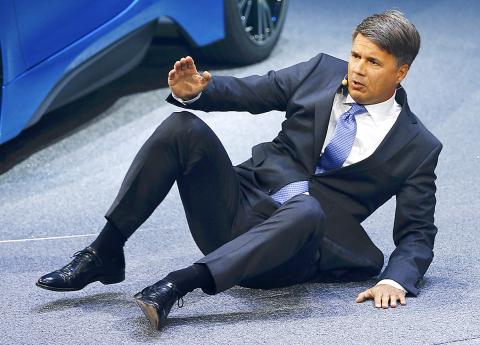
Photo: Reuters
The world press enjoyed a sneak preview yesterday and industry professionals have the grounds to themselves for two days before it is open to the public on Saturday.
After long years of crisis, the industry finally has something to smile about as demand picks up again in Europe, where new registrations increased by 8.2 percent in the first six months of this year.
The European Automobile Manufacturers’ Association is penciling in growth of about 5 percent for the whole year.
However, that increase will not be sufficient to return the industry to annual sales in Europe of 16 million units that it had seen before the 2008 to 2013 crisis cut the market by around a quarter.
“Even if we’re starting from very low levels, it’s still encouraging to see the market recover,” driven by double-digit growth in southern Europe, said Stefan Bratzel, director of the Center for Automotive Research CAM in Bergisch Gladbach, Germany.
However, it is not just Europe: The sector’s new-found health is evident in North America, too, with demand near record highs.
By contrast, emerging economies such as Brazil and Russia are mired in recession. China, where years of double-digit growth turned it into the world’s biggest automobile market, has been hit with a brutal economic slowdown, and demand is projected at just 3 percent this year.
Volkswagen AG generates 36 percent of its sales in China, just ahead of US rival General Motors Co’ 35 percent, but foreign joint ventures in China have lost ground to wholly owned Chinese makers, whose products are frequently cheaper.
Nevertheless, industry experts point out that the market penetration is still very low in China, so the demand is likely to continue to grow in the medium term, even if at a less profitable rate for foreign makers.
Among the new models on display at this year’s IAA, Renault SA’s Megane 4 and Opel’s Astra 5 will both be vying for attention. The French carmaker will unveil a new version of its Talisman, while German top-of-the-range maker Audi AG will present the next generation of its A4.
However, it will be the urban 4x4s, the market’s darlings, that are likely to steal consumers’ hearts, with Volkswagen and Ford Motor Co presenting more affordable models such as the Tiguan and the Edge, while Jaguar will show off its luxury F-Pace and Bentley its ultra-exclusive Bentayga.
For those opposed to the fuel-guzzlers, there are more ecologically minded models — particularly interesting for drivers in Europe, which already has the most stringent transport carbon-dioxide emission goals in the world and could see them tightened at the Conference of Parties 21 summit in Paris in December.
Toyota Motor Corp has chosen Frankfurt to lift the veil on the fourth generation of its flagship hybrid, Prius. BMW AG will also present a series combining both electric and gasoline engines.
Another key focus at this year’s IAA will be exciting new technologies such as automated driving. For the first time, about 30,000m2 of exhibition floor space will be given over to new forms of mobility, from the connected to the self-driving car.
In other news, BMW chief executive Harald Krueger fainted yesterday during a press briefing at the show, forcing the German carmaker to halt the presentation.
The 49-year-old Krueger, who has headed BMW since May, was speaking to reporters at the company’s exhibit when he apparently felt dizzy and collapsed. He was helped away by two bodyguards.
BMW said in a brief statement that Krueger had a dizzy spell and that he had not been feeling well in the morning after returning from a trip abroad. It added that he was feeling better after an initial examination.
A BMW spokesman at the show a short later said that Krueger had canceled all his meetings scheduled for yesterday and returned home.
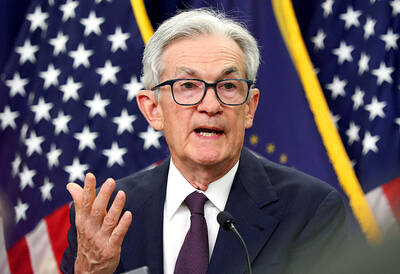
DIVIDED VIEWS: Although the Fed agreed on holding rates steady, some officials see no rate cuts for this year, while 10 policymakers foresee two or more cuts There are a lot of unknowns about the outlook for the economy and interest rates, but US Federal Reserve Chair Jerome Powell signaled at least one thing seems certain: Higher prices are coming. Fed policymakers voted unanimously to hold interest rates steady at a range of 4.25 percent to 4.50 percent for a fourth straight meeting on Wednesday, as they await clarity on whether tariffs would leave a one-time or more lasting mark on inflation. Powell said it is still unclear how much of the bill would fall on the shoulders of consumers, but he expects to learn more about tariffs
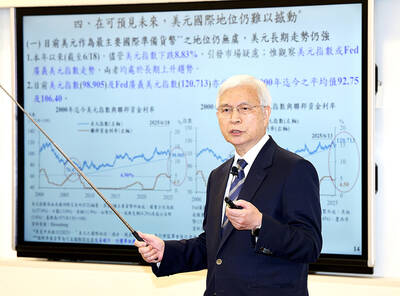
NOT JUSTIFIED: The bank’s governor said there would only be a rate cut if inflation falls below 1.5% and economic conditions deteriorate, which have not been detected The central bank yesterday kept its key interest rates unchanged for a fifth consecutive quarter, aligning with market expectations, while slightly lowering its inflation outlook amid signs of cooling price pressures. The move came after the US Federal Reserve held rates steady overnight, despite pressure from US President Donald Trump to cut borrowing costs. Central bank board members unanimously voted to maintain the discount rate at 2 percent, the secured loan rate at 2.375 percent and the overnight lending rate at 4.25 percent. “We consider the policy decision appropriate, although it suggests tightening leaning after factoring in slackening inflation and stable GDP growth,”
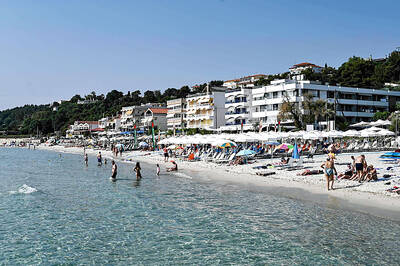
Greek tourism student Katerina quit within a month of starting work at a five-star hotel in Halkidiki, one of the country’s top destinations, because she said conditions were so dire. Beyond the bad pay, the 22-year-old said that her working and living conditions were “miserable and unacceptable.” Millions holiday in Greece every year, but its vital tourism industry is finding it harder and harder to recruit Greeks to look after them. “I was asked to work in any department of the hotel where there was a need, from service to cleaning,” said Katerina, a tourism and marketing student, who would
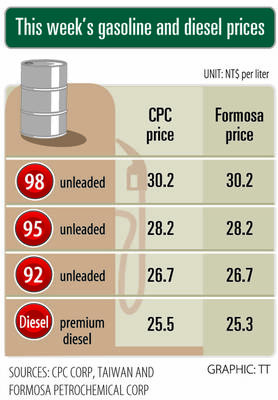
i Gasoline and diesel prices at fuel stations are this week to rise NT$0.1 per liter, as tensions in the Middle East pushed crude oil prices higher last week, CPC Corp, Taiwan (台灣中油) and Formosa Petrochemical Corp (台塑石化) said yesterday. International crude oil prices last week rose for the third consecutive week due to an escalating conflict between Israel and Iran, as the market is concerned that the situation in the Middle East might affect crude oil supply, CPC and Formosa said in separate statements. Front-month Brent crude oil futures — the international oil benchmark — rose 3.75 percent to settle at US$77.01


 RSS
RSS