


The government-funded Institute for Information Industry (III, 資策會) yesterday signed a memorandum of understanding (MOU) with video game engine developer Unity Technologies in a bid to boost Taiwan’s gaming industry.
“Given Unity’s leading position in the global market, we believe that collaboration to nurture local talent and cooperation with local game developers will benefit the nation’s gaming industry,” Vice Minister of Economic Affairs Shen Jong-chin (沈榮津) told a news conference at the two-day Unite 2015 Taipei forum.
San Francisco-based Unity is the largest engine and tool developer for 3D and 2D games worldwide with 45 percent global market share, the III said, citing industry data.
The number of users playing games powered by Unity’s technologies has reached more than 800 million people worldwide, the III added.
Taiwanese game developers Chinese Gamer International Corp (中華網龍), InterServ International Inc (昱泉國際) and Rayak Inc (雷亞遊戲) have used Unity’s engine and tools to develop their games.
Unity-based games can be run on a variety of platforms, including mobile devices, Web browsers and PCs. Rovio Entertainment Ltd, creator of the Angry Birds franchise, used the Unity engine to develop the mobile game Bad Piggies in 2013.
Under the MOU, Unity is to provide courses to game developers and authorize three high schools in Taiwan to use its development engine and tools for free, the ministry said.
The ministry said it is in talks with Unity to authorize more local high schools to use the company’s game engine and tools.
“Moreover, we hope the MOU with Unity will pave the way for the firm to set up offices in Taiwan, offering service and support to domestic game developers,” an Industrial Development Bureau official told the Taipei Times.
Unity greater China managing director Allen Foo (符國新) said the company’s technologies could also be applied to other industries, such as the medical, educational, architecture and advertising sectors.
“By combining Unity’s technologies and virtual-reality gadgets, students could learn the structure of an airplane in a classroom instead of touching a real airplane, which would lower educational costs,” Foo said.

The Eurovision Song Contest has seen a surge in punter interest at the bookmakers, becoming a major betting event, experts said ahead of last night’s giant glamfest in Basel. “Eurovision has quietly become one of the biggest betting events of the year,” said Tomi Huttunen, senior manager of the Online Computer Finland (OCS) betting and casino platform. Betting sites have long been used to gauge which way voters might be leaning ahead of the world’s biggest televised live music event. However, bookmakers highlight a huge increase in engagement in recent years — and this year in particular. “We’ve already passed 2023’s total activity and

Nvidia Corp CEO Jensen Huang (黃仁勳) today announced that his company has selected "Beitou Shilin" in Taipei for its new Taiwan office, called Nvidia Constellation, putting an end to months of speculation. Industry sources have said that the tech giant has been eyeing the Beitou Shilin Science Park as the site of its new overseas headquarters, and speculated that the new headquarters would be built on two plots of land designated as "T17" and "T18," which span 3.89 hectares in the park. "I think it's time for us to reveal one of the largest products we've ever built," Huang said near the

China yesterday announced anti-dumping duties as high as 74.9 percent on imports of polyoxymethylene (POM) copolymers, a type of engineering plastic, from Taiwan, the US, the EU and Japan. The Chinese Ministry of Commerce’s findings conclude a probe launched in May last year, shortly after the US sharply increased tariffs on Chinese electric vehicles, computer chips and other imports. POM copolymers can partially replace metals such as copper and zinc, and have various applications, including in auto parts, electronics and medical equipment, the Chinese ministry has said. In January, it said initial investigations had determined that dumping was taking place, and implemented preliminary
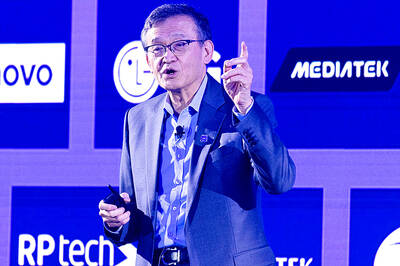
Intel Corp yesterday reinforced its determination to strengthen its partnerships with Taiwan’s ecosystem partners including original-electronic-manufacturing (OEM) companies such as Hon Hai Precision Industry Co (鴻海精密) and chipmaker United Microelectronics Corp (UMC, 聯電). “Tonight marks a new beginning. We renew our new partnership with Taiwan ecosystem,” Intel new chief executive officer Tan Lip-bu (陳立武) said at a dinner with representatives from the company’s local partners, celebrating the 40th anniversary of the US chip giant’s presence in Taiwan. Tan took the reins at Intel six weeks ago aiming to reform the chipmaker and revive its past glory. This is the first time Tan


 RSS
RSS