


Automobile parts maker Cub Elecparts Inc (為升) yesterday said it was aiming for profit of NT$10 per share this year, up from NT$6 last year, backed by strong demand for its tire pressure monitoring systems.
Shipments of the tire pressure monitoring systems are forecast to hit 1.2 million units this year, from 500,000 units a year ago, Cub Elecparts chairman Yu Shan-Chuan (尤山泉) said.
Sales of the systems are expected to account for 30 percent of the company’s total revenue this year and should help lift its net profit by 66.67 percent this year from last year’s NT$363.84 million (US$12.1 million), Yu said.
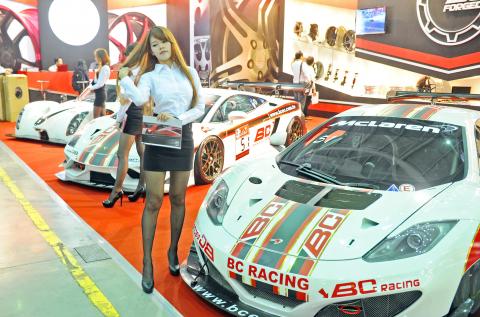
Photo: CNA
Cub Elecparts reported a revenue of NT$1.54 billion last year, up 11.59 percent from NT$1.38 billion a year ago.
The company has a factory in Shanghai, which has an annual capacity of 1.8 million units. It is planning to add one more production line at the Shanghai factory at the end of June and another new line in Taiwan by the end of the July, raising its total capacity to 5.4 million systems a year, Yu said.
The company is to use proceeds from the sale of NT$200 million in convertible bonds last year to finance its capacity expansion this year, he added.
Forecasting market demand for the systems, Yu said there are currently 400 million tire pressure monitoring systems in use in cars in the US, most of which were installed in 2007 and will have to be replaced within seven years.
Yu expects US demand for the system to be higher than last year’s 8 million units.
As for Europe, governments in the region are requiring car owners to start using winter tires in the winter this year, which should increase sales of tires and their monitoring systems, Yu said.
The company aims to sell 200,000 units to Europe this year, up from about 10,000 units a year ago, he said.
The company has a patent of 20 years for its system, which was developed in 2010 and fits most types of cars worldwide, he said.
Cub Elecparts sells about 70 percent of the systems in the vehicle aftermarket and 30 percent to automakers. Yu said the company's products fetch a higher price in the aftermarket and enjoy a gross margin of around 50 percent, higher than 30 percent for other brands, he added.
Yu was speaking at the Taipei Auto Parts & Accessories Show and the Taipei International Automobile Electronics Show. The shows opened yesterday and run through Saturday at the Taipei World Trade Center’s Exhibition Hall 1 and Nangang Exhibition Hall.
Cub Elecparts shares rose 3.11 percent to NT$265 yesterday, having surged 281.29 percent over the past 12 months, compared with the TAIEX's 15.55 percent increase over the same period.
SEEKING CLARITY: Washington should not adopt measures that create uncertainties for ‘existing semiconductor investments,’ TSMC said referring to its US$165 billion in the US Taiwan Semiconductor Manufacturing Co (TSMC, 台積電) told the US that any future tariffs on Taiwanese semiconductors could reduce demand for chips and derail its pledge to increase its investment in Arizona. “New import restrictions could jeopardize current US leadership in the competitive technology industry and create uncertainties for many committed semiconductor capital projects in the US, including TSMC Arizona’s significant investment plan in Phoenix,” the chipmaker wrote in a letter to the US Department of Commerce. TSMC issued the warning in response to a solicitation for comments by the department on a possible tariff on semiconductor imports by US President Donald Trump’s

The government has launched a three-pronged strategy to attract local and international talent, aiming to position Taiwan as a new global hub following Nvidia Corp’s announcement that it has chosen Taipei as the site of its Taiwan headquarters. Nvidia cofounder and CEO Jensen Huang (黃仁勳) on Monday last week announced during his keynote speech at the Computex trade show in Taipei that the Nvidia Constellation, the company’s planned Taiwan headquarters, would be located in the Beitou-Shilin Technology Park (北投士林科技園區) in Taipei. Huang’s decision to establish a base in Taiwan is “primarily due to Taiwan’s talent pool and its strength in the semiconductor
An earnings report from semiconductor giant and artificial intelligence (AI) bellwether Nvidia Corp takes center stage for Wall Street this week, as stocks hit a speed bump of worries over US federal deficits driving up Treasury yields. US equities pulled back last week after a torrid rally, as investors turned their attention to tax and spending legislation poised to swell the US government’s US$36 trillion in debt. Long-dated US Treasury yields rose amid the fiscal worries, with the 30-year yield topping 5 percent and hitting its highest level since late 2023. Stocks were dealt another blow on Friday when US President Donald

UNCERTAINTY: Investors remain worried that trade negotiations with Washington could go poorly, given Trump’s inconsistency on tariffs in his second term, experts said The consumer confidence index this month fell for a ninth consecutive month to its lowest level in 13 months, as global trade uncertainties and tariff risks cloud Taiwan’s economic outlook, a survey released yesterday by National Central University found. The biggest decline came from the timing for stock investments, which plunged 11.82 points to 26.82, underscoring bleak investor confidence, it said. “Although the TAIEX reclaimed the 21,000-point mark after the US and China agreed to bury the hatchet for 90 days, investors remain worried that the situation would turn sour later,” said Dachrahn Wu (吳大任), director of the university’s Research Center for


 RSS
RSS