


Weekend sales of used homes in some of Hong Kong’s biggest private housing estates fell 83 percent from the previous week as the government imposed additional taxes and raised down payments to curb surging prices.
The number of transactions fell to 10 on Saturday and yesterday at projects including Tai Koo Shing (太古城) in the Island East district and Mei Foo Sun Chuen (美孚新村) in Kowloon, Centaline Property Agency Ltd (中原地產), the city’s biggest privately held real estate broker, said in a statement yesterday. There were 59 deals the previous weekend, the broker said last week.
Hong Kong joined governments from South Korea to Brazil in seeking to stem fund inflows into their higher--yielding markets after the US Federal Reserve’s expanded monetary stimulus. Authorities are acting after home prices rose more than 50 percent since the beginning of last year. Hong Kong’s currency peg to the US dollar prevents its de-facto central bank from raising interest rates.
“Speculative activity” fell after the government announcements and few sellers slashed their prices, resulting in the contraction in transactions, Louis Chan (陳永傑), Centaline’s managing director for residential properties, said in the statement.
The Hang Seng Property Index, which tracks the territory’s seven biggest developers, fell 1.3 percent on Friday to the lowest since Oct. 29. The measure has declined 7.6 percent since this year’s peak on Nov. 8. It ended the week 4.1 percent lower, its biggest weekly drop since the five days ended May 7.
Homes sold within six months of purchase will incur a 15 percent stamp duty from Saturday, Hong Kong Financial Secretary John Tsang (曾俊華) said on Friday. Down payments for homes costing HK$12 million (US$1.5 million) or more will rise to 50 percent, from 40 percent.
Down payments for homes costing between HK$8 million and HK$12 million will be increased to 40 percent from 30 percent, Hong Kong Monetary Authority Chief Executive Norman Chan (陳德霖) said on Friday. The maximum loan to value for non-owner occupied residential properties will be lowered to 50 percent, Chan said.

The Eurovision Song Contest has seen a surge in punter interest at the bookmakers, becoming a major betting event, experts said ahead of last night’s giant glamfest in Basel. “Eurovision has quietly become one of the biggest betting events of the year,” said Tomi Huttunen, senior manager of the Online Computer Finland (OCS) betting and casino platform. Betting sites have long been used to gauge which way voters might be leaning ahead of the world’s biggest televised live music event. However, bookmakers highlight a huge increase in engagement in recent years — and this year in particular. “We’ve already passed 2023’s total activity and

Nvidia Corp CEO Jensen Huang (黃仁勳) today announced that his company has selected "Beitou Shilin" in Taipei for its new Taiwan office, called Nvidia Constellation, putting an end to months of speculation. Industry sources have said that the tech giant has been eyeing the Beitou Shilin Science Park as the site of its new overseas headquarters, and speculated that the new headquarters would be built on two plots of land designated as "T17" and "T18," which span 3.89 hectares in the park. "I think it's time for us to reveal one of the largest products we've ever built," Huang said near the
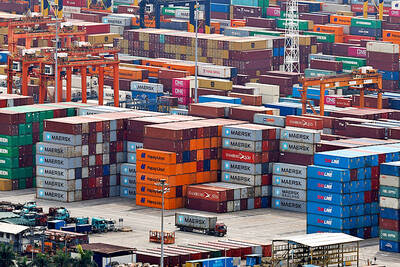
China yesterday announced anti-dumping duties as high as 74.9 percent on imports of polyoxymethylene (POM) copolymers, a type of engineering plastic, from Taiwan, the US, the EU and Japan. The Chinese Ministry of Commerce’s findings conclude a probe launched in May last year, shortly after the US sharply increased tariffs on Chinese electric vehicles, computer chips and other imports. POM copolymers can partially replace metals such as copper and zinc, and have various applications, including in auto parts, electronics and medical equipment, the Chinese ministry has said. In January, it said initial investigations had determined that dumping was taking place, and implemented preliminary

Intel Corp yesterday reinforced its determination to strengthen its partnerships with Taiwan’s ecosystem partners including original-electronic-manufacturing (OEM) companies such as Hon Hai Precision Industry Co (鴻海精密) and chipmaker United Microelectronics Corp (UMC, 聯電). “Tonight marks a new beginning. We renew our new partnership with Taiwan ecosystem,” Intel new chief executive officer Tan Lip-bu (陳立武) said at a dinner with representatives from the company’s local partners, celebrating the 40th anniversary of the US chip giant’s presence in Taiwan. Tan took the reins at Intel six weeks ago aiming to reform the chipmaker and revive its past glory. This is the first time Tan


 RSS
RSS