


Stan Shih (
Shih is the second business tycoon to be appointed as President Chen Shui-bian's (
Taiwan Semiconductor Manu-facturing Co (台積電) chairman Morris Chang (張忠謀), the founder of the world's largest contract chipmaker, successfully represented the nation at last year's APEC summit in Hanoi, Vietnam. But analysts are hopeful that Shih can do an even better job.
"Without a doubt, Shih is a great candidate for the APEC mission," said Wu Fu-cheng (吳福成), deputy director of the Taiwan Institute of Economic Research's (台經院) Division of International Affairs. "Shih is an even stronger representative of Taiwan's image than Chang."
Shih's status as a Taiwanese -- he was born in Lukang Township (
Raised by his single mother, Shih obtained a master's degree in electronics engineering at National Chiao Tung University in 1971. After graduating, Shih began his career at Unitron Industrial Corp (環宇電子), where he designed, developed and commercialized Taiwan's first desktop calculator.
Five years later, Shih and four partners founded Acer Group (originally known as Multitech) with NT$1 million of capital.
Although most Taiwanese high-tech companies focused on original equipment manufacturing for overseas brand name companies during the 1970s and 1980s, Shih realized the importance of a brand name and the value it could add to his company and products.
In 1992, Shih unveiled the "Smiling Curve" theory in which he expounded on how to add value in the IT-manufacturing industry. This came to be regarded as a blueprint for economic development and inspired the management of many companies.
According to Shih, one end of the PC industry value chain represents technology and patents while the other is brands and service. The middle part is assembly and manufacturing.
As both ends of the value chain command higher values than the middle section, companies should focus on "pulling" these ends upwards to increase profits, with the result that a graph of the chain curves like a smile.
Thanks to the successful realization of the "Smiling Curve" theory and decades of brand building and marketing, Acer Inc is the world's fourth largest PC vendor -- behind Hewlett-Packard Co, Dell Inc and Lenovo Group Ltd (聯想) -- and posted NT$10.22 billion in earnings last year.
Global acceptance of the Acer brand has not only boosted the company's sales, but also helped to associate made-in-Taiwan products with high levels of quality.
Shih's achievements in the IT industry make him a perfect spokesman for the APEC Digital Opportunity Center (ADOC) project -- an initiative proposed by Taiwan in 2003 to help narrow the digital divide between member economies.
"I will ask US President George W. Bush to support the project, given the abundant resources and talent in the US IT industry," Shih told reporters last Thursday.
Shih's achievements have also won him numerous tributes at home and abroad. He was selected as one of the "25 People You Ought to Know for Doing Business in Asia" by Fortune magazine in 1989, one of Asia's "Top 25 Digital Elite" by Asia Week in 2000 and one of the "25 Stars of Asia" by Business Week in 2004.
Shih retired from Acer in 2004 and established iD SoftCapital Group (
But his influence has not abated, with Time magazine profiling him in their "60 Years of Asian Heroes" feature last year.
Shih's willingness to be different was on display once more when he retired as he chose a professional, rather than a family member, to take the helm of Acer. Gianfranco Lanci, then president of Acer's International Operations Business Group, became president, while former president JT Wang (
A man of humble origins who transformed a small enterprise into a multinational conglomerate, Shih is a leading example of the entrepreneurs who created Taiwan's economic miracle, Wu said.
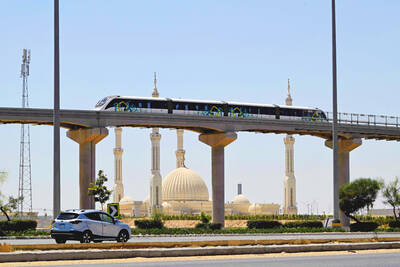
Cairo’s new monorail slices across the city skyline, running above the familiar chaos of blaring horns and aging buses’ exhaust fumes that mark rush hour below. The US$4.5 billion monorail, opened this month, is among Egypt’s most prominent new transport projects, part of a debt-funded infrastructure drive criticized for sapping state finances while bringing limited benefits to most of the country’s 109 million people. “It feels like you’re in a different country,” said Ramy Sayed, a restaurant manager, aboard a driverless Innovia 300 train. “No noise, no traffic, we’re not used to this.” The eastern line runs 56km from the bustling middle-class

Taiwanese firms have increased investment in the Philippines in recent years as Manila’s ties with Washington deepen and global supply chains continue to shift away from China, an expert at the Chung-Hua Institution for Economic Research (CIER, 中華經濟研究院) said yesterday. The Philippines had not been among Taiwanese investors’ top choices in Southeast Asia, CIER Taiwan ASEAN Studies Center director Kristy Hsu (徐遵慈) said at a seminar in Taipei. However, Taiwan’s investment in the country has grown significantly since the COVID-19 pandemic, reaching US $257 million last year, a high in recent years, she said. Although Taiwan’s total investment in the Philippines still lags
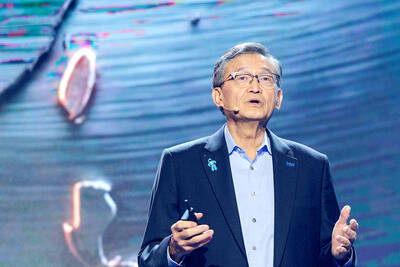
Intel Corp regards Taiwan Semiconductor Manufacturing Co (TSMC, 台積電) as a longstanding partner, as the US chipmaker would continue outsourcing production of advanced chips to TSMC, Intel chief executive officer Lip-Bu Tan (陳立武) said yesterday. “I don’t look at people as competitors. I look at the collaboration... Nvidia is also, you know, a good friend,” Tan told a news conference following his keynote speech at the Computex trade show in Taipei. “It’s a very trusted partnership for us... We are a big, top customer for them, and we’re going to continue doing that,” he said, referring to TSMC, the world’s largest foundry
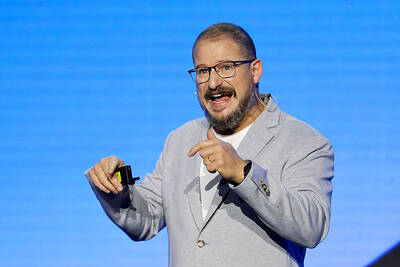
Artificial intelligence (AI) agents would supplant smartphones as the center of people’s digital lives, fundamentally reshaping personal devices and driving a major computing upgrade cycle, Qualcomm Inc CEO Cristiano Amon said yesterday. In his keynote speech for this year’s Computex trade show in Taipei, Amon said that the rise of "agentic AI" — AI systems capable of reasoning, planning and carrying out tasks autonomously — would transform how people interact with technology across phones, PCs, vehicles and wearable devices. Describing the technology as the next major evolution in computing, Amon said that "2026 is the year of agents.” For decades, smartphones have sat


 RSS
RSS