


Kacheek, Shoyru or Korbat might not ring a bell to you, but these are the pet breeds that Jeslyn Lin (
What makes these pets unique is that they are not real.
The 21-year-old Lin is just one of more than 30 million people in the world who are caring for virtual "pets" on Neopets.com.
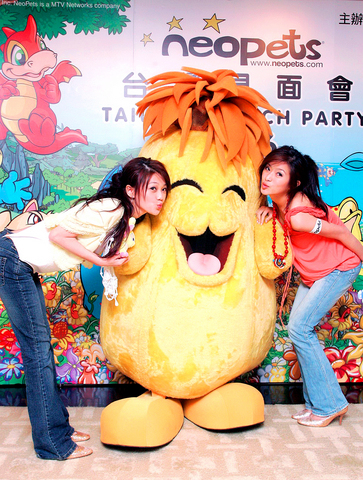
PHOTO: WANG WEI-LIN, TAIPEI TIMES
"Some people can't raise pets at home, so virtual pets are an ideal solution. If we don't feed our Neopets, they may get sick and we will have to tend to them," Lin said.
She first discovered Neo-pets.com through friends when attending high school in Singapore. Since then, she has spent two to three hours every day in an online fantasy land -- even though she is now enrolled in the Arts and Social Sciences faculty of the National University of Singapore.
"I enjoy playing games on Neopets.com the most and after accumulating `Neopoints,' I can even store them in banks for interest," she said.
Founded in November 1999 and headquartered in Glendale, California, Neopets.com was bought by the Viacom Group -- the conglomerate that owns the MTV and Nickelodeon television channels -- for US$160 million in June last year.
Now, as a division of MTV Networks' Kids and Family Group, Neopets.com enables members of the Pokemon generation to create virtual pets from a range of fantastical species, buy and sell items for these pets, play games and enter contests and explore the pets' virtual world, which is called "Neopia." Two Chinese-language versions of the site, one using simplified and one using traditional characters, were launched in November 2003. Since then, 210,000 Taiwanese have joined as members.
That number is expected to soar to 1.5 million in the coming years, Bobby Yuan (
"Taiwan has a high concentration of Internet users and we would like to increase the visibility of the network here," he added.
The company has roped in handset firm Sony Ericsson, beverage brand "La tea" and candy producer Taiwan Morinaga Co (森永製果), to sponsor the cyber-land, and more firms are expected to join soon, Yuan said.
As members sign up and participate in Neopets.com for free, the company is earning money from sponsors through advertisements that push their commercial messages in the Neopia world. This included big names like Pepsi, McDonald's, Nestle and Kellogg's.
Late last month, MTV teamed up with US wireless operator Cingular Wireless to introduce Neopets Mobile, a mobile-phone application enabling Neopet owners to keep tabs on their pets and explore the Neopia world from anywhere they can get a cell signal.
Regardless of whether the platform is the Internet or mobile phones, appealing content will be the key factor if the site intends to outshine rivals such as Gopets.com or Powerpets.com, according to Yuan.
The company therefore refreshes its content every day to hook users with artists and designers based in Singapore and the US, said Billy Shum (
"We are thinking of adding some Chinese culture-related content in the future. It will be based on international concepts, but we hope it will create a bond with Asian members," he added.


The domestic unit of the Chinese-owned, Dutch-headquartered chipmaker Nexperia BV will soon be able to produce semiconductors locally within China, according to two company sources. Nexperia is at the center of a global tug-of-war over critical semiconductor technology, with a Dutch court in February ordering a probe into alleged mismanagement at the company. The geopolitical tussle has disrupted supply chains, with some carmakers reportedly forced to cut production due to chip shortages. Local production would allow Nexperia’s domestic arm, Nexperia Semiconductors (China) Ltd (安世半導體中國), to bypass restrictions in place since October on the supply of silicon wafers — etched with tiny components to

Taiwan’s foreign exchange reserves fell below the US$600 billion mark at the end of last month, with the central bank reporting a total of US$596.89 billion — a decline of US$8.6 billion from February — ending a three-month streak of increases. The central bank attributed the drop to a combination of factors such as outflows by foreign institutional investors, currency fluctuations and its own market interventions. “The large-scale outflows disrupted the balance of supply and demand in the foreign exchange market, prompting the central bank to intervene repeatedly by selling US dollars to stabilize the local currency,” Department of Foreign

Taiwan is open to joining a global liquefied natural gas (LNG) program if one is created, but on the condition that countries provide delivery even in a scenario where there is a conflict with China, an energy department official said yesterday. While Taiwan’s priority is to have enough LNG at home, the nation is open to exploring potential strategic reserves in other countries such as Japan or South Korea, Energy Administration Deputy Director-General Chen Chung-hsien (陳崇憲) said. While the LNG market does not have a global reserve for emergencies like that of oil, the concept has been raised a few times —
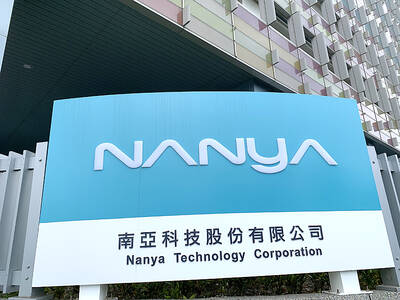
AI-FUELED DEMAND: The company has been benefiting from the skyrocketing prices for DRAM chips amid the AI frenzy, especially its core product — DDR4 DRAM chips DRAM chipmaker Nanya Technology Corp (南亞科技) yesterday reported that its revenue for the first quarter surged 582.91 percent to NT$49.09 billion (US$1.54 billion) from NT$7.19 billion a year earlier, as the supply crunch caused chip price spikes. Last quarter’s figure is the highest on record. On a quarterly basis, revenue jumped 63.14 percent from NT$30.09 billion, the company said. In January, Nanya Technology expected global DRAM supply scarcity to continue through the first half of 2028, thanks to strong demand for artificial intelligence (AI) applications. Market researcher TrendForce Corp (集邦科技) forecast prices of standard DRAM chips would rise between 58 percent and 63


 RSS
RSS