


Network-equipment maker Accton Technology Corp (智邦科技) yesterday announced it would form a joint venture with Madrid-based Fon SA, a community WiFi developer, to produce a WiFi-sharing service for the local market.
Fon was established last November with the idea of sharing broadband connections through wireless routers to form a global community. Its investors include Google and Skype Technologies SA.
To become a member of Fon, or a "Fonero," users with broadband access need to register with Fon online and download dedicated software onto their WiFi routers. They can then get free access throughout the community wherever there is coverage.
The high-speed and free Internet access has attracted more than 40,000 users in 144 countries within five months, making Fon the world's largest WiFi community, Martin Varsavsky, founder and CEO of Fon, said at a press conference in Taipei yesterday.
"After converting home-WiFis into hotspots to provide access for all WiFi devices, Fon could facilitate transmission of pictures, music, video clips and even games, a capacity that 3G [third-generation] telecommunications cannot achieve," Varsavsky said.
Fon plans to boost the number of its users to 1 million by the end of next year, with Taiwan making up 3 to 5 percent of subscribers, said Huang An-jie (黃安捷), Accton's chief executive officer.
Accton, which unveiled the first Skype-enabled Wi-Fi phone last November, is the first company in Asia to work with Fon, Huang said.
The joint venture, which will be established in late August, will be responsible for Fon's community building, marketing, sales, business development with Internet Service Providers, portals and information technology companies, Huang said.
He refused to reveal the proposed investment amount.
Through the partnership, Accton will also manufacture WiFi routers that are Fon software compatible. Fon has been getting its routers from Linksys Group Inc, a division of Cisco Systems Inc. But now Accton will be the main supplier of the routers, as Accton's products cost 40 percent less, Varsavsky told the Taipei Times.
To promote the service here, Fon plans to provide about 5,000 routers to local users for free as it did in Germany, Varsavsky said.
The routers are usually sold for about US$20 each in other other countries, but the price in Taiwan has not been set yet, he said.
In elaborating Fon's business model, Varsavsky described Fon players as belonging to one of three categories: Linus, Bills and Aliens. As a Linus, the user agrees to share bandwidth to others. As a Bill, the user sells bandwidth and gets 50 percent of the revenue generated by Aliens, people do not join Fon but who pay to use the connection online.
Fon ties the charge to Aliens to the bus fare in local markets, Varsavsky said. For example, the charge in Europe is about 4 euros per 24 hours, which is very affordable, he said.
Even though Fon's business model has been copied in China, Varsavsky said he will not give up the market.
"Fon is open-source and can be easily copied ? We are very convinced that people will join a bigger network, not small ones," he said.
WiFi-sharing poses a tremendous opportunity for Taiwanese manufacturers, who
could develop related products such as WiFi radio, game consoles, digital
cameras, digital music players and a slew of products to meet demand,
Varsavsky said.

SECOND-RATE: Models distilled from US products do not perform the same as the original and undo measures that ensure the systems are neutral, the US’ cable said The US Department of State has ordered a global push to bring attention to what it said are widespread efforts by Chinese companies, including artificial intelligence (AI) start-up DeepSeek (深度求索), to steal intellectual property from US AI labs, according to a diplomatic cable. The cable, dated Friday and sent to diplomatic and consular posts around the world, instructs diplomatic staff to speak to their foreign counterparts about “concerns over adversaries’ extraction and distillation of US AI models.” Distillation is the process of training smaller AI models using output from larger, more expensive ones to lower the costs of training a powerful new

Micron Technology Inc is a driving force pushing the US Congress to pass legislation that would put new export restrictions on equipment its Chinese competitors use to make their chips, according to people familiar with the matter. A US House of Representatives panel yesterday was to vote on the “MATCH Act,” a bill designed to close gaps in restrictions on chipmaking equipment. It would also pressure foreign companies that sell equipment to Chinese chipmaking facilities to align with export curbs on US companies like Lam Research Corp and Applied Materials Inc. The bill targets facilities operated by China’s ChangXin Memory Technologies Inc

Singapore-based ride-hailing and delivery giant Grab Holdings’ planned acquisition of Foodpanda’s Taiwan operations has yet to enter the formal review stage, as regulators await supplementary documents, the Fair Trade Commission (FTC) said yesterday. Acting FTC Chairman Chen Chih-min (陳志民) told the legislature’s Economics Committee that although Grab submitted its application on March 27, the case has not been officially accepted because required materials remain incomplete. Once the filing is finalized, the FTC would launch a formal probe into the deal, focusing on issues such as cross-shareholding and potential restrictions on market competition, Chen told lawmakers. Grab last month announced that it would acquire
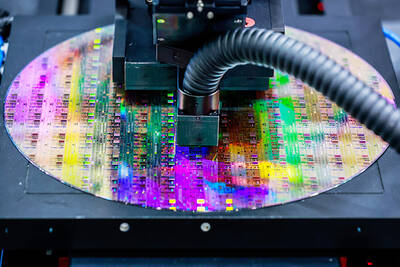
The artificial intelligence (AI) boom has triggered a seismic reshuffling of global equity markets, with Taiwan and South Korea muscling past European nations one by one. With its stock market now valued at nearly US$4.3 trillion, Taiwan surpassed the UK, Europe’s biggest market, earlier this month, data compiled by Bloomberg showed. South Korea is about US$140 billion away from doing the same. The tech-heavy Asian markets have shot past Germany and France in the past seven months. The shift is largely down to massive gains in shares of three companies that provide essential hardware for AI: Taiwan Semiconductor Manufacturing Co (TSMC, 台積電),


 RSS
RSS