


For the obsessively guarded, conservatively dressed and unflamboyant Oeri, Hoffman and Sacher families, avian flu could be good news. Over the next two years, the heirs of Fritz Hoffman, founders of Roche, one of the world's most powerful pharmaceutical companies, and who already rank as among the world's richest families, could see their combined ?10 billion (US$17.7 billion) fortune reach giddy heights.
Twenty members of the founding family control Roche, which industry analysts estimate will benefit from the Tamiflu drug thought to relieve the symptoms of avian flu, with extra profits of ?500 million this year and ?1 billion next.
And since the family owns about 10 percent of shares and crucially 50.01 percent of voting rights, they will ensure that no outside interests seize their company and enjoy the profits -- though many would like to.
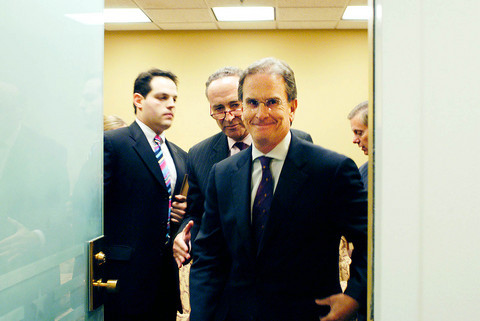
PHOTO: NY TIMES NEWS AGENCY
As avian flu spreads from southeast Asia into Europe, sparking fears of a worldwide epidemic that medical experts say could claim 50 million lives, Roche, famous as the company behind the Valium tranquillizer, appears poised to clean up.
The Basel-based company is already the fastest growing drugs firm in the world with a share performance to match. Investor returns have increased 50 percent in a year. Last week its share price reached record highs after it said third-quarter profits rose by 20 percent to ?3.9 billion.
And that growth is primarily due to a drug it did not even invent. It was US biotech firm Gilead that developed Tamiflu. But nine years ago, Gilead signed a development and licensing agreement with Roche.
It is currently the subject of legal action which will be resolved in a year. Gilead claims Roche has been negligent in its manufacture of Tamiflu which has led, Gilead says, to a series of product recalls. Gilead also says Roche has failed to market the product well, which has reduced the potential revenue the drug could have made. Roche categorically refutes the allegations.
But as legal action rumbles, Roche faces other possibly more serious threats. The firm is under unrelenting pressure to increase production of Tamiflu. In the US, Senator Charles Schumer has threatened legislation compulsory to license Tamiflu unless Roche allowed generic producers to boost the number of pills in circulation.
The senior Democratic senator accused Roche of "putting profits ahead of world safety." He has threatened, along with Republican lawmakers, to introduce legislation to force Roche to relax its stranglehold on the drug.
Pressure appears to have paid off. Last Thursday, after a month of holding its position, Roche said it would talk to four generic drug manufacturers about increasing production. Health campaigners say this is no guarantee that Roche will act. If it does, it will delay matters as long as possible so it gets the most revenue possible before low-cost manufacturers get in on the act.
Michael Bailey, of campaigning group Oxfam says: "This situation is absurd. A government will have to make a move because Roche seemingly can't deliver. It's a classic case of international intellectual property law not working."
"It seems Roche is holding on as long as possible before allowing generic companies the right to produce so it can make as much cash as possible," he says.
Roche says it can produce 10 million treatments each year and so far 40 governments have placed orders for Tamiflu. It says that although any government ordering a bulk supply should expect to wait a year before its order is satisfied, generic firms have to prove that they can safely manufacture Tamiflu as there are 10 complicated steps involved in its production.
While Roche is coming under intense scrutiny, the financial community is hugely supportive of the company. After all, today it is possibly Europe's best performing drug firm thanks to its investment in biotechnology companies way before other drug majors.
Much of its profits are due to its 55 percent stake in Genentech, the US biotechnology company behind targeted cancer drugs such as MabThera and Avastin. The company has strengthened its diagnostic division and is leading moves to tailor drugs to individual patients through the use of new technologies.
Denise Anderson, head of healthcare at Kepler Equities, says: "They have made paradigm changing moves. They think more carefully about trends. They just started talking about healthcare IT. Right now they are in a sweetspot where successful drugs are coming on stream and I expect that to last for a good few years."
Roche has resolutely rejected merger offers. Novartis, its bigger rival, also from Switzerland, bought a near third share in the company four years ago. It has long been thought that this was a prelude to a merger that would produce a national Swiss champion.
But the three family clans believe mergers yield no value and divert management's energy away from day-to-day business.
Though it is Fritz Gerber and Andre Hoffman who sit on Roche's board and look after the interests of the families, Roche is run by Franz Humer, who earns ?5.4 million -- the third biggest basic salary of any publicly quoted executive in Europe.
"The Hoffman family don't need money," says an informed insider. "For them it's a prestige thing. They are typically Swiss. They are conservative and do things for the long term."
But others believe that a new generation of Roche heirs will not block a merger, as the need to create a buttress against US giant Pfizer and UK rival GlaxoSmithKline deepens.
While the pharmaceuticals industry emerged in Europe with aspirin being discovered at Bayer in Germany, its center of gravity has shifted to the US, attracted by its research scientists and lack of price controls.
But Switzerland has a reserve of scientific expertise -- Swiss drug research papers receive more citations even than US ones.
Although its expertise is not disputed, the firm has been no stranger to controversy. In the 1970s, Stanley Adams, a Roche employee, handed over documents to the European Economic Community (EEC) as it was then, detailing how the company kept the price of vitamins high with the explicit collusion of its supposed rivals. But an EEC bungle identified Adams. Roche decided to prosecute and he was imprisoned under tough Swiss commercial secrecy laws. His wife then committed suicide. Twenty years later, Roche was at it again -- marshalling a price-fixing cartel in exactly the same product. It was fined more than US$500 million by US and EU competition regulators.
The firm has also been singled out by health campaigners for dragging its feet in allowing AIDS-devastated countries in Africa to get access to vital medicines. It was one of the 39 companies that threatened to take South Africa to court to overturn its right to produce cheap copies of expensive brand-name anti-HIV drugs.
And today though it is unclear how well Roche is helping the world prepare for what could be a devastating flu epidemic.
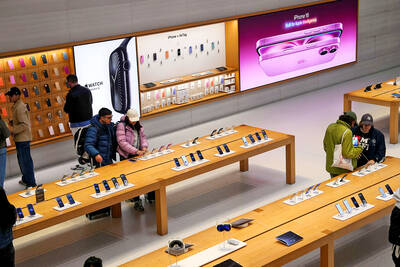
BYPASSING CHINA TARIFFS: In the first five months of this year, Foxconn sent US$4.4bn of iPhones to the US from India, compared with US$3.7bn in the whole of last year Nearly all the iPhones exported by Foxconn Technology Group (富士康科技集團) from India went to the US between March and last month, customs data showed, far above last year’s average of 50 percent and a clear sign of Apple Inc’s efforts to bypass high US tariffs imposed on China. The numbers, being reported by Reuters for the first time, show that Apple has realigned its India exports to almost exclusively serve the US market, when previously the devices were more widely distributed to nations including the Netherlands and the Czech Republic. During March to last month, Foxconn, known as Hon Hai Precision Industry

Taiwan Semiconductor Manufacturing Co (TSMC, 台積電) and the University of Tokyo (UTokyo) yesterday announced the launch of the TSMC-UTokyo Lab to promote advanced semiconductor research, education and talent development. The lab is TSMC’s first laboratory collaboration with a university outside Taiwan, the company said in a statement. The lab would leverage “the extensive knowledge, experience, and creativity” of both institutions, the company said. It is located in the Asano Section of UTokyo’s Hongo, Tokyo, campus and would be managed by UTokyo faculty, guided by directors from UTokyo and TSMC, the company said. TSMC began working with UTokyo in 2019, resulting in 21 research projects,

Ashton Hall’s morning routine involves dunking his head in iced Saratoga Spring Water. For the company that sells the bottled water — Hall’s brand of choice for drinking, brushing his teeth and submerging himself — that is fantastic news. “We’re so thankful to this incredible fitness influencer called Ashton Hall,” Saratoga owner Primo Brands Corp’s CEO Robbert Rietbroek said on an earnings call after Hall’s morning routine video went viral. “He really helped put our brand on the map.” Primo Brands, which was not affiliated with Hall when he made his video, is among the increasing number of companies benefiting from influencer
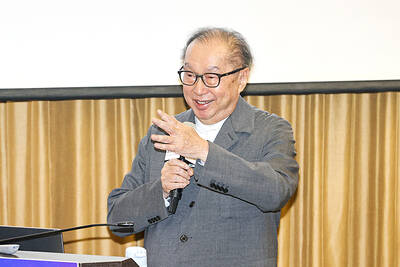
Quanta Computer Inc (廣達) chairman Barry Lam (林百里) yesterday expressed a downbeat view about the prospects of humanoid robots, given high manufacturing costs and a lack of target customers. Despite rising demand and high expectations for humanoid robots, high research-and-development costs and uncertain profitability remain major concerns, Lam told reporters following the company’s annual shareholders’ meeting in Taoyuan. “Since it seems a bit unworthy to use such high-cost robots to do household chores, I believe robots designed for specific purposes would be more valuable and present a better business opportunity,” Lam said Instead of investing in humanoid robots, Quanta has opted to invest


 RSS
RSS