


China plans to accelerate development of its futures and derivatives markets to help companies cope with currency and stock fluctuations in a more market-driven financial system, officials said.
The government is considering introducing interest-rate and stock-index futures, Cheng Siwei (程思危), vice chairman of the National People's Congress, and Shang Fulin (
China is making its currency more flexible, deregulating interest rates and increasing the supply of tradable shares on stock markets, increasing the need of companies and investors for tools to hedge risks.
The government hopes that a more developed domestic derivatives market will help avoid a repeat of scandals such as China Aviation Oil (Singapore) Corp, which lost US$550 million trading options in Singapore last year.
China Aviation "is a wake-up call," Cheng said at today's conference. "It's a sign that we lack the ability to hedge risk. It's necessary for China to develop financial derivatives so that we can be competitive."
A derivative is a financial obligation whose value is derived from interest rates, the outcome of specific events, or the price of underlying assets such as debt, equities and commodities.
China hasn't allowed trading in financial futures since the mid-1990s, when the government halted trading after speculation and insider trading caused the market to crash. Authorities shut all but three exchanges and scrapped more than 50 contracts.
The introduction of currency futures in China will take "a long time" and may not happen until the yuan becomes fully convertible, Cheng said.
China on July 21 ended the yuan's decade-old peg to the US dollar and started managing it against a basket of currencies.
The yuan is allowed to move 0.3 percent either side of a daily fixing rate set by the central bank. The People's Bank of China on Sept. 23 widened the daily trading band for the euro, yen and Hong Kong dollar to 3 percent, from 1.5 percent. The government hasn't given a timetable for free-floating the currency.
The start of a program this year to convert non-tradable, mostly state-owned, stockholdings into common shares that can be bought and sold on exchanges has paved the way for developments such as stock-index futures, China Securities Regulatory Commission Chairman Shang told the conference.
Non-tradable shares make up almost two-thirds of the value of listed companies. The country is seeking to unwind five decades of state ownership and bring its exchanges in line with global standards as it opens them wider to overseas investors.
The Chicago Mercantile Exchange plans to develop China-based futures products in partnership with domestic exchanges such as the Shanghai Stock Exchange and Shanghai Futures Exchange, Chief Executive Craig Donohue said in an interview.
The Merc is trying to position itself to lead China's evolving derivatives market, and is also working with Chinese regulators and banks to encourage use of the US$600 trillion US-listed derivatives market.
"Chinese banks and financial institutions are currently using our products such as euro-dollar products, our stock index futures contracts and ultimately, we hope, the foreign-exchange contracts," Donohue said.
China restricts trading in overseas futures to domestic lenders such as Bank of China and Agricultural Bank of China, while 26 Chinese companies are approved to trade in overseas commodities futures markets, said Steve Ng, ABN Amro Holding NV's Asia head of global futures.
ABN Amro, the biggest Dutch bank, plans to apply to set up a futures venture with Beijing-based Galaxy Securities Co to tap growing demand in China.
"China has the potential to be the biggest futures market in Asia within the next five years," Ng said. ABN Amro's revenue from China futures operations has doubled in the past two years, he said, declining to give figures.
China already allows trading in 11 types of commodity futures, including copper, cotton and soybeans. As of June, the nation had about 180 futures brokerages. US exchanges trade futures contracts on more than 130 products.
China's central bank last month said it will let more than 130 domestic and foreign banks trade yuan forward contracts and swaps on behalf of clients.
Forwards are agreements in which assets are bought and sold at current prices for delivery at a later specified time and date. They will allow local companies and investors to protect themselves from swings in the yuan and other currencies.
The Shanghai stock exchange is studying plans to introduce exchange-traded funds, or ETFs, based on the Asia Bond Fund, ETF warrants and stock-index futures, Geng Liang, head of the exchange, said at the conference.
The Shenzhen stock exchange is running trials of stock-index futures and is studying plans for stock options, said Zhang Yujun, the exchange's chief executive.
Use of derivatives would have enabled China to earn higher returns on its foreign-exchange reserves, which stood at US$711 billion at the end of June, NPC Vice Chairman Cheng said. The government made US$40 billion on the reserves last year, mainly through bond interest and appreciation of the euro, he said.


The domestic unit of the Chinese-owned, Dutch-headquartered chipmaker Nexperia BV will soon be able to produce semiconductors locally within China, according to two company sources. Nexperia is at the center of a global tug-of-war over critical semiconductor technology, with a Dutch court in February ordering a probe into alleged mismanagement at the company. The geopolitical tussle has disrupted supply chains, with some carmakers reportedly forced to cut production due to chip shortages. Local production would allow Nexperia’s domestic arm, Nexperia Semiconductors (China) Ltd (安世半導體中國), to bypass restrictions in place since October on the supply of silicon wafers — etched with tiny components to
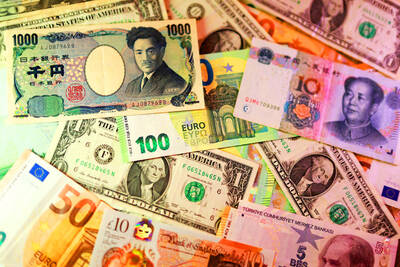
Taiwan’s foreign exchange reserves fell below the US$600 billion mark at the end of last month, with the central bank reporting a total of US$596.89 billion — a decline of US$8.6 billion from February — ending a three-month streak of increases. The central bank attributed the drop to a combination of factors such as outflows by foreign institutional investors, currency fluctuations and its own market interventions. “The large-scale outflows disrupted the balance of supply and demand in the foreign exchange market, prompting the central bank to intervene repeatedly by selling US dollars to stabilize the local currency,” Department of Foreign
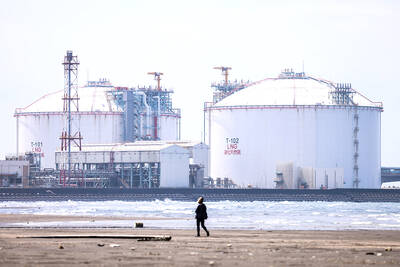
Taiwan is open to joining a global liquefied natural gas (LNG) program if one is created, but on the condition that countries provide delivery even in a scenario where there is a conflict with China, an energy department official said yesterday. While Taiwan’s priority is to have enough LNG at home, the nation is open to exploring potential strategic reserves in other countries such as Japan or South Korea, Energy Administration Deputy Director-General Chen Chung-hsien (陳崇憲) said. While the LNG market does not have a global reserve for emergencies like that of oil, the concept has been raised a few times —
AI-FUELED DEMAND: The company has been benefiting from the skyrocketing prices for DRAM chips amid the AI frenzy, especially its core product — DDR4 DRAM chips DRAM chipmaker Nanya Technology Corp (南亞科技) yesterday reported that its revenue for the first quarter surged 582.91 percent to NT$49.09 billion (US$1.54 billion) from NT$7.19 billion a year earlier, as the supply crunch caused chip price spikes. Last quarter’s figure is the highest on record. On a quarterly basis, revenue jumped 63.14 percent from NT$30.09 billion, the company said. In January, Nanya Technology expected global DRAM supply scarcity to continue through the first half of 2028, thanks to strong demand for artificial intelligence (AI) applications. Market researcher TrendForce Corp (集邦科技) forecast prices of standard DRAM chips would rise between 58 percent and 63


 RSS
RSS