


Tatung Co (
Tatung previously diversified into brand-name digital music players, computers and related products, with the hope of winning orders from international vendors.
"Our sales growth this year is partly due to the increasing contribution from those new products," said company president Lin Wei-shan (林蔚山) on the sidelines of the launch of Tatung's full product line for this year.
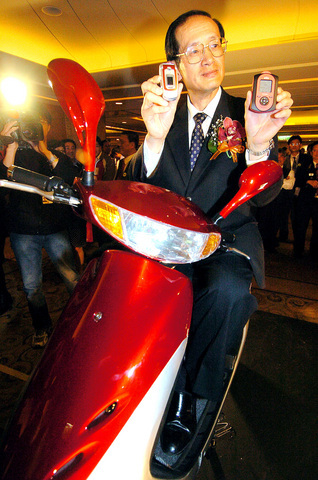
PHOTO: GEORGE TSORNG, TAIPEI TIMES
Lin said the company's sales this year would jump 15 percent to around NT$350 billion from NT$300 billion last year.
Tatung aims to boost its own-brand mobile handset sales to at least 60,000 units this year from nothing, after expanding its product portfolio to as many as 10 models, Lin said.
The company debuted its first handset in the beginning of the year.
Additionally, Tatung has ambitions to expand outside its home turf to develop liquid-crystal-display (LCD) TVs and MP3 players.
The company said it would make 500,000 LCD TVs and 1 million MP3 players this year, mostly for overseas customers.
"The Taiwan market serves as a testing ground. Our ultimate purpose is to make phones for international brands," Lin said.
But industry watchers expressed caution over whether the TV maker will be able to make quick profits from the new business.
"It's understandable that Tatung is expanding into the wireless communications sector as its Chinese counterpart, Haier Group (
"But Haier is struggling to make money from the phone business," Tseng said.
Helen Chen (
"It will be difficult for entrant Tatung to snare orders from existing players as they maintain quite good ties with their customers, such as Motorola Inc, who tend to keep the same suppliers," Chen said.
What worries Chen is whether Tatung's LCD panel manufacturing affiliate Chunghwa Picture Tubes Ltd (
"Chunghwa Picture Tubes could be a burden dragging down Tatung's earnings this year," Chen said.
Tatung last year posted a NT$4 billion non-operating loss due to Chunghwa Picture Tubes.
Adding in another possible losing year for the LCD manufacturing arm this year, Chen projected that Tatung's earnings for this year would slide to NT$0.5 a share, from NT$1.27 last year.
Tatung's shares fell for the seventh straight trading session yesterday to close at NT$11.45 on the Taiwan Stock Exchange.

The Eurovision Song Contest has seen a surge in punter interest at the bookmakers, becoming a major betting event, experts said ahead of last night’s giant glamfest in Basel. “Eurovision has quietly become one of the biggest betting events of the year,” said Tomi Huttunen, senior manager of the Online Computer Finland (OCS) betting and casino platform. Betting sites have long been used to gauge which way voters might be leaning ahead of the world’s biggest televised live music event. However, bookmakers highlight a huge increase in engagement in recent years — and this year in particular. “We’ve already passed 2023’s total activity and

Nvidia Corp CEO Jensen Huang (黃仁勳) today announced that his company has selected "Beitou Shilin" in Taipei for its new Taiwan office, called Nvidia Constellation, putting an end to months of speculation. Industry sources have said that the tech giant has been eyeing the Beitou Shilin Science Park as the site of its new overseas headquarters, and speculated that the new headquarters would be built on two plots of land designated as "T17" and "T18," which span 3.89 hectares in the park. "I think it's time for us to reveal one of the largest products we've ever built," Huang said near the
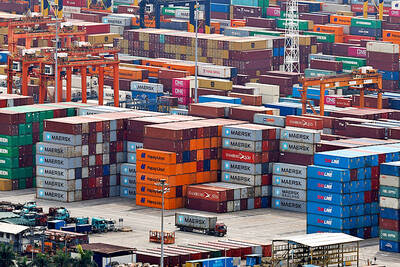
China yesterday announced anti-dumping duties as high as 74.9 percent on imports of polyoxymethylene (POM) copolymers, a type of engineering plastic, from Taiwan, the US, the EU and Japan. The Chinese Ministry of Commerce’s findings conclude a probe launched in May last year, shortly after the US sharply increased tariffs on Chinese electric vehicles, computer chips and other imports. POM copolymers can partially replace metals such as copper and zinc, and have various applications, including in auto parts, electronics and medical equipment, the Chinese ministry has said. In January, it said initial investigations had determined that dumping was taking place, and implemented preliminary
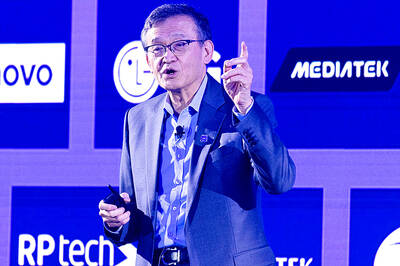
Intel Corp yesterday reinforced its determination to strengthen its partnerships with Taiwan’s ecosystem partners including original-electronic-manufacturing (OEM) companies such as Hon Hai Precision Industry Co (鴻海精密) and chipmaker United Microelectronics Corp (UMC, 聯電). “Tonight marks a new beginning. We renew our new partnership with Taiwan ecosystem,” Intel new chief executive officer Tan Lip-bu (陳立武) said at a dinner with representatives from the company’s local partners, celebrating the 40th anniversary of the US chip giant’s presence in Taiwan. Tan took the reins at Intel six weeks ago aiming to reform the chipmaker and revive its past glory. This is the first time Tan


 RSS
RSS