


Clad only in shorts, a man with shaved head precariously balances on two large, irregularly shaped wooden balls. As he lurches forward with demented baby steps, he struggles to stay upright; he can barely make his way across the room.
For Hong Kong artist Ho Siu-Kee, this act illustrates the precarious situation Hong Kong artists face today, a time of change and uncertainty. For Ho, the frustrating attempt simply to cross the room symbolizes the awkwardness and powerlessness Hong Kong residents are feeling during their transition to Chinese rule.
Walking on Two Balls is part of Ho's solo exhibition, Connotative Body. A combination of computer manipulated photographs, video installations and sculpture, the exhibition is on display at IT Park until Dec. 11.
COURTESY OF IT PARK
Walking on Two Balls, also indicates the degree to which Ho's art is about the body's direct relationship to space and time. Even though most of his work is documented by photographs or video, in them the artist is a performer and uses his body as an instrument.
According to media guru Marshall McLuhan, a machine or tool becomes an extension of its user's body. The wheel acts as an extension of the feet, a book an extension of the eyes, electricity of the nerves. Ho captures this notion by attaching prostheses to his head, back, arms and feet and photographing himself.
Like a post-modern Da Vinci, Ho constructs scientific contraptions that act as extensions of the body. In Flying Machine, for example, Ho, with bandaged hands, holds a hand-made flying machine that is nearly his size. In the first photo, his arms are outstretched to his sides while the propeller blades jut straight up into the air. In the second, his arms jut straight up and the blades move perpendicular to the ground. The body imitates the movement of the blades and vice versa. Does the machine control the man or the man control the machine?
COURTESY OF IT PARK
In The Third Eye photo series (1997), a double portrait of the artist, Ho wears a metal-pipe fitting as headgear. It holds a small glass ball in front of his eyes that extends his vision; yet the glass ball operates much like the eye's retina, inverting the image and thus incapacitating the vision.
The actual headgear is installed on a large glass jar shaped like the artist's head. Viewers can look through the glass ball to see the portraits on the wall -- also inverted. The piece raises issues about how vision distorts perception: you can't always trust what you see.
The comical video installation Contact Point (1996) further toys with issues of perception. Two monitors face each other. In the left monitor, Ho throws a ball off-screen to his counterpart self in the right monitor, who catches the ball and throws it back to his left.
This back-and-forth interplay creates a dialogue in the space between the two monitors. Viewers feel as if they can almost interrupt the two monitor-bound characters and catch the ball themselves.
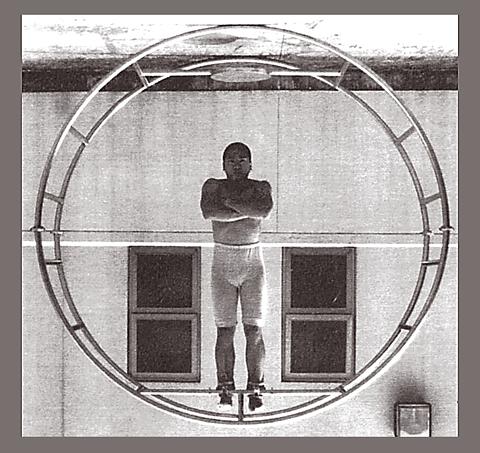
In Gravity Hoop (1997), a frontal and side view both show the artist hanging upside down, motionless, in his large metallic circular ladder. He remains deep in concentration, like a Hindu fakir or an astronaut in intensive training; the work hints at the body's endurance, the passage of time.
Yet the piece also seems like some form of protest or challenge, and in many ways it best illustrates the essence of Ho's message. His gesture is defiant. He seems to be testing the body's limitations against the machine; the images are reminiscent of Brave New World. Or maybe it's simply the life for an artist in today's Hong Kong.
Ho Siu-Kee Connotative Body Until Dec. 11
IT Park, 41, 2F Yitung St.
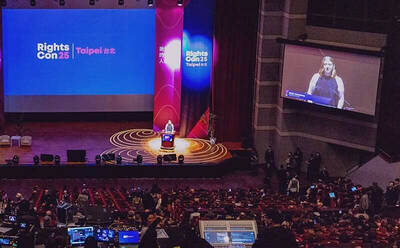
SILENCING CRITICS: In addition to blocking Taiwan, China aimed to prevent rights activists from speaking out against authoritarian states, a Cabinet department said The Ministry of Foreign Affairs (MOFA) yesterday condemned transnational repression by Beijing after RightsCon, a major digital human rights conference scheduled to be held in Zambia this week, was abruptly canceled due to Chinese pressure over Taiwanese participation. This year’s RightsCon, the world’s largest conference discussing issues “at the intersection of human rights and technology,” was scheduled to take place from tomorrow to Friday in Lusaka, and expected to draw 2,600 in-person attendees from 150 countries, along with 1,100 online participants. However, organizers were forced to cancel the event due to behind-the-scenes pressure from China, the ministry said, expressing its “strongest condemnation”
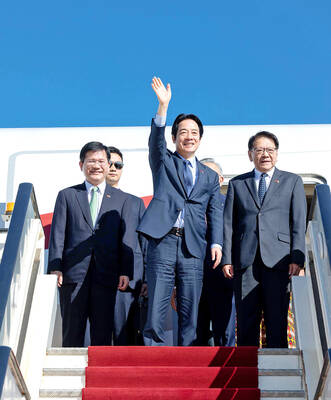
DELAYED BUT DETERMINED: The president’s visit highlights Taiwan’s right to international engagement amid regional pressure from China President Willaim Lai (賴清德) yesterday arrived in Eswatini, more than a week after his planned visit to Taiwan’s sole African ally was suspended because of revoked overflight permits. “The visit, originally scheduled for April 22, was postponed due to unforeseen external factors,” Lai wrote on social media. “After several days of careful arrangements by our diplomatic and national security teams, we successfully arrived today.” Lai said he looked forward to further deepening Taiwan-Eswatini relations through closer cooperation in the economy, agriculture, culture and education, as well as advancing the nation’s international partnerships. The president was initially scheduled to arrive in time to celebrate
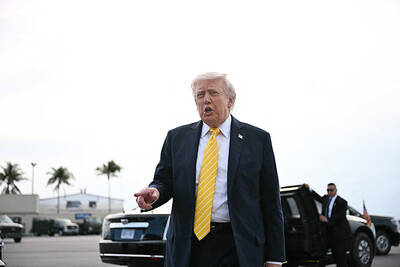
Iran’s Islamic Revolutionary Guard Corp (IRGC) yesterday said the US faced a choice between an “impossible” military operation or a “bad deal” with Tehran, after US President Donald Trump disparaged Iran’s latest peace proposal. Negotiations between the two countries have been deadlocked since a ceasefire came into effect on April 8, with only one round of direct peace talks held so far. Iran’s Tasnim and Fars news agencies reported that Tehran had submitted a 14-point proposal to mediator Pakistan, but Trump was quick to cast doubt on it. “I will soon be reviewing the plan that Iran has just sent to us, but

A group affiliated with indicted Chinese immigrant Xu Chunying (徐春鶯) is to be dissolved for monitoring Chinese immigrants in Taiwan, a source said yesterday. Xu, the secretary-general of the Cross-Strait Marriage and Family Service Alliance, was indicted on March 24 on charges of violating the Anti-Infiltration Act (反滲透法). The alliance “illegally monitored" Chinese immigrants living in Taiwan on behalf of the Chinese Communist Party (CCP) and the Ministry of the Interior is expected to dissolve the organization in the coming days under provisions of the Civil Associations Act (人民團體法), the source said. Xu, who married a Taiwanese in 1993 and became a Republic


 RSS
RSS