


Factories in China and India cranked up production last month and Japanese business morale rose to its highest in more than a year on signs of improving global demand, boosting hopes for a sustainable economic recovery.
China’s official purchasing managers’ index (PMI) rose to 55.1 last month from 52.0 in February, beating expectations and pointing to brisk first-quarter GDP growth that could spur further policy tightening by the central bank.
Sub-indexes for output, new orders, new export orders, imports and job creation all rose strongly, as did input prices, highlighting mounting inflationary pressures as the economy surges and companies look to pass on rising costs to consumers.
The headline PMI from a parallel HSBC/Markit survey rose to 57.0, the third-highest level in the six-year history of the survey, from 55.8 in February. A reading above 50 means activity is expanding.
“Another substantially high headline manufacturing PMI reading, combined with strong growth of exports, points to an acceleration in industrial production and likely over 11 percent GDP growth in the first quarter,” Qu Hongbin (屈宏斌), chief economist for China at HSBC, said in a statement yesterday. “With inflation pressures rapidly accumulating, this increases the risk of interest rate hikes in the coming months.”
Strong demand from China, the world’s third-largest economy, is proving a boon for its neighbors as Asia’s major Western export markets have been far slower to recover.
South Korea reported that exports last month rose 35.1 percent from a year earlier, beating an expected 32.9 percent rise.
“Taking into account that our main trading partners are China and other emerging markets and those markets are still flourishing, we can expect a positive outlook for the first half of the year,” said Kim Jae-eun, an economist at Hyundai Securities in Seoul.
Japan has also seen a steady export recovery, driven largely by sales to China, which has helped offset persistently weak domestic demand that is hobbling the economy.
The Bank of Japan’s “tankan” survey yesterday showed morale among the country’s big manufacturers, the biggest beneficiaries of the export rise, improved to its best level since the failure of Lehman Brothers shocked financial markets in September 2008.
Large manufacturers expect export sales to grow 4.5 percent this year and next year, compared with an expected 18.3 percent decline in the fiscal year that ended on Wednesday, though they remain cautious about boosting wages or spending on new plants and equipment.
Japanese manufacturing activity slowed slightly last month, but a rise in export orders to the highest in almost six years suggested production would grow.
India’s factories were also busier last month, though growth slowed from a 20-month high in February as companies faced mounting cost pressures.
While South Korea’s year-on-year export numbers appear impressive, investment bank ING said monthly export growth may have moderated from February, highlighting concerns in Asia that the global recovery may be slower and more uneven than expected.
Chinese government economist Zhang Liqun (張立群) said time would tell whether the improvement in global demand could be sustained.
“From the demand side, the strong recovery in exports might not be sustainable and actual investment growth is slowing. So the outlook for growth in demand and orders is still not clear,” he said.
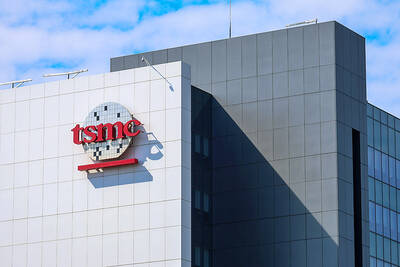
Taiwan Semiconductor Manufacturing Co (TSMC, 台積電), the world’s largest foundry service provider, yesterday said that global semiconductor revenue is projected to hit US$1.5 trillion in 2030, after the figure exceeds US$1 trillion this year, as artificial intelligence (AI) demand boosts consumption of token and compute power. “We are still at the beginning of the AI revolution, but we already see a significant impact across the whole semiconductor ecosystem,” TSMC deputy cochief operating officer Kevin Zhang (張曉強) said at the company’s annual technology symposium in Hsinchu City. “It is fair to say that in the past decade, smartphones and other mobile devices were
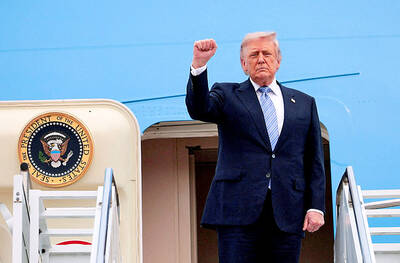
US-CHINA SUMMIT: MOFA welcomed US reassurance of no change in its Taiwan policy; Trump said he did not comment when Xi talked of opposing independence US President Donald Trump yesterday said he has not made a decision on whether to move forward with a major arms package for Taiwan after hearing concerns about it from Chinese President Xi Jinping (習近平). Trump’s comments on Taiwan came as he flew back to Washington after wrapping up critical talks in which both leaders said important progress was made in stabilizing US-China relations even as deep differences persist between the world’s two biggest powers on Iran and Taiwan. “I will make a determination,” Trump said, adding: “I’ll be making decisions. But, you know, I think the last thing we need right
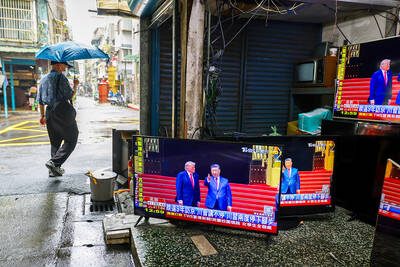
TAIWAN ISSUE: US treasury secretary Scott Bessent said on the first day of meetings that ‘it wouldn’t be a US-China summit without the Taiwan issue coming up’ There were no surprises on the first day of the summit between US President Donald Trump and Chinese President Xi Jinping (習近平), the Mainland Affairs Council (MAC) said yesterday, as the government reiterated that cross-strait stability is crucial to the Asia-Pacific region, as well as the world. As the two presidents met for a highly anticipated summit yesterday, Chinese state media reported that Xi warned Trump that missteps regarding Taiwan could push their two countries into “conflict.” Trump arrived in China with accolades for his host, calling Xi a “great leader” and “friend,” and extending an invitation to visit the White House
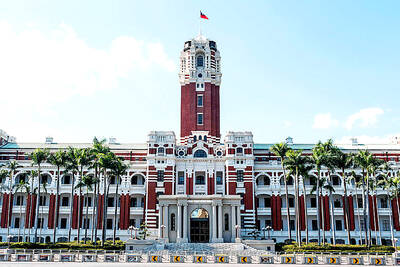
SECURITY: Taipei presses the US for arms supplies, saying the arms sales are not only a reflection of the US security commitment to Taiwan but also serve as a mutual deterrent against regional threats Taiwan is committed to preserving the cross-strait “status quo” and contributing to regional peace and stability, the Presidential Office said yesterday. “It is an undeniable fact that the Republic of China is a sovereign and independent democratic nation,” Presidential Office spokeswoman Karen Kuo (郭雅慧) reiterated, adding that Beijing has no right to claim sovereignty over Taiwan. The statements came after US President Donald Trump warned against Taiwanese independence. Trump wrapped up a state visit to Beijing on Friday, during which Chinese President Xi Jinping (習近平) had pressed him not to support Taiwan. Taiwan depends heavily on US security backing to deter China from carrying


 RSS
RSS