


The financially troubled American Insurance Group (AIG) is to sell its local unit Philippine-American Life and General Insurance Co (Philam Life), the unit’s chief executive Jose Cuisia said yesterday.
About 10 local and foreign entities have expressed interest in acquiring all or parts of the group, which is involved in insurance, banking and asset management, Cuisia told a news conference.
He declined to give details and said no time frame had been set by AIG for the sale of the local unit known locally as Philam Life.
Cuisia put the Philippine unit’s net worth at 49.4 billion pesos (US$1.05 billion).
“AIG announced that it will refocus the company on its core property and casualty insurance business to repay its loan from the Federal Reserve Bank of New York,” Cuisia said.
He said he was “surprised” with the decision because Philam Life could be considered a “crown jewel” to AIG.
Philam Life is the Philippines’ most profitable and largest insurer, employing about 1,500 people and backed by assets worth 170 billion pesos.
“AIG is seeking top-rated, financially strong brand names with the capability to continue Philam Life’s legacy of leadership, strength, stability and dedication to its policy holders, employees and shareholders,” Cuisia said.
“This is an opportunity for local companies to own a trophy company,” he said, citing Philam Life’s leading role in local insurance.
He said AIG has hired investment banks JP Morgan and Blackstone to advise it on the sale.
The advisers will help AIG decide whether to sell Philam Life as a whole or part by part, he added.
He said the company remains “strongly capitalized” and would be able to meet all its commitments to depositors, investors and policy holders.
He said most of Philam Life’s investments were tied to government securities and bonds, and that the firm did not have any offshore exposure to troubled US financial institutions.
Cuisia said he was “not leading a management buyout” of the company.
Philam Life deputy president and chief operating officer Michel Khalaf said the company has for decades remained a “net contributor” to AIG.
While the company will seek to retain all its employees, he said there could be some “rationalization” if a buy-out led to duplication of jobs.

‘NO SECURITY RISK’: The Railway Bureau reassured the public that the technicians’ activities were limited to technical guidance and did not involve sensitive systems The Railway Bureau yesterday said it had invited eight Chinese technicians to assist with an airport MRT construction project. The bureau issued the confirmation after an Internet user said Chinese nationals had entered the construction zone of Taiwan Taoyuan International Airport’s Terminal 3 project. They asked why “individuals from an enemy state” were allowed access to such a major national infrastructure project, which raised serious concerns over Taiwan’s industrial safety, sensitive systems and information security. The bureau’s Northern Region Engineering Branch Office said subcontractor Taiwan Handle Industrial Co (台灣手把工業) of the Taoyuan airport MRT’s “Contract No. CU05 Project A14 Station Civil, MEP &

The National Chungshan Institute of Science and Technology yesterday showcased its locally developed variants of the Vision 60 robotic patrol dog, which it plans to deploy on the nation’s outlying territories in the South China Sea. The variants were produced under the Joint Lab project — created by the institute and domestic companies — and assembled with domestically produced motors, lenses and artificial intelligence (AI) systems alongside licensed tech from the US, Missile and Rocket Systems Research Division deputy director Jen Kuo-kang (任國光) told the media event at a military base in Taipei’s Dazhi (大直) area. Taiwan has built up its strengths
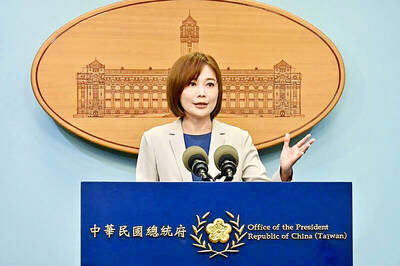
TIT-FOR-TAT: The US allegedly revoked the visa of a Chinese national working at Xinhua News Agency in the US in response to Beijing’s expulsion of Vivian Wang The Presidential Office yesterday condemned China for expelling a New York Times correspondent from Beijing following the newspaper’s interview with President William Lai (賴清德), saying the move highlighted Beijing’s suppression of press freedom and its threat to international news media. Taiwan has noted a series of recent incidents in which Beijing used similar tactics to “threaten and pressure international media outlets and journalists,” Presidential Office spokeswoman Karen Kuo (郭雅慧) said in a statement. “This concerns not only press freedom and freedom of expression, but also the safety of journalists, and Taiwan and relevant partners are paying close attention to the situation,” she
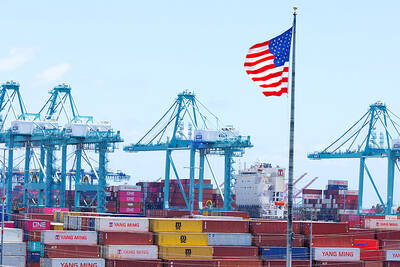
NOT IMMEDIATE: Taiwan has a chance to appeal the proposed 10 percent tariff before it starts, while other countries face a 12.5 percent tariff from the trade office Taiwan is among 60 economies determined by the US to have failed to impose or enforce a ban on the importation of goods produced with forced labor, according to a notice released on Tuesday by the Office of the US Trade Representative (USTR), which proposed imposing an additional 10 percent or more tariff on them. The USTR in a statement said that following an investigation, it had determined under Section 301 of the Trade Act of 1974 that the failure of the 60 economies to impose and effectively enforce a prohibition on the importation of goods produced with forced labor is


 RSS
RSS