


Singapore is counting on the acclaim emanating from the first Grand Prix under lights to brighten the gloom hovering over its tourism industry.
With 40,000 overseas visitors on shopping sprees, many sporting team T-shirts and caps, Orchard Road retailers were basking in a three-day bonanza from Friday through yesterday.
In contrast, managers of other shopping centers near roads blocked off for the race stared down almost empty aisles.
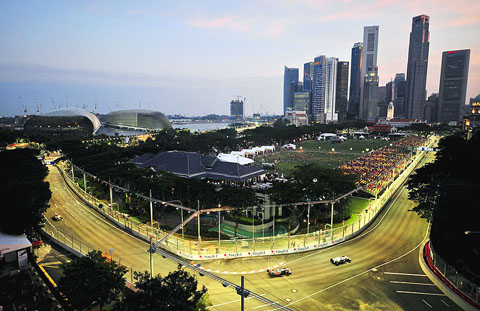
PHOTO: EPA
Assurances of intangible benefits to the city-state brought little consolation.
“It’s so quiet,” a supermarket staff member said. “There are usually four times more people on weekends.”
Economists cautioned against expectations that the Formula 1 (F1) race would boost the slowing economy. Initial estimates are likely to be pared lower amid the dismal global economic outlook, said Alvin Liew, Standard Chartered Bank economist.
The city-state image will be the big winner, they said.
The race, which attracted a global television audience “should be the catalyst in changing Singapore’s efficient, but dull image,” said Goh Shu Fen (吳淑芬), head of an advertising industry consulting firm.
It could attract more tourists, conferences, sports and businesses in the long haul, Goh said.
Singapore is paying US$200 million over five years to promote itself as a fun place to visit. Two casino resorts to be completed by 2010 and the completion last year of the world’s largest observation wheel, taller than the London Eye, are all part of Singaporean Prime Minister Lee Hsien Loong’s (李顯龍) drive to inject a significant “wow” factor.
The TV views of the skyline juxtaposed with the sight of the F1 racers hurtling past the Singapore Flyer and historic icons have made for stunning watching, media analysts said.
“Hopefully, this will open people’s eyes,” said sports supremo Bernie Ecclestone who came up with the idea of night racing in Singapore.
Against the prospect of the city-state slipping into a technical recession this quarter and predictions that the economy may grow less than 4 percent this year, the overwhelming praise for the venue has been heartening.
Some doubt, however, that this year’s target for 10.8 million tourists will be reached. The city-state has been aiming for a larger slice of the tourism pie to compensate for less manufacturing.
Beyond the race weekend, there was little foreign interest in a jamboree with a variety of attractions that started ahead of the main event in hopes of encouraging tourists to stay longer.
Much to the disappointment of hotels, spectators flew in right before Friday’s practice sessions.
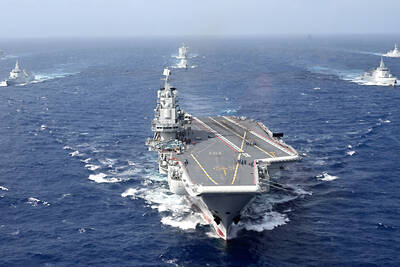
PROVOCATIVE: Chinese Deputy Ambassador to the UN Sun Lei accused Japan of sending military vessels to deliberately provoke tensions in the Taiwan Strait China denounced remarks by Japan and the EU about the South China Sea at a UN Security Council meeting on Monday, and accused Tokyo of provocative behavior in the Taiwan Strait and planning military expansion. Ayano Kunimitsu, a Japanese vice foreign minister, told the Council meeting on maritime security that Tokyo was seriously concerned about the situation in the East China and South China seas, and reiterated Japan’s opposition to any attempt to change the “status quo” by force, and obstruction of freedom of navigation and overflight. Stavros Lambrinidis, head of the EU delegation to the UN, also highlighted South China Sea
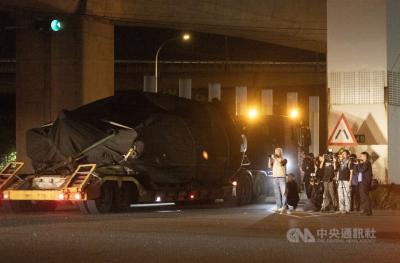
The final batch of 28 M1A2T Abrams tanks purchased from the US arrived at Taipei Port last night and were transported to the Armor Training Command in Hsinchu County’s Hukou Township (湖口), completing the military’s multi-year procurement of 108 of the tanks. Starting at 12:10am today, reporters observed more than a dozen civilian flatbed trailers departing from Taipei Port, each carrying an M1A2T tank covered with black waterproof tarps. Escorted by military vehicles, the convoy traveled via the West Coast Expressway to the Armor Training Command, with police implementing traffic control. The army operates about 1,000 tanks, including CM-11 Brave Tiger
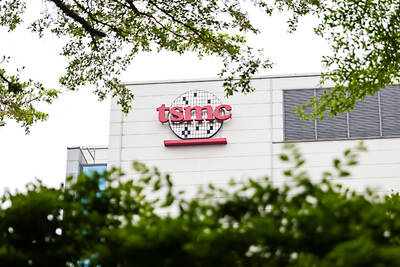
Taiwan Semiconductor Manufacturing Co (TSMC, 台積電), the world’s largest contract chipmaker, said it expects its 2-nanometer (2nm) chip capacity to grow at a compound annual rate of 70 percent from this year to 2028. The projection comes as five fabs begin volume production of 2-nanometer chips this year — two in Hsinchu and three in Kaohsiung — TSMC senior vice president and deputy cochief operating officer Cliff Hou (侯永清) said at the company’s annual technology symposium in Silicon Valley, California, last week. Output in the first year of 2-nanometer production, which began in the fourth quarter of last year, is expected to
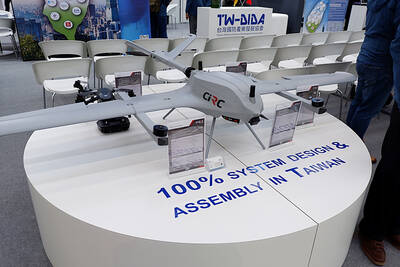
Taiwan’s drone exports surged past US$100 million in the first quarter, exceeding last year’s full-year total, with the Czech Republic emerging as the largest buyer, the Ministry of Economic Affairs said. Exports of complete drones reached US$115.85 million in the period, about 1.2 times the total recorded for all of last year, the ministry said in a report. Exports to the Czech Republic accounted for about US$100 million, far outpacing other markets. Poland, last year’s top destination, recorded about US$11.75 million in the first quarter. Taiwan’s drone exports have expanded rapidly in the past few years, with last year’s total


 RSS
RSS