


An industry group says it has won a new round in a court battle with Yahoo's China arm, which is accused of helping online music pirates.
A Beijing appeals court on Thursday upheld a ruling against Yahoo China over its search engine's links to outside Web sites that carried illegally copied music, the International Federation of Phonographic Industries (IFPI) said.
Court officials would not confirm the report. Porter Erisman, a spokesman for Alibaba.com, the local partner managing Yahoo's China arm, said he had not seen the ruling and could not comment on it. He said Yahoo China hoped to reach an agreement with music companies to create a licensed download service.
China is a leading source of pirated copies of music, movies and other goods. Operators of pirate Web sites offer music, games and other services to attract users and make money from advertising or online commerce.
Industry groups have won a series of lawsuits against companies accused of profiting from piracy but say violations are growing despite increased Chinese enforcement.
In the latest case, the IFPI -- representing companies including Warner Music, Sony BMG and Universal Vivendi -- accused Yahoo China of violating copyrights because of links between its search engine and Web sites with 229 illegally copied songs.
The Beijing No. 2 Intermediate People's Court ruled in April that Yahoo China facilitated the infringement of copyrights, awarding 210,000 yuan (US$27,000) in damages.
Yahoo China appealed, arguing that search engines should not be liable for content on outside Web sites. The IFPI said that appeal was rejected by the Bei-jing Higher People's Court.
China changed its laws on enforcement of copyrights and other intellectual property after a similar lawsuit earlier against Chinese search engine Baidu.com Inc, and Yahoo China was sued under the new system.

PROVOCATIVE: Chinese Deputy Ambassador to the UN Sun Lei accused Japan of sending military vessels to deliberately provoke tensions in the Taiwan Strait China denounced remarks by Japan and the EU about the South China Sea at a UN Security Council meeting on Monday, and accused Tokyo of provocative behavior in the Taiwan Strait and planning military expansion. Ayano Kunimitsu, a Japanese vice foreign minister, told the Council meeting on maritime security that Tokyo was seriously concerned about the situation in the East China and South China seas, and reiterated Japan’s opposition to any attempt to change the “status quo” by force, and obstruction of freedom of navigation and overflight. Stavros Lambrinidis, head of the EU delegation to the UN, also highlighted South China Sea

The final batch of 28 M1A2T Abrams tanks purchased from the US arrived at Taipei Port last night and were transported to the Armor Training Command in Hsinchu County’s Hukou Township (湖口), completing the military’s multi-year procurement of 108 of the tanks. Starting at 12:10am today, reporters observed more than a dozen civilian flatbed trailers departing from Taipei Port, each carrying an M1A2T tank covered with black waterproof tarps. Escorted by military vehicles, the convoy traveled via the West Coast Expressway to the Armor Training Command, with police implementing traffic control. The army operates about 1,000 tanks, including CM-11 Brave Tiger

Taiwan Semiconductor Manufacturing Co (TSMC, 台積電), the world’s largest contract chipmaker, said it expects its 2-nanometer (2nm) chip capacity to grow at a compound annual rate of 70 percent from this year to 2028. The projection comes as five fabs begin volume production of 2-nanometer chips this year — two in Hsinchu and three in Kaohsiung — TSMC senior vice president and deputy cochief operating officer Cliff Hou (侯永清) said at the company’s annual technology symposium in Silicon Valley, California, last week. Output in the first year of 2-nanometer production, which began in the fourth quarter of last year, is expected to
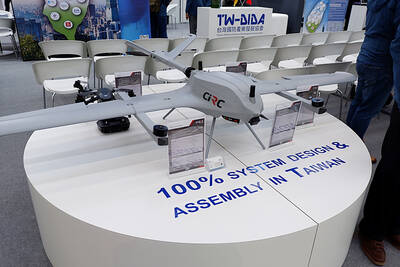
Taiwan’s drone exports surged past US$100 million in the first quarter, exceeding last year’s full-year total, with the Czech Republic emerging as the largest buyer, the Ministry of Economic Affairs said. Exports of complete drones reached US$115.85 million in the period, about 1.2 times the total recorded for all of last year, the ministry said in a report. Exports to the Czech Republic accounted for about US$100 million, far outpacing other markets. Poland, last year’s top destination, recorded about US$11.75 million in the first quarter. Taiwan’s drone exports have expanded rapidly in the past few years, with last year’s total


 RSS
RSS