


Internet search leader Google Inc is testing technology that allows people using its mobile mapping service to identify their location even if their phones are not equipped with a global positioning system (GPS) receiver.
The new tracking feature introduced Wednesday is being touted as an added convenience because it will enable people on the go to skip the task of typing a starting address on a mobile handset's small keys when they turn to Google's maps for guidance.
Using the technology, dubbed "My Location," requires simply pressing zero on a mobile handset equipped with the new software. The sender's location shows up as a blue dot on Google's mobile maps.
The tracking system isn't set up to collect a user's phone number or any other personal information that would reveal a person's identity, said Steve Lee, product manager for Google's mobile maps. As a safeguard, the feature can be turned off at any time by simply clicking on a link in the help menu.
Those assurances probably will alleviate privacy concerns raised about the new service, analyst Greg Sterling of Sterling Market Intelligence aid.
After trying out "My Location" on a Blackberry device, Sterling predicted people would embrace it. He called it "an incremental improvement but still meaningful."
Unlike GPS, Google's tracking feature also works indoors. "My Location" also drains less power from a phone's battery than a GPS receiver does.
On the downside, Google's service isn't as precise as GPS. In most instances, Google hopes to get within 400m to 5km of a user's location -- close enough to provide helpful "neighborhood-level" information, Lee said.
The database that identifies the location of a mobile phone is still under construction, so the service still sometimes draw a blank. The company expects to fill in the holes as more people use the service, Lee said.
The database currently spans more than 20 countries, including US, much of Europe, Australia, New Zealand, the Russian Federation and Taiwan. It doesn't yet work in China or Japan.
By knowing more about a mobile phone's location, Google conceivably could make more money displaying ads from nearby businesses hoping to lure in more customers. The Mountain View-based company currently doesn't plan to show ads on mobile maps but may in the future, Lee said.
Already the owner of the most lucrative advertising network on the Internet, Google eventually hopes to do a better job of mining profits from the mobile Web.
To help realize that goal, Google plans to introduce a new mobile software package called Android next year to make its online services more accessible to people while they're away from computers at home or the office.
Although a growing number of smartphones come with GPS receivers, Google estimates that about 85 percent of mobile handsets now in use don't have the satellite-powered technology.
Google's alternative will work on most smart phones, including the Blackberry and the latest generation of Nokia handsets. But it's still not compatible with the iPhone, Motorola Q, Samsung Blackjack and Palm Treo 700w and other models.

‘NO SECURITY RISK’: The Railway Bureau reassured the public that the technicians’ activities were limited to technical guidance and did not involve sensitive systems The Railway Bureau yesterday said it had invited eight Chinese technicians to assist with an airport MRT construction project. The bureau issued the confirmation after an Internet user said Chinese nationals had entered the construction zone of Taiwan Taoyuan International Airport’s Terminal 3 project. They asked why “individuals from an enemy state” were allowed access to such a major national infrastructure project, which raised serious concerns over Taiwan’s industrial safety, sensitive systems and information security. The bureau’s Northern Region Engineering Branch Office said subcontractor Taiwan Handle Industrial Co (台灣手把工業) of the Taoyuan airport MRT’s “Contract No. CU05 Project A14 Station Civil, MEP &

A US uncrewed surface vessel (USV) encountered multiple Chinese warships during an autonomous transit of the Taiwan Strait, US defense company Seasats said in a statement on Wednesday. Seasats announced that a Lightfish USV had completed the first autonomous transit of the Taiwan Strait. Over five days, the USV traversed the entire length of the Strait while constantly monitoring surface vessel traffic, the company said. The Lightfish encountered multiple Chinese warships, one of which was a Chinese People’s Liberation Army Navy (PLAN) Type 056 corvette, it said. The Chinese vessels were operating “well within Taiwan’s exclusive economic zone without transmitting their identity via the
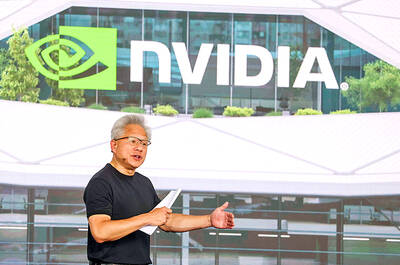
‘BOOMING’: ’ The number of partners we have here is incredible. You can see from their stock prices. They’re doing so well, they’re so happy,’ Jensen Huang said Nvidia Corp’s spending in Taiwan has ballooned to about US$150 billion a year, 10 times the US$10 billion to US$15 billion the company spent five years ago, Nvidia chief executive officer Jensen Huang (黃仁勳) said yesterday, suggesting Taiwan’s strategic importance in the global artificial intelligence (AI) supply chain. “Taiwan is the epicenter of the AI revolution. This is where the chips come, packaging comes. This is where the systems are made. This is where AI supercomputers were created,” Huang said at a meeting for the company’s employees in Beitou-Shilin Technology Park (北投士林科技園區) in Taipei, the planned site of Nvidia’s Taipei headquarters. “Taiwan
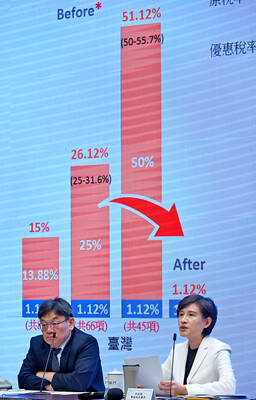
GREATER REACH? Auto parts and wood products would face tariffs of up to 15%, matching those targeting the EU, Japan and South Korea, Vice Premier said The US has announced that preferential tariff treatment for Taiwan’s non-semiconductor Section 232 goods would take effect retroactively from May 1, the Executive Yuan said yesterday. The US government yesterday posted a notice on the Federal Register’s public inspection Web site previewing tariff concessions for Taiwan under a memorandum of understanding (MOU) on Taiwan-US investment after two months of negotiations. The MOU signed on Jan. 15 stipulated three major preferential tariff arrangements: a 15 percent “reciprocal” tariff rate for Taiwan without stacking most-favored nation (MFN) rates; preferential Section 232 treatment for semiconductors and related products; and preferential Section 232 treatment for non-semiconductor


 RSS
RSS