


A consumer advocacy group has expressed outrage over Apple Inc's battery replacement program for the iPhone, while developers and hackers are trying to figure out ways they could expand the capabilities of the hot new gadget.
The hybrid cellphone, iPod media player and wireless Web-browsing device launched to much fanfare on June 29. On the same day, the Foundation for Consumer and Taxpayer Rights fired off a letter to Apple and AT&T Inc, the cellphone's exclusive carrier, complaining that customers were being left in the dark about the procedure and cost of replacing the gadget's battery.
The iPhone's battery is apparently soldered on inside the device and cannot be swapped out by the owner like most other cellphones.
Apple spokeswoman Jennifer Hakes said on Thursday the firm posted the battery replacement details on its Web site last Friday after the product went on sale.
Users would have to submit their iPhone to Apple for battery service. The service will cost users US$79, plus US$6.95 for shipping and will take three business days.
The procedure is similar to the one it has for the company's best-selling iPod players, but because some users will not want to live without their cellphones, Apple is also offering a loaner iPhone for US$29 while the gadget is under repair.
Harvey Rosenfield, founder of the Santa Monica, California-based consumer watchdog group that wrote the letter last week, contends the iPhone's battery and repair costs should have been clearly disclosed earlier. The company outlined its cellular service rates and many other features of the iPhone in advance of its launch, which drew snaking lines around stores across the country.
"Some of them might be waking up now," Rosenfield said, "wondering who they got in bed with."
Apple did not have an immediate comment on the consumer group's concerns.
Rosenfield said he did not detect the battery information, which is located under several layers of links on Apple's support page on its Web site, until earlier this week. Technology blogs also started reporting their discoveries of it this week while one of the questions Wall Street Journal tech columnist Walt Mossberg fielded on Thursday from his readers was about what happens when the iPhone battery dies.
"The cellphone industry is notorious for not being consumer-friendly while Apple has a fairly good reputation, so for Apple to stand on a technicality of a hidden disclosure that's going to cost the user as much as 20 percent of the purchase price I think will prove to be a colossal mistake," Rosenfield said.
The iPhone costs US$499 or US$599, depending on the model, and requires a minimum two-year US$60-a-month service plan with AT&T.
Meanwhile, software developers anxious to find ways they could introduce applications tailored for the iPhone's Web browser were preparing to get together in Silicon Valley this weekend at an ad hoc conference called iPhoneDevCamp.
Also, a tech-savvy audience cheered the latest work this week of a hacker known for cracking copy-protection technology and creating workarounds of Apple products. Jon Lech Johansen, also known as "DVD Jon," posted on his blog on Tuesday a method for people to turn on the iPod and WiFi features -- but not the cellphone functions -- of the iPhone without going through the required activation process and service fees of AT&T.

‘NO SECURITY RISK’: The Railway Bureau reassured the public that the technicians’ activities were limited to technical guidance and did not involve sensitive systems The Railway Bureau yesterday said it had invited eight Chinese technicians to assist with an airport MRT construction project. The bureau issued the confirmation after an Internet user said Chinese nationals had entered the construction zone of Taiwan Taoyuan International Airport’s Terminal 3 project. They asked why “individuals from an enemy state” were allowed access to such a major national infrastructure project, which raised serious concerns over Taiwan’s industrial safety, sensitive systems and information security. The bureau’s Northern Region Engineering Branch Office said subcontractor Taiwan Handle Industrial Co (台灣手把工業) of the Taoyuan airport MRT’s “Contract No. CU05 Project A14 Station Civil, MEP &

A US uncrewed surface vessel (USV) encountered multiple Chinese warships during an autonomous transit of the Taiwan Strait, US defense company Seasats said in a statement on Wednesday. Seasats announced that a Lightfish USV had completed the first autonomous transit of the Taiwan Strait. Over five days, the USV traversed the entire length of the Strait while constantly monitoring surface vessel traffic, the company said. The Lightfish encountered multiple Chinese warships, one of which was a Chinese People’s Liberation Army Navy (PLAN) Type 056 corvette, it said. The Chinese vessels were operating “well within Taiwan’s exclusive economic zone without transmitting their identity via the

Taiwan is still in the process of assessing the possibility of recruiting workers from Eswatini, the Ministry of Foreign Affairs said yesterday, adding that its goal is to help Eswatini upgrade its vocational training centers. If there are plans to recruit workers from Eswatini, safeguarding national security, protecting public health and ensuring the employment rights of Taiwanese would be prerequisites, Department of West Asian and African Affairs Director-General Yen Chia-liang (顏嘉良) told a news conference. Key considerations would also include filling labor shortages in specific industries, and fostering bilateral professional and technical exchanges, he said. Yen was asked about the progress of labor
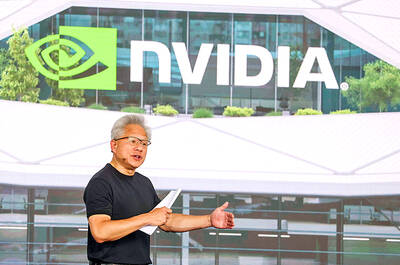
‘BOOMING’: ’ The number of partners we have here is incredible. You can see from their stock prices. They’re doing so well, they’re so happy,’ Jensen Huang said Nvidia Corp’s spending in Taiwan has ballooned to about US$150 billion a year, 10 times the US$10 billion to US$15 billion the company spent five years ago, Nvidia chief executive officer Jensen Huang (黃仁勳) said yesterday, suggesting Taiwan’s strategic importance in the global artificial intelligence (AI) supply chain. “Taiwan is the epicenter of the AI revolution. This is where the chips come, packaging comes. This is where the systems are made. This is where AI supercomputers were created,” Huang said at a meeting for the company’s employees in Beitou-Shilin Technology Park (北投士林科技園區) in Taipei, the planned site of Nvidia’s Taipei headquarters. “Taiwan


 RSS
RSS