


One year after accepting a government challenge to work toward eliminating the use of a potentially dangerous chemical used to make Teflon and other products, the DuPont Co said on Monday it plans to stop using the chemical by 2015.
The Environmental Protection Agency (EPA) asked the Wilmington, Delaware-based chemical giant and seven other companies last year to commit to a 95 percent reduction in environmental emissions and product content levels of perfluorooctanoic acid (PFOA) and associated chemicals by 2010.
The companies also were asked to work toward the elimination of PFOA and associated chemicals from emissions and products by 2015.
On Monday, DuPont said technological advances have allowed it to remove more than 97 percent of trace levels of PFOA and associated chemicals from surface protection fluorotelomers used in products such as oil-resistant paper packaging and stain and water-repellent textiles.
DuPont also has been able to reduce PFOA content by at least 97 percent in fluoropolymer coatings that are used in Teflon cookware, architectural coatings and electronics applications.
"We have been working for a long time, but particularly over the last year, on alternative technologies to PFOA," said David Boothe, business manager for DuPont fluoroproducts. "We believe that work is going to allow us to eliminate the need to make, buy, or use PFOA by 2015 ... That's firmer language than `work toward.'"
Boothe said DuPont also has reduced manufacturing emissions of PFOA by 94 percent worldwide since 2000, and expects to achieve reductions of 97 percent by the end of this year.
"We are encouraged and pleased that our progress to date has been so promising," said DuPont chairman and chief executive officer Charles Holliday Jr. "As a result, we will intensify our efforts by doubling our R&D investment."
Jane Houlihan, a researcher with the Environmental Working Group, described DuPont's announcement as "very encouraging."
"I hope other companies are following suit," she said, adding that her group, which helped bring PFOA under public scrutiny, has questions about whether DuPont products might still contain trace amounts of PFOA or chemicals that might degrade to PFOA.
"We think there are some big remaining gaps in the science," she said.
While studies continue, DuPont maintains that there are no human health effects known to be caused by PFOA, and that Teflon-coated cookware is safe.
PFOA is a processing aid used in making fluoropolymers, which have a wide variety of product applications, including nonstick cookware. The chemical also can be an unintended byproduct in the manufacturing of fluorotelomers used in surface protection products.
An EPA science advisory board last year concluded that PFOA should be classified as a likely carcinogen.
Jim Gulliford, assistant administrator for the EPA's Office of Prevention, Pesticides and Toxic Substances, praised DuPont for supporting the agency's effort to work toward eliminating emissions and product content levels of PFOA and related chemicals.
DuPont is one of the largest users of PFOA and the only company that manufactures it in the US.
In 2005, the company agreed to pay more than US$107 million to settle a class-action lawsuit filed by Ohio and West Virginia residents living near a DuPont plant in Parkersburg, West Virginia, who claimed that DuPont intentionally withheld and misrepresented information about the human health threat posed by PFOA.
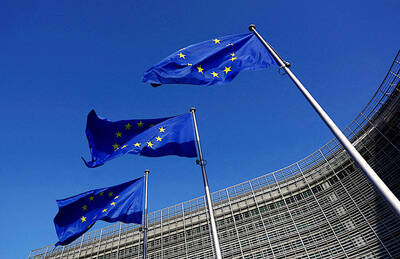
LEVERAGE: China did not ‘need to fire a shot’ to deny Taiwan airspace over Africa when it owns ‘half the continent’s debt,’ a US official said, calling it economic warfare The EU has raised concerns about overflight rights following the delay of President William Lai’s (賴清德) planned state visit to the Kingdom of Eswatini after three African nations denied overflight clearance for his charter at the last minute. Taiwanese allies Paraguay and Saint Kitts and Nevis, as well as several US lawmakers and the Inter-Parliamentary Alliance on China (IPAC) condemned China for allegedly pressuring the countries. Lai was scheduled to fly directly to Taiwan’s only African ally from yesterday to Sunday to celebrate the 40th anniversary of King Mswati III’s accession and his 58th birthday, but Seychelles, Mauritius and Madagascar suddenly revoked
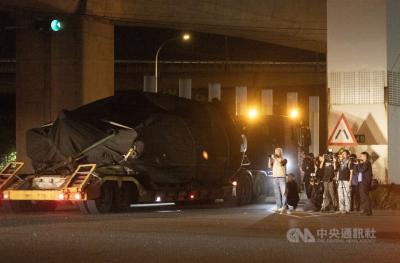
The final batch of 28 M1A2T Abrams tanks purchased from the US arrived at Taipei Port last night and were transported to the Armor Training Command in Hsinchu County’s Hukou Township (湖口), completing the military’s multi-year procurement of 108 of the tanks. Starting at 12:10am today, reporters observed more than a dozen civilian flatbed trailers departing from Taipei Port, each carrying an M1A2T tank covered with black waterproof tarps. Escorted by military vehicles, the convoy traveled via the West Coast Expressway to the Armor Training Command, with police implementing traffic control. The army operates about 1,000 tanks, including CM-11 Brave Tiger
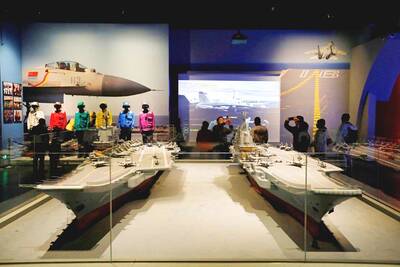
China on Wednesday teased in a video an aircraft carrier that could be its fourth, and the first using nuclear power, while making an allusion to Taiwan and vowing to further build up its islands, as it looks to boost maritime power, secure resources and bolster territorial claims. The video, issued on the eve of the 77th founding anniversary of the Chinese People’s Liberation Army Navy, featured fictional officers with names that are homophones of three commissioned aircraft carriers, the Liaoning (遼寧), Shandong (山東) and Fujian (福建). Titled Into the Deep, it showed a 19-year-old named “Hejian” (何劍) joining the group, sparking

PROVOCATIVE: Chinese Deputy Ambassador to the UN Sun Lei accused Japan of sending military vessels to deliberately provoke tensions in the Taiwan Strait China denounced remarks by Japan and the EU about the South China Sea at a UN Security Council meeting on Monday, and accused Tokyo of provocative behavior in the Taiwan Strait and planning military expansion. Ayano Kunimitsu, a Japanese vice foreign minister, told the Council meeting on maritime security that Tokyo was seriously concerned about the situation in the East China and South China seas, and reiterated Japan’s opposition to any attempt to change the “status quo” by force, and obstruction of freedom of navigation and overflight. Stavros Lambrinidis, head of the EU delegation to the UN, also highlighted South China Sea


 RSS
RSS