


An Airbus A380 landed in Japan yesterday, as part of a final series of test flights intended to lead to the superjumbo's air-worthiness certification by the end of the year.
The plane, which is on an Asian tour and flew from Hong Kong, arrived safely in Narita International Airport near Tokyo, airport spokesman Masaharu Watanabe said.
The final four flights in the test schedule, ending Nov. 30, are designed to put the 555-seater A380 through 150 hours of flights under the kind of operating conditions it will experience with airlines. Yesterday's arrival is part of the second of the four trips.
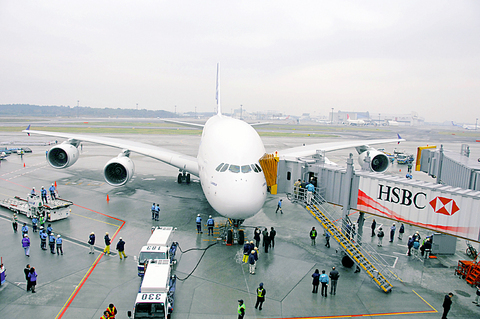
PHOTO: AFP
During its Narita stopover, aviation officials will make sure the huge aircraft can fit the facility and equipment at the airport, while going through a series of routine work such as maintenance, fueling and attaching a boarding bridge, Watanabe said.
"It's the first time for Narita to accommodate such a big plane," Watanabe said. "We have to make sure if the plane fits the facility."
The airport's observation balcony was crowded with many Japanese aviation enthusiasts who were taking pictures of the A380, he said.
"I'm hoping to go down to the spot later and take a look," he said.
The superjumbo will return to France on Monday, before taking off again for Chinese airports in Beijing, Shanghai and Guangdong next week, Airbus said in a statement. It will then fly to South Africa, Australia and Canada in the coming weeks.
The company has said the A380 is on track for certification by the middle of next month.
Airbus has received orders for 166 superjumbo jets. Singapore Airlines will be the first carrier to fly the superjumbo after it receives its first plane next October.
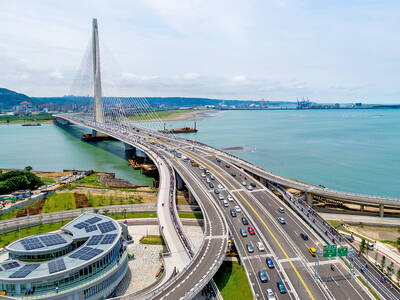
The Ministry of Transportation and Communications yesterday inaugurated the Danjiang Bridge across the Tamsui River in New Taipei City, saying that the structure would be an architectural icon and traffic artery for Taiwan. Feted as a major engineering achievement, the Danjiang Bridge is 920m long, 211m tall at the top of its pylon, and is the longest single-pylon asymmetric cable-stayed bridge in the world, the government’s Web site for the structure said. It was designed by late Iraqi-British architect Zaha Hadid. The structure, with a maximum deck of 70m, accommodates road and light rail traffic, and affords a 200m navigation channel for boats,
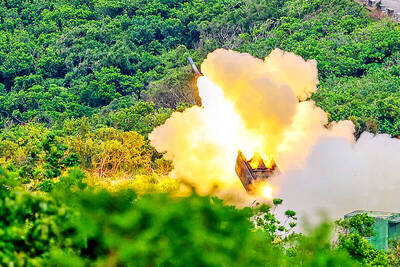
PRECISION STRIKES: The most significant reason to deploy HIMARS to outlying islands is to establish a ‘dead zone’ that the PLA would not dare enter, a source said A High Mobility Artillery Rocket System (HIMARS) would be deployed to Penghu County and Dongyin Island (東引) in Lienchiang County (Matsu) to force the Chinese military to retreat at least 100km from the coastline, a military source said yesterday. Taiwan has been procuring HIMARS and Army Tactical Missile Systems (ATACMS) from the US in batches. Once all batches have been delivered, Taiwan would possess 111 HIMARS units and 504 ATACMS, which have a range of 300km. Considering that “offense is the best defense,” the military plans to forward-deploy the systems to outlying islands such as Penghu and Dongyin so that

‘CLEAR MESSAGE’: The bill would set up an interagency ‘tiger team’ to review sanctions tools and other economic options to help deter any Chinese aggression toward Taiwan US Representative Young Kim has introduced a bill to deter Chinese aggression against Taiwan, calling for an interagency “tiger team” to preplan coordinated sanctions and economic measures in response to possible Chinese military or political action against Taiwan. “[Chinese President] Xi Jinping [習近平] has directed the People’s Liberation Army to be ready to invade Taiwan by 2027. China has a plan. America should have one too,” Kim said in a news release on Thursday last week. She introduced the “Deter PRC [People’s Republic of China] aggression against Taiwan act” to “ensure the US has a coordinated sanctions strategy ready should

TAIWAN ISSUE: US treasury secretary Scott Bessent said on the first day of meetings that ‘it wouldn’t be a US-China summit without the Taiwan issue coming up’ There were no surprises on the first day of the summit between US President Donald Trump and Chinese President Xi Jinping (習近平), the Mainland Affairs Council (MAC) said yesterday, as the government reiterated that cross-strait stability is crucial to the Asia-Pacific region, as well as the world. As the two presidents met for a highly anticipated summit yesterday, Chinese state media reported that Xi warned Trump that missteps regarding Taiwan could push their two countries into “conflict.” Trump arrived in China with accolades for his host, calling Xi a “great leader” and “friend,” and extending an invitation to visit the White House


 RSS
RSS