


Unexpected demand for shares in Australia's giant telecommunications company Telstra nearly doubled the value of an expanded government float to A$15.5 billion (US$11.9 billion), final figures showed yesterday.
Finance Minister Nick Minchin announced that retail investors would pay a total of A$3.60 a share and institutional investors A$3.70 for 4.25 billion shares -- up from the 2.15 billion shares originally on offer.
"The level of interest from investors, both retail and institutional, was much higher than expected, making T3 the second biggest share offering in Australian history," Minchin said.
The partial float of the government's remaining 51.8 percent stake in the troubled telco is known as T3 because it is the third tranche offered after T1 in 1997 and T2 in 1999, which brought in A$16 billion.
Despite having to ditch plans to offer the entire government stake because of a plunging share price, the latest sale finally realizes Prime Minister John Howard's desire to end government ownership of the company.
The float got off to a rocky start against the background of a public row between the government and Telstra's US chief executive Sol Trujillo, who complained of restrictive regulations and interference in the running of the company.
The offer was also expected to meet resistance from the "mum and dad" investors who lost heavily after paying A$7.40 a share in the T2 sale and watching the price plunge by more than half.
But they were offered a range of sweeteners including a discount and a projected 14 percent yield to next June, and snapped up the lion's share of the stock on offer.
Minchin said 95 percent of the retail applications would be satisfied, with small investors taking 60 percent of the shares, domestic institutions 28 percent and international institutions 12 percent.
"In order to satisfy the much higher than expected entitlement demand from existing shareholders, the base offer size has been increased, in accordance with the prospectus, to 3.69 billion shares," Minchin said.
"In addition, as set out in the prospectus, a further 554 million shares were made available to satisfy other demand in the institutional offer, bringing the total institutional offer size to 1.7 billion shares," he said.
Minchin said the remainder of the government's stake, 17 percent, would be placed in the Future Fund, established to cover public service pension payments, where it will be held for at least two years.
The final investment price of A$3.60 for retail investors was determined after an institutional bookbuild which priced a second instalment for the shares at A$1.60 each.
The securities will begin trading as instalment receipts on the Australian Stock Exchange today.
Telstra shares closed at A$3.75 on the Australian Stock Exchange on Friday.
Terry Campbell, chairman of Goldman Sachs JBWere, one of three investment banks that managed the T3 sale, said he expects Telstra shares to trade at a slight discount today.
And Argo Investments managing director Rob Patterson said that demand for Telstra shares might be close to exhausted by the expanded float.
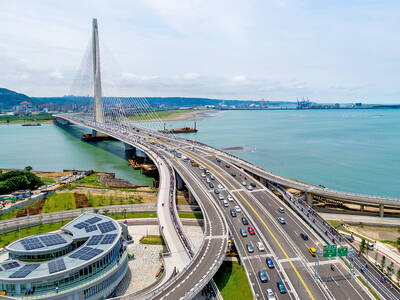
The Ministry of Transportation and Communications yesterday inaugurated the Danjiang Bridge across the Tamsui River in New Taipei City, saying that the structure would be an architectural icon and traffic artery for Taiwan. Feted as a major engineering achievement, the Danjiang Bridge is 920m long, 211m tall at the top of its pylon, and is the longest single-pylon asymmetric cable-stayed bridge in the world, the government’s Web site for the structure said. It was designed by late Iraqi-British architect Zaha Hadid. The structure, with a maximum deck of 70m, accommodates road and light rail traffic, and affords a 200m navigation channel for boats,
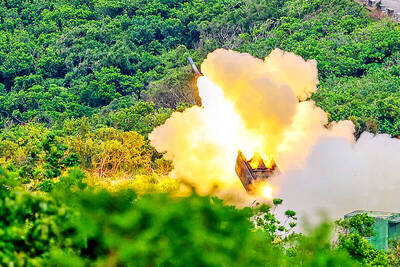
PRECISION STRIKES: The most significant reason to deploy HIMARS to outlying islands is to establish a ‘dead zone’ that the PLA would not dare enter, a source said A High Mobility Artillery Rocket System (HIMARS) would be deployed to Penghu County and Dongyin Island (東引) in Lienchiang County (Matsu) to force the Chinese military to retreat at least 100km from the coastline, a military source said yesterday. Taiwan has been procuring HIMARS and Army Tactical Missile Systems (ATACMS) from the US in batches. Once all batches have been delivered, Taiwan would possess 111 HIMARS units and 504 ATACMS, which have a range of 300km. Considering that “offense is the best defense,” the military plans to forward-deploy the systems to outlying islands such as Penghu and Dongyin so that
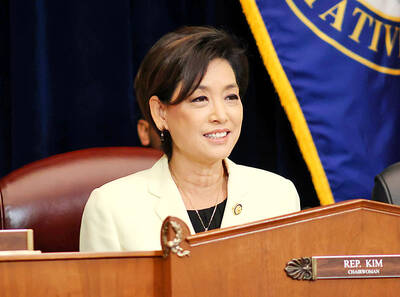
‘CLEAR MESSAGE’: The bill would set up an interagency ‘tiger team’ to review sanctions tools and other economic options to help deter any Chinese aggression toward Taiwan US Representative Young Kim has introduced a bill to deter Chinese aggression against Taiwan, calling for an interagency “tiger team” to preplan coordinated sanctions and economic measures in response to possible Chinese military or political action against Taiwan. “[Chinese President] Xi Jinping [習近平] has directed the People’s Liberation Army to be ready to invade Taiwan by 2027. China has a plan. America should have one too,” Kim said in a news release on Thursday last week. She introduced the “Deter PRC [People’s Republic of China] aggression against Taiwan act” to “ensure the US has a coordinated sanctions strategy ready should

TAIWAN ISSUE: US treasury secretary Scott Bessent said on the first day of meetings that ‘it wouldn’t be a US-China summit without the Taiwan issue coming up’ There were no surprises on the first day of the summit between US President Donald Trump and Chinese President Xi Jinping (習近平), the Mainland Affairs Council (MAC) said yesterday, as the government reiterated that cross-strait stability is crucial to the Asia-Pacific region, as well as the world. As the two presidents met for a highly anticipated summit yesterday, Chinese state media reported that Xi warned Trump that missteps regarding Taiwan could push their two countries into “conflict.” Trump arrived in China with accolades for his host, calling Xi a “great leader” and “friend,” and extending an invitation to visit the White House


 RSS
RSS