


More than a thousand fans lined up in Times Square for yesterday's launch of Nintendo's entry into the holiday season's field of competing video game consoles, the cheap but innovative Wii.
Despite the throngs, the midnight launch event went smoothly. That contrasted with the launch of Sony Corp's PlayStation 3 console just two days earlier, which forced police to disperse crowds at some stores around the country.
The first buyer, Isaiah Triforce Johnson, had been waiting in line outside the store for more than a week. He wore a Nintendo Power Glove, a wearable controller that came out in 1989, while shaking hands with Nintendo of America president Reggie Fils-Aime after buying the first Wii.
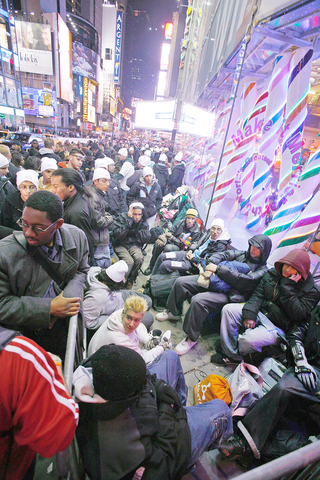
PHOTO: AP
Johnson said he had legally changed his middle name to a reference in Nintendo's Zelda series of games.
Launching right after the much-vaunted and technically sophisticated PlayStation 3 is a brave move for Nintendo, which is playing catch-up after losing dominance of the home console market to Sony in the mid-1990s.
The Wii itself is a daring design. It eschews the high-definition graphics that are the main selling points of the PlayStation 3 and Microsoft Corp's Xbox 360, which came out a year ago. Instead, Nintendo hopes to attract a new generation of fans by changing the way games are played.
The console includes a motion-sensitive controller that acts as a tennis racket, baseball bat, steering wheel, gun or sword depending on the game.
Fils-Aime said the company made "some very tough choices" in designing the Wii.
"Tough choices about not including a DVD player at the start, tough choices about not including high-definition capability at the start. That's because we wanted a mass-market price, and we believe the market will validate those decisions come launch day on this Sunday [today]," he said.
The Wii costs US$250 and includes one game. The two Play-Station 3 models cost US$500 and US$600, with no game included. The two Xbox 360 models cost US$300 and US$400, with no game.
Online, the prices are steeper: PlayStation 3s were selling for around US$2,500 on eBay on Saturday, while Wiis (listed by sellers who had pre-ordered from retailers and expected to get the units yesterday) were listed at around US$500.
Sony had about 400,000 Play-Station 3s in North American stores on Friday. Nintendo has said it would have "five to 10" times as many Wiis available at launch, and will have shipped 4 million units by the end of the year. It still expects consoles to sell out in stores.
The relative abundance of units, and a smaller fan base, were expected to make yesterday a calmer shopping day than on Friday. On Saturday evening, people were lining up at stores more to show their devotion to Nintendo and celebrate the occasion than because they were afraid of not getting a Wii.
At the Nintendo World store in Rockefeller Center, 86 people were lined up for the morning opening. Anthony Eaton, dressed in green as the character Link from the Zelda series, looked chagrined when passing girls called him "Peter Pan."
Eaton, 18, didn't really need to be in line, since his friend had pre-ordered a Wii for him that would be available for pickup the next day.

‘NO SECURITY RISK’: The Railway Bureau reassured the public that the technicians’ activities were limited to technical guidance and did not involve sensitive systems The Railway Bureau yesterday said it had invited eight Chinese technicians to assist with an airport MRT construction project. The bureau issued the confirmation after an Internet user said Chinese nationals had entered the construction zone of Taiwan Taoyuan International Airport’s Terminal 3 project. They asked why “individuals from an enemy state” were allowed access to such a major national infrastructure project, which raised serious concerns over Taiwan’s industrial safety, sensitive systems and information security. The bureau’s Northern Region Engineering Branch Office said subcontractor Taiwan Handle Industrial Co (台灣手把工業) of the Taoyuan airport MRT’s “Contract No. CU05 Project A14 Station Civil, MEP &

The National Chungshan Institute of Science and Technology yesterday showcased its locally developed variants of the Vision 60 robotic patrol dog, which it plans to deploy on the nation’s outlying territories in the South China Sea. The variants were produced under the Joint Lab project — created by the institute and domestic companies — and assembled with domestically produced motors, lenses and artificial intelligence (AI) systems alongside licensed tech from the US, Missile and Rocket Systems Research Division deputy director Jen Kuo-kang (任國光) told the media event at a military base in Taipei’s Dazhi (大直) area. Taiwan has built up its strengths
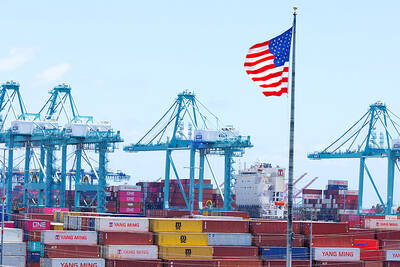
NOT IMMEDIATE: Taiwan has a chance to appeal the proposed 10 percent tariff before it starts, while other countries face a 12.5 percent tariff from the trade office Taiwan is among 60 economies determined by the US to have failed to impose or enforce a ban on the importation of goods produced with forced labor, according to a notice released on Tuesday by the Office of the US Trade Representative (USTR), which proposed imposing an additional 10 percent or more tariff on them. The USTR in a statement said that following an investigation, it had determined under Section 301 of the Trade Act of 1974 that the failure of the 60 economies to impose and effectively enforce a prohibition on the importation of goods produced with forced labor is
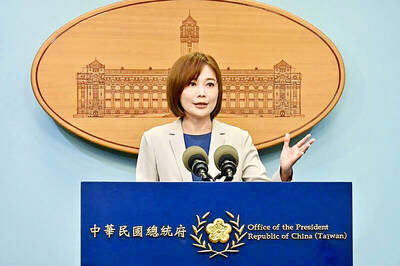
TIT-FOR-TAT: The US allegedly revoked the visa of a Chinese national working at Xinhua News Agency in the US in response to Beijing’s expulsion of Vivian Wang The Presidential Office yesterday condemned China for expelling a New York Times correspondent from Beijing following the newspaper’s interview with President William Lai (賴清德), saying the move highlighted Beijing’s suppression of press freedom and its threat to international news media. Taiwan has noted a series of recent incidents in which Beijing used similar tactics to “threaten and pressure international media outlets and journalists,” Presidential Office spokeswoman Karen Kuo (郭雅慧) said in a statement. “This concerns not only press freedom and freedom of expression, but also the safety of journalists, and Taiwan and relevant partners are paying close attention to the situation,” she


 RSS
RSS