


Oil traded near its lowest price this year amid rising US fuel inventories and speculation that OPEC, which pumps 40 percent of the world's crude, won't effectively reduce supplies to prop up prices.
"From OPEC's point of view it would be desirable to cut production by 1 million barrels a day," said Klaus Breil, a fund manager at Cominvest Asset Management in Frankfurt.
"At the moment it looks like only 700,000 barrels can be reached," Breil said.
Crude oil for November delivery fell US$0.11 to US$57.48 a barrel in after-hours electronic trading on the New York Mercantile Exchange at 10:04am in London. Brent crude oil fell US$0.21 to US$58.44 a barrel on the ICE Futures exchange in London.
Oil has fallen about 27 percent from a record US$78.40 a barrel on July 14. The plunge prompted OPEC to consider reducing production. Several OPEC members have announced voluntary cuts, but conflicting statements have caused skepticism over whether the reductions will take hold.
Analysts were split on whether US stockpiles of distillate fuel, a category that includes heating oil and diesel, rose or fell last week. Supplies probably declined 125,000 barrels from 151.5 million the prior week, according to analysts.
Oil rose earlier on higher demand from China, which raised purchases of crude 24 percent last month from a year earlier on demand from farmers. China's imports climbed to 12.2 million tonnes or about 3.29 million barrels a day, the Beijing-based Customs General Administration of China said yesterday.
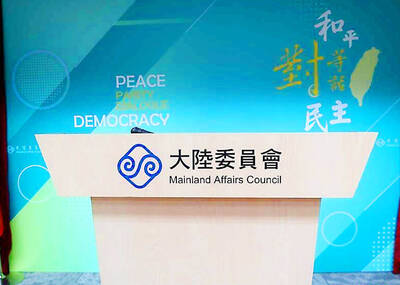
NO RECIPROCITY: Taipei has called for cross-strait group travel to resume fully, but Beijing is only allowing people from its Fujian Province to travel to Matsu, the MAC said The Mainland Affairs Council (MAC) yesterday criticized an announcement by the Chinese Ministry of Culture and Tourism that it would lift a travel ban to Taiwan only for residents of China’s Fujian Province, saying that the policy does not meet the principles of reciprocity and openness. Chinese Deputy Minister of Culture and Tourism Rao Quan (饒權) yesterday morning told a delegation of Chinese Nationalist Party (KMT) lawmakers in a meeting in Beijing that the ministry would first allow Fujian residents to visit Lienchiang County (Matsu), adding that they would be able to travel to Taiwan proper directly once express ferry

FAST RELEASE: The council lauded the developer for completing model testing in only four days and releasing a commercial version for use by academia and industry The National Science and Technology Council (NSTC) yesterday released the latest artificial intelligence (AI) language model in traditional Chinese embedded with Taiwanese cultural values. The council launched the Trustworthy AI Dialogue Engine (TAIDE) program in April last year to develop and train traditional Chinese-language models based on LLaMA, the open-source AI language model released by Meta. The program aims to tackle the information bias that is often present in international large-scale language models and take Taiwanese culture and values into consideration, it said. Llama 3-TAIDE-LX-8B-Chat-Alpha1, released yesterday, is the latest large language model in traditional Chinese. It was trained based on Meta’s Llama-3-8B

STUMPED: KMT and TPP lawmakers approved a resolution to suspend the rate hike, which the government said was unavoidable in view of rising global energy costs The Ministry of Economic Affairs yesterday said it has a mandate to raise electricity prices as planned after the legislature passed a non-binding resolution along partisan lines to freeze rates. Chinese Nationalist Party (KMT) lawmakers proposed the resolution to suspend the price hike, which passed by a 59-50 vote. The Taiwan People’s Party (TPP) voted with the KMT. Legislative Speaker Han Kuo-yu (韓國瑜) of the KMT said the resolution is a mandate for the “immediate suspension of electricity price hikes” and for the Executive Yuan to review its energy policy and propose supplementary measures. A government-organized electricity price evaluation board in March

NOVEL METHODS: The PLA has adopted new approaches and recently conducted three combat readiness drills at night which included aircraft and ships, an official said Taiwan is monitoring China’s People’s Liberation Army (PLA) exercises for changes in their size or pattern as the nation prepares for president-elect William Lai’s (賴清德) inauguration on May 20, National Security Bureau (NSB) Director-General Tsai Ming-yen (蔡明彥) said yesterday. Tsai made the comment at a meeting of the Legislative Yuan’s Foreign Affairs and National Defense Committee, in response to Democratic Progressive Party (DPP) Legislator Wang Ting-yu’s (王定宇) questions. China continues to employ a carrot-and-stick approach, in which it applies pressure with “gray zone” tactics, while attempting to entice Taiwanese with perks, Tsai said. These actions aim to help Beijing look like it has


 RSS
RSS