


China's wealthiest person prospered by turning recycled paper from the US into Chinese packaging products -- and like many fellow tycoons, by listing her company on an overseas stock market.
Zhang Yin (
Zhang's company listed shares on the Hong Kong Stock Exchange in March, becoming one of scores of mainland-based companies enriched by international investors' fervor for Chinese assets. The company recently saw its share price surge after reporting that its fiscal 2006 net profit more than quadrupled to 1.375 billion yuan (US$174 million).
Lists of China's richest people tend to reflect shifting economic trends.
Dot-com magnates of years past have yielded rank to real estate tycoons and electronics retailers, who in turn are ceding ground to newcomers like Zhang and fifth-ranked Shi Zhengrong (
No. 2 is Huang Guangyu (黃光裕), also known as Wong Kwong Yu, who founded GoMe Appliances (國美電器), China's biggest electronics retailer. Huang, who was ranked first last year, now has personal wealth estimated at US$2.5 billion, according to the list.
Along with his brother, property developer Huang Junqing's US$800 million fortune, the Huangs hold wealth estimated at US$3.3 billion.
"Urbanization and ever-increasing household incomes have continued to be the key drivers for wealth creation in China," said Hoogewerf, who has been compiling lists of China's wealthy since 1999.
Paper tycoon Zhang, the eldest of eight children born to a military family in northeastern China, emigrated to Hong Kong as a young adult and built up her business shipping waste paper from the US to China, where it is recycled into containerboard at factories in southern and eastern China.
As is true elsewhere, real estate is key to many personal fortunes: seven of the top 10 richest Chinese are at least in part property developers. Likewise, seven of the top 10 have companies with shares traded in Hong Kong.
Among the other top women tycoons is Chen Ningning (
The ranks of China's wealthiest have expanded, with 15 people having fortunes exceeding US$1 billion, up from seven last year, Hoogewerf said.
The average size of the wealth held by each individual also rose, by 48 percent over a year earlier to US$276 million.
The growing divide between rich and poor is a politically volatile issue in China, despite the Communist Party's wholesale shift away from central planning toward a more capitalist-style economy.
Helping the vast majority of have-nots was to top the agenda at closed-door meetings held in Beijing this week.
Though most of China's newly affluent are little affected by such high-level politicking, fortunes are sometimes made and lost quickly amid power plays by top leaders, Hoogewerf said.
One of the tycoons absent from this year's list was Zhang Rongkun (
Zhang, owner of Fuxi Investments, ranked 48th on last year's list.
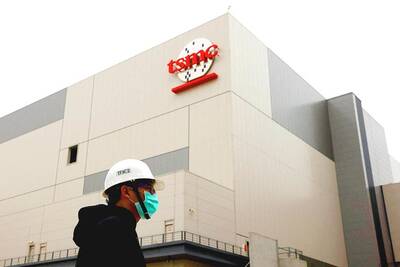
Taiwan Semiconductor Manufacturing Co (TSMC, 台積電) on Wednesday said that a new chip manufacturing technology called “A16” is to enter production in the second half of 2026, setting up a showdown with longtime rival Intel over who can make the fastest chips. TSMC, the world’s biggest contract manufacturer of advanced computing chips and a key supplier to Nvidia and Apple, announced the news at a conference in Santa Clara, California, where TSMC executives said that makers of artificial intelligence (AI) chips will likely be the first adopters of the technology rather than a smartphone maker. Analysts said that the technologies announced on
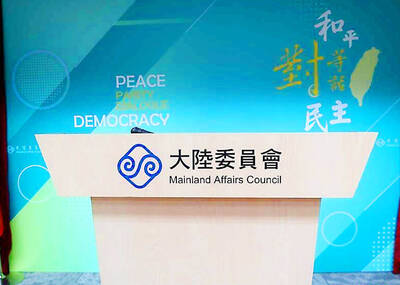
NO RECIPROCITY: Taipei has called for cross-strait group travel to resume fully, but Beijing is only allowing people from its Fujian Province to travel to Matsu, the MAC said The Mainland Affairs Council (MAC) yesterday criticized an announcement by the Chinese Ministry of Culture and Tourism that it would lift a travel ban to Taiwan only for residents of China’s Fujian Province, saying that the policy does not meet the principles of reciprocity and openness. Chinese Deputy Minister of Culture and Tourism Rao Quan (饒權) yesterday morning told a delegation of Chinese Nationalist Party (KMT) lawmakers in a meeting in Beijing that the ministry would first allow Fujian residents to visit Lienchiang County (Matsu), adding that they would be able to travel to Taiwan proper directly once express ferry

CALL FOR DIALOGUE: The president-elect urged Beijing to engage with Taiwan’s ‘democratically elected and legitimate government’ to promote peace President-elect William Lai (賴清德) yesterday named the new heads of security and cross-strait affairs to take office after his inauguration on May 20, including National Security Council (NSC) Secretary-General Wellington Koo (顧立雄) to be the new defense minister and former Taichung mayor Lin Chia-lung (林佳龍) as minister of foreign affairs. While Koo is to head the Ministry of National Defense and presidential aide Lin is to take over as minister of foreign affairs, Tsai Ming-yen (蔡明彥) would be retained as the nation’s intelligence chief, continuing to serve as director-general of the National Security Bureau, Lai told a news conference in Taipei. Koo,
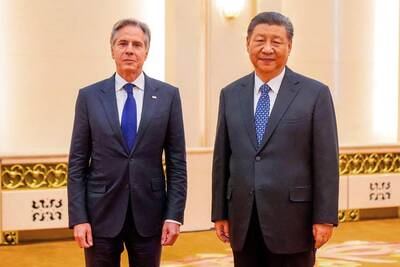
MANAGING DIFFERENCES: In a meeting days after the US president signed a massive foreign aid bill, Antony Blinken raised concerns with the Chinese president about Taiwan US Secretary of State Antony Blinken yesterday met with Chinese President Xi Jinping (習近平) and senior Chinese officials, stressing the importance of “responsibly managing” the differences between the US and China as the two sides butt heads over a number of contentious bilateral, regional and global issues, including Taiwan and the South China Sea. Talks between the two sides have increased over the past few months, even as differences have grown. Blinken said he raised concerns with Xi about Taiwan and the South China Sea, along with China’s support for Russia and its invasion of Ukraine, as well as other issues


 RSS
RSS