

The Paris Motor Show will roar into life next Saturday when international car makers converge on the French capital hoping to wow crowds with prototype models and woo critics with green technologies.
This year, the mix of exhibits is expected to underscore two key developments for the industry and the global economy, namely concern about global warming and the emergence of China as a world manufacturing force.
After being thrown on the defensive last week by a ground-breaking court case in California, the industry is ready to prove its environmental credentials by showcasing hybrid cars, biofuel technology and emission innovations.
California said last Wednesday it was suing six US and Japanese automakers for their alleged contribution to global warming, the first such legal fight in the US.
This year's Paris event show will be the first time Chinese manufacturers display their wares at the show in the French capital, underlining their ambition to compete with the leading sellers in Europe: Volkswagen of Germany, PSA Peugeot Citroen of France and Ford of the US.
The Chinese presence, which was established at the Frankfurt auto show last year, will be led by manufacturers Landwind and Great Wall Motor.
Over the course of the two-week show, which runs from next Saturday to Oct. 15, more than 65 new models are to be given their world premiere in front of the more than 1 million people who attend each year.
Alongside new green technology, manufacturers will also look to satisfy appetites for big, gas-guzzling sports utility vehicles (SUVs) and four-wheel-drives.
This has been one of the fastest growing segments of the car market in recent years, but a surge in gasoline prices has switched many consumers' attention to the importance of fuel efficiency.
This year's show also coincides with a period of talks between some of the biggest names in the industry, many of which are struggling with acute global competition and rising production costs.
Renault and Nissan are in talks with General Motors with a view to including the struggling US giant in their two-way alliance.
And Malaysia's loss-making national carmaker Proton said on Friday that the first round of talks on a possible pact with PSA Peugeot Citroen will begin this week.
The US trio of General Motors, Ford and Chrysler are all struggling to adapt to demand for more fuel efficient vehicles instead of trucks and SUVs.
Volkswagen is in the midst of a giant cost-cutting program, French manufacturers Renault and PSA are facing falling market share in Europe while Italian group Fiat is still recovering after years of losses.

FRIDAY, SATURDAY: While Typhoon Champi might weaken, officials warned about large waves, while some transport services and tourist spots have been affected Typhoon Champi is forecast to have the greatest effect on Taiwan tomorrow and on Saturday, with a sea warning issued late last night and a land warning expected afternoon today, the Central Weather Administration (CWA) said yesterday. The storm’s projected track has shifted slightly westward and it could begin moving away from Taiwan toward Japan’s Kyushu island on Saturday, with the warnings potentially lifted as early as Saturday afternoon, CWA forecaster Chang Cheng-chuan (張承傳) said. As of yesterday afternoon, Champi was about 910km east-southeast of Oluanpi (鵝鑾鼻), Taiwan proper’s southernmost point, CWA data showed. Its maximum sustained winds had weakened slightly to
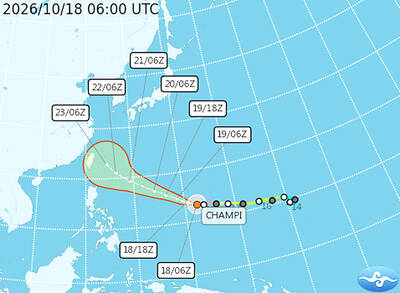
A sea warning for Typhoon Champi could be issued as early as Wednesday night, possibly followed by a land warning on Thursday night or Friday, as the storm approaches Taiwan, the Central Weather Administration (CWA) said yesterday. The typhoon is expected to have its greatest impact on Taiwan on Friday and Saturday, bringing heavy rain to central and northern Taiwan and to Yilan and Hualien counties in the east, CWA forecaster Liu Pei-teng (劉沛滕) said. As of 2pm yesterday, Champi was about 2,470km east-southeast of Oluanpi (鵝鑾鼻), Taiwan’s southernmost tip, moving westnorthwest at 20kph. It had maximum sustained winds of 191kph and a
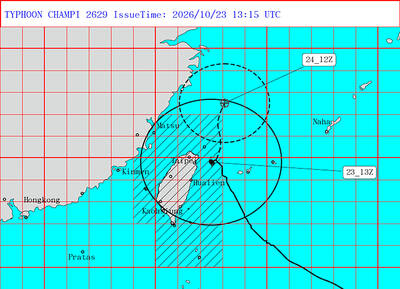
STAY CAUTIOUS: Rain is expected to begin easing this afternoon, but a CWA forecaster said that if the storm stalls or loops on its approach, heavy winds are likely Typhoon Champi, which caused widespread damage and injuries, and prompted road closures and evacuations across Taiwan yesterday, is expected to continue to bring heavy rain this morning, with up to 900mm of rain forecast for mountainous areas of New Taipei City, Taoyuan and Yilan County, the Central Weather Administration (CWA) said yesterday. At one point a super typhoon and one of the strongest storms in the Pacific this year, Champi was packing gusts of about 191kph near its center as of 8:30pm, the CWA said. Taipei, New Taipei City, Keelung, Taoyuan, Hsinchu city and county, Taichung; and Yilan, Miaoli, Changhua, Nantou, Yunlin

The Coast Guard Administration (CGA) yesterday urged China not to exploit typhoons to assert jurisdiction over the Taiwan Strait. The CGA issued the remarks after it found that China was shadowing eight Japan Coast Guard ships that sheltered in Taiwan proper’s western waters due to Typhoon Champi. Eight Japan Coast Guard (JCG) vessels sailed southward along the Taiwan Strait median line from 6am on Thursday, reaching waters southwest of Penghu County’s Cimei Island (七美島), outside Taiwan’s contiguous zone, which extends 24 nautical miles (44.4km) from the territorial sea baseline, it said. As the Japanese ships prepared for the typhoon, they were followed by


 RSS
RSS