


IMF chief Rodrigo de Rato yesterday welcomed the passage of reforms giving a bigger voice to four emerging economies, but warned that the members face daunting challenges in keeping global growth on track.
"The global growth cycle may be turning," de Rato said, pointing to high oil prices, massive imbalances in trade and investment and the threat of renewed protectionism amid stalled world trade talks.
Meanwhile, World Bank President Paul Wolfowitz chided wealth countries to follow through on promised aid to Africa, the one region he said has been "conspicuously left behind."

PHOTO: AP
"The international community is at risk of falling short on its commitments to increase aid to Africa," Wolfowitz told delegates attending the annual meeting of the World Bank, which lends money to help developing nations fight poverty, and its sister institution, the IMF.
"I remain convinced that Africa has to be our number one priority," he said, highlighting in particular the needs of countries that have recently emerged from crises, such as Sierra Leone, Liberia and the Democratic Republic of Congo.
De Rato and other finance leaders pressed for reviving the Doha Round of WTO talks that collapsed in July amid disagreements over how much to cut agricultural trade barriers.
"The stakes are too high to accept failure," de Rato said. "I call on the G7 countries and the major emerging market economies to intervene quickly to conserve the gains made in negotiations made so far, and to put the Doha Round back on track."
In the biggest news to come out of the annual meeting so far, the 184-nation IMF on Monday night approved reforms to increase the voting shares of China, South Korea, Turkey and Mexico.
As a second step of reform, the institution will overhaul the voting structure of all member nations.
The moves are meant to better reflect the growing economic influence of developing countries in the IMF, which was founded in 1945 to foster economic stability and provide emergency loans to members in financial crisis.
Voting shares affect member countries' say in the decisions of the Washington-based institution and how much they can borrow from it.
"These reforms are the first step in a process that will raise the level of representation of many emerging market countries," the IMF boss said. "They will enhance our effectiveness and add legitimacy to all the other reforms that we are implementing."
But Indian Finance Minister P. Chidambaram called the reform plan "hopelessly flawed." India and several other major developing economies like Argentina and Brazil wanted to see the voting shares of all members revised in one step.
The 23 countries that voted against the plan "lost the vote but have not lost the argument," Chidambaram said, adding "We hold the IMF to their promise."
The measure won 90.6 percent of the vote. It needed 85 percent to pass.
The weight of each nation's vote is tied to its quota, or financial commitments to the institution, which are determined by the sizes of their economies and currency reserves and openness to trade and capital flows.
The U.S. has a voting share of about 17 percent -- effective veto power -- while European nations together account for about a third of the total and Japan has 6.1 percent. Argentina has a voting share of 0.99 percent, while Palau has 0.01 percent.
Monday's decision raises China's voting share to 3.65 percent from 2.93, raising its rank from eighth to sixth. As a group, the four nations' voting share will grow to nearly 7 percent under the reforms from 5.3 percent.
De Rato warned about the growth of global imbalances and urged the US to act to curb its massive trade and fiscal deficits.
"The United States should take advantage of its good growth performance to make sustainable reductions in its structural fiscal deficit," he said.
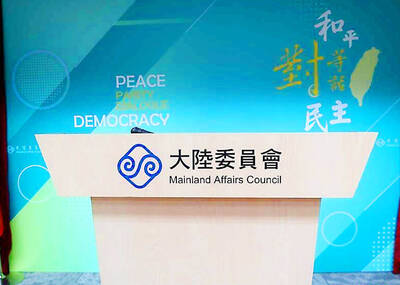
NO RECIPROCITY: Taipei has called for cross-strait group travel to resume fully, but Beijing is only allowing people from its Fujian Province to travel to Matsu, the MAC said The Mainland Affairs Council (MAC) yesterday criticized an announcement by the Chinese Ministry of Culture and Tourism that it would lift a travel ban to Taiwan only for residents of China’s Fujian Province, saying that the policy does not meet the principles of reciprocity and openness. Chinese Deputy Minister of Culture and Tourism Rao Quan (饒權) yesterday morning told a delegation of Chinese Nationalist Party (KMT) lawmakers in a meeting in Beijing that the ministry would first allow Fujian residents to visit Lienchiang County (Matsu), adding that they would be able to travel to Taiwan proper directly once express ferry

STUMPED: KMT and TPP lawmakers approved a resolution to suspend the rate hike, which the government said was unavoidable in view of rising global energy costs The Ministry of Economic Affairs yesterday said it has a mandate to raise electricity prices as planned after the legislature passed a non-binding resolution along partisan lines to freeze rates. Chinese Nationalist Party (KMT) lawmakers proposed the resolution to suspend the price hike, which passed by a 59-50 vote. The Taiwan People’s Party (TPP) voted with the KMT. Legislative Speaker Han Kuo-yu (韓國瑜) of the KMT said the resolution is a mandate for the “immediate suspension of electricity price hikes” and for the Executive Yuan to review its energy policy and propose supplementary measures. A government-organized electricity price evaluation board in March

FAST RELEASE: The council lauded the developer for completing model testing in only four days and releasing a commercial version for use by academia and industry The National Science and Technology Council (NSTC) yesterday released the latest artificial intelligence (AI) language model in traditional Chinese embedded with Taiwanese cultural values. The council launched the Trustworthy AI Dialogue Engine (TAIDE) program in April last year to develop and train traditional Chinese-language models based on LLaMA, the open-source AI language model released by Meta. The program aims to tackle the information bias that is often present in international large-scale language models and take Taiwanese culture and values into consideration, it said. Llama 3-TAIDE-LX-8B-Chat-Alpha1, released yesterday, is the latest large language model in traditional Chinese. It was trained based on Meta’s Llama-3-8B

NOVEL METHODS: The PLA has adopted new approaches and recently conducted three combat readiness drills at night which included aircraft and ships, an official said Taiwan is monitoring China’s People’s Liberation Army (PLA) exercises for changes in their size or pattern as the nation prepares for president-elect William Lai’s (賴清德) inauguration on May 20, National Security Bureau (NSB) Director-General Tsai Ming-yen (蔡明彥) said yesterday. Tsai made the comment at a meeting of the Legislative Yuan’s Foreign Affairs and National Defense Committee, in response to Democratic Progressive Party (DPP) Legislator Wang Ting-yu’s (王定宇) questions. China continues to employ a carrot-and-stick approach, in which it applies pressure with “gray zone” tactics, while attempting to entice Taiwanese with perks, Tsai said. These actions aim to help Beijing look like it has


 RSS
RSS