

■ Telecoms
Orascom may boost stake
Orascom Telecom Holding SAE, the Middle East's largest mobile-phone operator by subscriptions, may boost its stake in Hutchison Telecommunications International Ltd (和記電訊) by 3.3 percent, chief executive officer Naguib Sawiris said on Saturday. Orascom, which agreed last December to buy a 19.3 percent stake in Hutchison for US$1.3 billion, wants to merge with the Asian telecommunications company, Sawiris said. Hutchison is a unit of Hutchison Whampoa Ltd (和記黃埔), which is owned by Hong Kong billionaire Li Ka-shing (李嘉誠). Sawiris is seeking to expand in Asia and Africa to make Orascom one of the world's 10 largest telecommunications companies.
■ Automobiles
VW `planning price cut'
Volkswagen, which is at odds with unions over high labor costs and over-staffing, is planning to cut the price of one of its volume cars and introduce a Brazilian-made model, an industry newspaper, Automobilwoche, said on Saturday. It said the company's head of brands, Wolfgang Bernhard, proposed to cut the cost of manufacturing the Polo, by 2,000 euros (US$2,500) per vehicle from 2008. The weekly said he also wanted to offer Europeans a no-frills model, the Fox, which is currently produced in Brazil. Volkswagen declined to respond, saying it did not comment on speculation about models. The company also partly denied a report in a news weekly, Der Spiegel, that 30,000, not 20,000 jobs in Germany, might be eliminated as Volkswagen raises productivity. VW's head of personnel, Horst Neumann, said through a spokesman he had not spoken of any specific number. The spokesman declined to say which number was correct.
■ Banking
Lawmakers urge revisions
Japanese ruling and opposition lawmakers urged the Bank of Japan yesterday to introduce asset disclosure rules after the central bank chief admitted having kept a scandal-tainted investment. "They should revise their internal regulations" on asset disclosure, said Toranosuke Katayama, a senior official of Prime Minister Junichiro Koizumi's Liberal Democratic Party. "I think at least assets held by a governor of the Bank of Japan must be disclosed," Katayama said. Embattled central bank chief Toshihiko Fukui said on Friday he made millions of yen in profits from an investment in a scandal-tainted fund that has triggered calls for his resignation. Fukui, who first made the investment just before taking office, pledged to report precise figures by tomorrow. Fukui, who was then in the private sector, had invested in the fund of Yoshiaki Murakami, a former bureaucrat who became an activist for shareholder rights.
■ Banking
Japanese looking to Islam
Japan will study Islamic financial practices in a bid to attract Middle Eastern oil money, a daily said yesterday. The government-backed Japan Bank for International Cooperation (JBIC) has formed a four-man advisory board of Islamic legal scholars the Nihon Keizai Shimbun said. JBIC will also study Islamic-style finance in a tie-up with Sumitomo Mitsui Banking Corp, Mizuho Corporate Bank and Bank of Tokyo-Mitsubishi UFJ, the business daily said. The aim is to help Japanese private financial institutions enter the Islamic financial market, Nihon Keizai said.
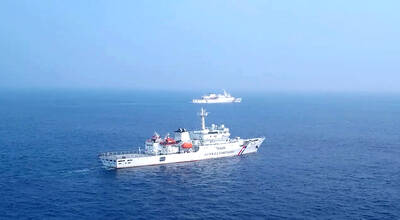
PATROL PARTNERS: The ‘Chiayi’ and the ‘Penghu’ departed for a two-day joint patrol of Palau’s exclusive economic zone, the CGA’s second diplomatic visit to the country The Coast Guard Administration (CGA) set a record for its southernmost deployment of a coast guard vessel as the vessels Chiayi and the Penghu reached Palau’s Pulo Anna Island on Saturday in a cooperative exercise between the two countries. The island, about 217 nautical miles (401km) southwest of Koror in the Palauan state of Sonsorol and 1,220 nautical miles from Taiwan’s southernmost point, Oluanpi (鵝鑾鼻), is the furthest south a CGA vessel has sailed. The two vessels are in Palau for the coast guard’s second diplomatic visit to the country. They docked at Malakal Harbor on Tuesday last week. The coast guard
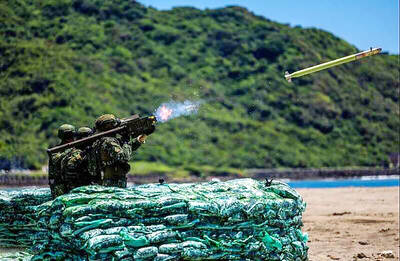
BATCH 1: The military has plans to assign the weapons to the army to defend Taiwan proper, as well as outlying islands and the navy for the Marine Corps, the official said Taiwan is to receive 500 Stinger missiles and 178 launchers from the US by the end of the year, the first batch under a planned two-stage acquisition totaling 2,621 missiles and 763 launchers, a defense official said yesterday on condition of anonymity. The portable missiles would play a vital role in the nation’s air defense capabilities, the source said. The army plans to deploy 2,235 missiles and 657 launchers to defend Taiwan proper and outlying islands, they said, citing military documents. The navy is allotted 295 missiles and 85 launchers to arm the Marine Corps and some surface vessels that lack air defense
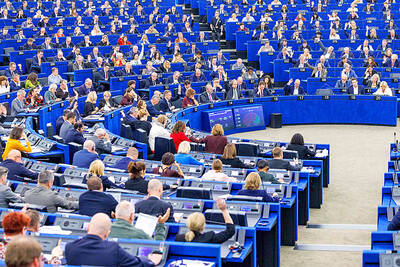
The European Parliament on Wednesday adopted a recommendation on EU-China political relations that rejected China’s efforts to restrict Taiwan’s participation in international organizations and exchanges. The recommendation, addressed to the European Council, the European Commission and EU High Representative for Foreign Affairs and Security Policy Kaja Kallas, includes several references to EU-Taiwan relations and expresses support for closer ties, saying they would bring positive benefits and have strategic importance. Describing Taiwan as a valuable partner in trade and technology, the European Parliament said it “rejects China’s attempts to coerce international organizations, third countries and other actors into restricting Taiwan’s international participation and
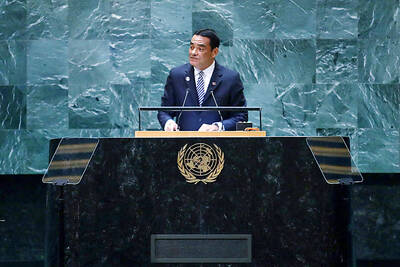
RIGHT TO DIPLOMACY: Under the UN Charter, every state has the right to conduct foreign policy free from external pressure, Belize said in a statement Belize and Paraguay on Monday condemned Beijing sanctions over their countries’ ties with Taiwan, saying China’s actions create unnecessary tensions. Earlier on Monday, Beijing announced sanctions against Paraguayan Minister of Information and Communication Technologies Gustavo Villate and Belizean Minister of Foreign Affairs Francis Fonseca. The Paraguayan Ministry of Foreign Affairs said it rejected the sanctions, writing on X that they created unnecessary friction. It added that it reaffirmed its support for Taiwan and its commitment to democratic values and principles. Villate told the Spanish-language Paraguayan daily ABC Color the sanctions were “predictable” and linked them to several cooperation projects between Taiwan and Paraguay. The projects


 RSS
RSS