


An alliance of investors and researchers is pledging to monitor technology companies that do business in countries with shaky human-rights reputations, and is asking the companies to proclaim their commitment to freedom of expression.
Twenty-five investment groups, representing about US$21 billion in assets in the US, Europe and Australia, are signatories to a "joint investor statement on freedom of expression and the Internet," an initiative led by media watchdog Reporters Without Borders.
The statement comes after several instances in which technology companies have been criticized for cooperating with governments, notably China, in order to secure strong market positions.
"As shareholders, we need to feel confident that our companies are not complicit in human-rights abuses, directly or indirectly, and that they're not collaborating to effectively quell Internet traffic, to harm their own good reputations and to reduce their long-term growth opportunities,'' said Dawn Wolfe, social research and advocacy analyst for Boston Common Asset Management, one of the participating investment funds.
Although China and other countries have come under fire for limiting what their citizens can see or post on the Web, China also is a particularly sought-after market, for the potential its vast population offers.
Microsoft Corp and Google Inc have been accused of helping the government there censor news sites and blogs. And in a recent case, Reporters Without Borders criticized Yahoo Inc for allegedly helping the Chinese government trace the private e-mail account of a Chinese journalist who was later imprisoned for providing state secrets to foreigners. Sunnyvale, California-based Yahoo has defended its move, saying it is obliged to comply with Chinese regulations.
Julien Pain, head of the Internet Freedom Desk for the watchdog group, said Reporters Without Borders had tried to enter into dialogue with technology companies, without much success. He said he hoped bringing in some of the companies' shareholders would encourage them to do more.
"I don't know if it's going be successful in the end," he said. "What we want is to raise the issue. We want them to discuss this issue and engage in some thinking about it."
At a news conference on Monday, Wolfe and Adam Kanzer, director of shareholder advocacy for Domini Social Investments, discussed a shareholder resolution calling on Cisco Systems Inc to report on what the company was doing to develop a human-rights policy, which Wolfe said she would present at the company's annual meeting next week.
Cisco, the world's biggest maker of computer-networking equipment, was the main equipment provider for ChinaNet, which serves the vast majority of China's Internet users. Reporters Without Borders and others have questioned whether Cisco helped the Chinese government come up with ways to monitor Internet use.
Cisco has denied participating in any kind of censorship, and has said the products it sells in China are the same sold around the world. On Monday, Cisco released its first Citizenship Report, which outlines the company's business practices.
also see story:
Pioneers of the Internet have found their limits
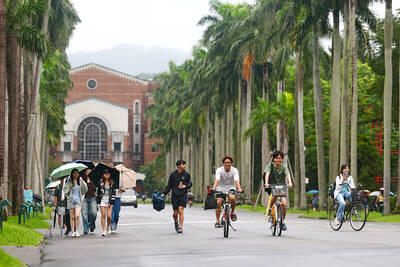
National Taiwan University (NTU) yesterday said it disqualified a person from an entrance examination for using AI smart glasses to cheat, along with two others for making untruthful statements in their curriculum vitae. The three applicants were given null scores, Taiwan’s highest-ranked university said, calling on prospective students to be honest in the admissions process. NTU registrar Lee Hung-sen (李宏森) said that the cheating applicant wore a hat and thick-rimmed glasses to the second written exam for medical school, claiming that they felt cold. Suspicions were aroused when the applicant stared oddly at the test for long stretches while steadily bringing the paper
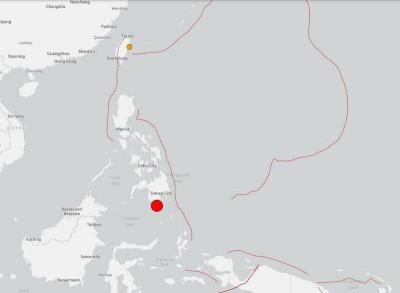
A magnitude 7.8 earthquake struck off the southern coast of Mindanao in the Philippines at 7:38am today, prompting the US Tsunami Warning System to issue an alert for neighboring countries, including Taiwan. The system issued a purple alert indicating a "tsunami threat." The potential threat zone includes Taiwan, the Philippines, Papua New Guinea, Yap and Palau. Philippine authorities were assessing the damage from the quake, with the office of civil defense seeking to verifying initial reports that 15 people had been killed and 129 injured in the region, mostly from falling debris. Arlene Hollero, disaster chief of Maasim town in the Philippines' Sarangani Province,

‘GRAY ZONE’ PRESSURE: Beijing’s activities are intended to create the deceitful impression that China has jurisdiction over the area around Taiwan, the CGA said Taiwan’s rights over its territorial waters and exclusive economic zone must not be violated by any country, the Mainland Affairs Council said yesterday, adding that it will not accept any unprovoked actions. The council issued the remarks in response to the China Coast Guard conducting maritime enforcement drills near eastern Taiwan and claiming to fully exercise China’s maritime administrative law enforcement authority. The Coast Guard Administration (CGA) has been closely monitoring the situation and is taking concrete steps to defend the nation’s sovereignty and secure its waters, the council said. China has no sovereign rights over the waters off eastern
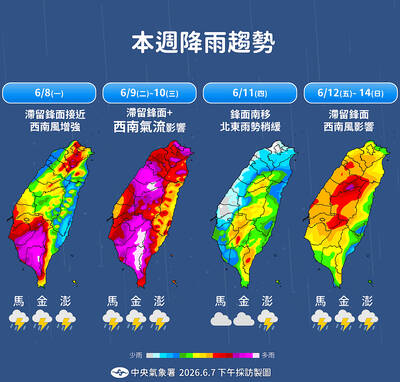
Heavy rain is expected to affect parts of Taiwan this week, the Central Weather Administration (CWA) said yesterday as a meteorologist said the active part of the annual plum rain season has started. A stationary plum rain front and southwesterly winds would bring unstable weather and abundant moisture to Taiwan from today for about a week, with the heaviest rainfall forecast for tomorrow and Wednesday, the CWA said. The agency said western and northeastern Taiwan, and mountainous areas in the east and southeast, could expect showers or thunderstorms on those two days, with localized heavy rain possible. Other parts of


 RSS
RSS