


US interest rates are likely to rise further this year to keep inflation in check as labor market strength fuels income growth, Federal Reserve officials said.
Fed Governor Susan Bies and Regional Fed bank presidents Anthony Santomero of Philadelphia, Gary Stern of Minneapolis, Jeffrey Lacker of Richmond, Virginia, and Sandra Pianalto of Cleveland said in separate speeches on Tuesday rates need to increase as long as the US economy expands with steady employment gains.
"It is prudent to move the federal funds rate up to a position that gives me more confidence that monetary policy is no longer accommodative," Pianalto, 50, told the Association for Corporate Growth in Pittsburgh. "I would prefer this strategy to finding out the hard way" that inflation is on the rise.
The US central bank raised interest rates five times in as many meetings since June, lifting the benchmark overnight lending rate to 2.25 percent from 1 percent. The Fed has moved in quarter-point steps, in keeping with a phrase in policy statements to remove its low-rate policy at a "measured" pace.
"The challenge is for us to move from an expansionary policy to a more neutral policy in a manner that allows the economy to grow, but does not allow inflation to accelerate," Santomero said after a speech to the Greater Philadelphia Chamber of Commerce.
Santomero forecast economic growth of 3.5 percent to 4 percent this year, employment gains of 150,000 to 200,000 a month, and "relatively stable" prices.
The Fed's policy-making Open Market Committee next meets beginning next month. Bies, Stern and Santomero are voting members this year.
"The Federal Reserve can continue to remove its policy accommodation at a measured pace, consistent with its commitment to maintain price stability as a necessary condition for maximum sustainable economic growth," Bies, 57, said in a speech to financial executives in Baltimore, Fed officials indicated over the past few weeks they see little immediate inflation threat. Their preferred price measure, the personal consumption expenditures index, minus food and energy, rose 1.5 percent for the 12 months ending November.
Both Stern and Pianalto said that rate meets their definition of price stability.
"I don't think there is a piece of data or a set of data that says the dynamics have changed dramatically in the past few weeks," Santomero said in an interview.
Richmond Fed bank president Jeffrey Lacker, 49, told reporters after a North Carolina speech yesterday that "inflation expectations remain contained."
Still, Fed officials cite risks of rising prices, including the possibility that higher energy and commodity costs are passed through to finished goods, or that wages begin to rise as productivity rates decrease, forcing companies to hire more workers to meet existing demand.

South Korea has adjusted its electronic arrival card system to no longer list Taiwan as a part of China, a move that the Ministry of Foreign Affairs said would help facilitate exchanges between the two sides. South Korea previously listed “Taiwan” as “Taiwan (China)” in the drop-down menus of its online arrival card system, where people had to fill out where they came from and their next destination. The ministry had requested South Korea make a revision and said it would change South Korea’s name on Taiwan’s online immigration system from “Republic of Korea” to “Korea (South),” should the issue not be

Tainan, Taipei and New Taipei City recorded the highest fines nationwide for illegal accommodations in the first quarter of this year, with fines issued in the three cities each exceeding NT$7 million (US$220,639), Tourism Administration data showed. Among them, Taipei had the highest number of illegal short-term rental units, with 410. There were 3,280 legally registered hotels nationwide in the first quarter, down by 14 properties, or 0.43 percent, from a year earlier, likely indicating operators exiting the market, the agency said. However, the number of unregistered properties rose to 1,174, including 314 illegal hotels and 860 illegal short-term rental
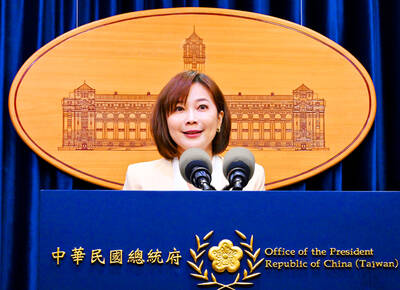
ECONOMIC COERCION: Such actions are often inconsistently applied, sometimes resumed, and sometimes just halted, the Presidential Office spokeswoman said The government backs healthy and orderly cross-strait exchanges, but such arrangements should not be made with political conditions attached and never be used as leverage for political maneuvering or partisan agendas, Presidential Office spokeswoman Karen Kuo (郭雅慧) said yesterday. Kuo made the remarks after China earlier in the day announced 10 new “incentive measures” for Taiwan, following a landmark meeting between Chinese President Xi Jinping (習近平) and Chinese Nationalist Party (KMT) Chairwoman Cheng Li-wun (鄭麗文) in Beijing on Friday. The measures, unveiled by China’s Xinhua news agency, include plans to resume individual travel by residents of Shanghai and China’s Fujian
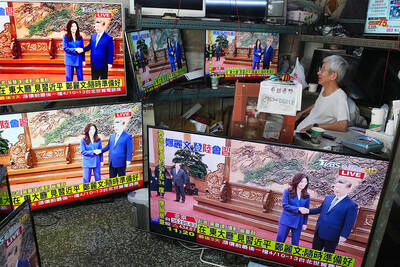
Chinese President Xi Jinping (習近平) and Chinese Nationalist Party (KMT) Chairwoman Cheng Li-wun (鄭麗文) met in Beijing yesterday, where they vowed to bring people on both sides of the Taiwan Strait closer to facilitate the “great rejuvenation of the Chinese nation.” The meeting was held in the East Hall of the Great Hall of the People, a venue typically reserved for meetings between Xi and foreign heads of state. In public remarks prior to a closed-door meeting, Xi, in his role as head of the Chinese Communist Party (CCP), said that Taiwan is historically part of China, and remains an “inalienable” and


 RSS
RSS