


Air Canada's creditors voted over-whelmingly on Tuesday to approve a restructuring plan, paving the way for the airline's emergence from bankruptcy-court shelter after more than a year.
The vote was 99.6 percent in favor, the Montreal-based airline announced after a special meeting.
"The strong support for Air Canada's restructuring plan received from creditors today is appre-ciated," said chief executive officer Robert Milton.
"This positive response from creditors represents by far the most critical vote of confidence in the strength of our business plan and the airline's prospects going forward," Milton said.
The airline plans to emerge from creditor protection on Sept. 30, af-ter approval by the court overseeing its restructuring at a hearing scheduled for Aug. 23 in Toronto.
Air Canada accepted in June a US$183 million investment proposal from New York firm Cerberus Capital Management for a 9.2 percent stake in the struggling airline.
The Cerberus investment is in convertible preference shares of Air Canada, which has been undergoing court supervised bankruptcy restructuring since April last year.
The investment, in addition to the US$621 million raised through an equity offering to be underwritten by Deutsche Bank, brings the total equity raised by Air Canada to around US$803 million.
The plan will see creditors receive just pennies on the dollar for their debts.
Air Canada, which has been operating under creditor protection since April last year, has said potential claims were whittled down from US$78 billion to as little as US$6.1 billion.
The airline estimated that if total claims were US$7.5 billion, creditors would recover about US$0.925 for every dollar owed.
But the main value for the creditors will be in the equity they will receive in the restructured airline. That may be worth plenty if Air Canada's plan succeeds.
As part of its restructuring plan, the new Air Canada holding company plans to establish several units as stand-alone businesses.
In addition to regional subsidiary Jazz and online travel business Destina which are already established as on their own, Air Canada plans to spin off its technical services, cargo and ground handling operations into separate busi-nesses or limited partnerships.
The company is forecasting operating profits of US$823 million on revenue of US$6.6 billion for this year, and US$1.2 billion on US$6.8 billion next year.
But it now has to deal with soaring fuel prices. In reporting the second-quarter results earlier this month, Air Canada said fuel costs rose 28 percent from a year earlier to US$281 million.
After slashing costs, debts and thousands of jobs, Air Canada may be on course to exit creditor protection on Sept. 30, but nothing can protect it from record crude-oil prices -- or from possible future shocks ranging from an economic recession to terrorism.
Last week, Air Canada named former premiers Frank McKenna and Pierre Marc Johnson to the board of directors that will oversee the airline after its restructuring, a move analysts say may help smooth its way in Ottawa.
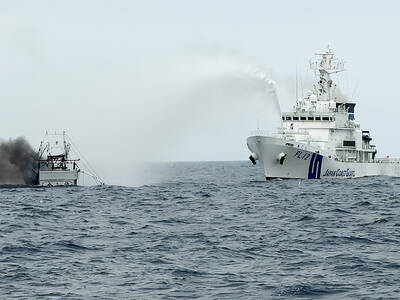
CREDIT-GRABBER: China said its coast guard rescued the crew of a fishing vessel that caught fire, who were actually rescued by a nearby Taiwanese boat and the CGA Maritime search and rescue operations do not have borders, and China should not use a shipwreck to infringe upon Taiwanese sovereignty, the Coast Guard Administration (CGA) said yesterday. The coast guard made the statement in response to the China Coast Guard (CCG) saying it saved a Taiwanese fishing boat. The Chuan Yu No. 6 (全漁6號), a fishing vessel registered in Keelung, on Thursday caught fire and sank in waters northeast of Diaoyutai Islands (釣魚台). The vessel left Keelung’s Badouzih Fishing Harbor (八斗子漁港) at 3:35pm on Sunday last week, with seven people on board — a 62-year-old Taiwanese captain surnamed Chang (張) and six

RISKY BUSINESS: The ‘incentives’ include initiatives that get suspended for no reason, creating uncertainty and resulting in considerable losses for Taiwanese, the MAC said China’s “incentives” failed to sway sentiment in Taiwan, as willingness to work in China hit a record low of 1.6 percent, a Ministry of Labor survey showed. The Directorate-General of Budget, Accounting and Statistics (DGBAS) also reported that the number of Taiwanese workers in China has nearly halved from a peak of 430,000 in 2012 to an estimated 231,000 in 2024. That marked a new low in the proportion of Taiwanese going abroad to work. The ministry’s annual survey on “Labor Life and Employment Status” includes questions respondents’ willingness to seek employment overseas. Willingness to work in China has steadily declined from

The Legislative Yuan’s Finance Committee yesterday approved proposed amendments to the Amusement Tax Act (娛樂稅法) that would abolish taxes on films, cultural activities and competitive sporting events, retaining the fee only for dance halls and golf courses. The proposed changes would set the maximum tax rate for dance halls and golf courses at 50 and 20 percent respectively, with local governments authorized to suspend the levies. Article 2 of the act says that “amusement tax shall be levied on tickets sold or fees charged by amusement places, facilities or activities” in six categories: “Cinema; professional singing, story-telling, dancing, circus, magic show, acrobatics

Tainan, Taipei and New Taipei City recorded the highest fines nationwide for illegal accommodations in the first quarter of this year, with fines issued in the three cities each exceeding NT$7 million (US$220,639), Tourism Administration data showed. Among them, Taipei had the highest number of illegal short-term rental units, with 410. There were 3,280 legally registered hotels nationwide in the first quarter, down by 14 properties, or 0.43 percent, from a year earlier, likely indicating operators exiting the market, the agency said. However, the number of unregistered properties rose to 1,174, including 314 illegal hotels and 860 illegal short-term rental


 RSS
RSS