


Hopeless.
That's how Jacky Qu sums up his job prospects when he graduates next year from college in the frigid northeastern Chinese city of Shenyang.
"I've seen both my parents lose their jobs," the 22-year-old computer studies major said, nursing a beer in a pub where he sings part-time to earn extra cash. "There's no work up here. I'd rather go anywhere but Shenyang."

PHOTO: REUTERS
Qu's parents thought they would have jobs for life at state-run firms in China's old industrial heartland.
After Beijing launched economic reforms more than two decades ago, many lumbering state firms found they could no longer keep pace with their leaner cousins along the coast who were busy attracting foreign investment.
Jobs vanished at an alarming rate. Take aviation and auto giant Harbin Aviation Industry Group, a few hours from the Russian border.
The firm chopped three-quarters of its workforce over the past 20 years, though it still employs 27,000 people.
Communist Party leaders in Beijing, who value stability above all else, fear more job losses in the northeast could spread wider social unrest, threatening a decade of breakneck national economic growth and even the Chinese state itself.
Once the crown jewel of the centrally planned economy, the northeast is China's rust belt today. The countryside is littered with the hulks of factories, and trees are reclaiming the railway sidings that once ferried goods to the rest of the country.
Things may get worse.
"Our urban unemployment rate is officially 6 percent," said Zhang Wenyue, governor of Liaoning province, where Shenyang is located. "But the real figure is much higher. We have a responsibility to say what the actual situation is."
Western businessmen in Shenyang -- a gritty, crumbling city that was a Mongol trading centre in the 11th century -- cite government contacts as saying a more realistic jobless rate was 40 percent.
College students such as Qu will graduate into a tight labor market, with 2.5 times more graduates seeking work than in 2001, state media say. And further restructuring in the northeast has made work scarcer.
PROTESTS
The region's richest city, Dalian, wants to close or sell 33 major state-owned enterprises within two years, adding 100,000 to the dole queue, doubling the figure now.
Hence a recent history of unrest.
In March 2002, two of the country's largest demonstrations erupted in the northeast, a region lauded as an industrial utopia under Mao Zedong (
Worker demands for unpaid benefits at the oil fields of Daqing and protests in the flagging smelting town of Liaoyang and elsewhere forced Beijing to tackle the plight of the urban unemployed.
The province of Heilongjiang -- which makes up the rust belt, together with Liaoning and Jilin -- is expecting almost 2 million more people to be out of work in the next two years, up from about a million at the end of last year.
And that's just the official number. Many workers are classified not as unemployed but as "laid-off" -- they still receive a modicum of social security from old work units and perhaps a pittance in salary, but no longer go to work.
They are a common sight on street corners in the northeast, holding aloft wooden boards with roughly painted characters advertising their expertise, hoping for day jobs as laborers.
Finding permanent jobs is difficult, despite the government throwing money at shiny new labour exchanges and re-training.
"It's next to impossible for someone like me to get work," said electrician Ning Baoquan, 50, who was laid off when the tractor factory that employed him shut last year.
"I just don't have the skills for any of these," he said, looking gloomily at an electronic board displaying openings at a Shenyang jobs center, many advertising for people under 35.
Even when they find jobs, former state sector workers may not stick them out.
"They're not used to hard work," said one Western executive based in Shenyang. "They try it for a week and then quit, saying they can't cope and that they can survive perfectly well on government assistance."
It's attitudes like that the government wants to change.
The registered unemployed are allowed to walk away from three jobs before their social security -- about 200 yuan a month -- is suspended, said Wang Yonglan, director of Shenyang's employment bureau.
"But for many of these workers the only skill they may have is the ability to turn a screwdriver," she lamented.
And the northeast is rapidly becoming a source of labor for the rest of China -- 110,00 people left Shenyang last year to find work elsewhere. The city even encourages richer provinces to hold employment fairs.
So what does the future hold for Qu?
"I want to go to Taiwan. I want to become a pop star."
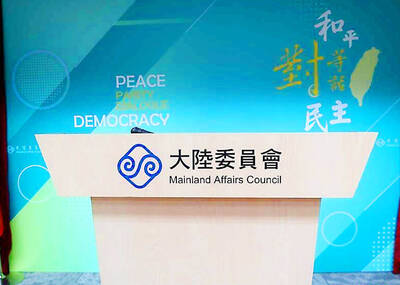
NO RECIPROCITY: Taipei has called for cross-strait group travel to resume fully, but Beijing is only allowing people from its Fujian Province to travel to Matsu, the MAC said The Mainland Affairs Council (MAC) yesterday criticized an announcement by the Chinese Ministry of Culture and Tourism that it would lift a travel ban to Taiwan only for residents of China’s Fujian Province, saying that the policy does not meet the principles of reciprocity and openness. Chinese Deputy Minister of Culture and Tourism Rao Quan (饒權) yesterday morning told a delegation of Chinese Nationalist Party (KMT) lawmakers in a meeting in Beijing that the ministry would first allow Fujian residents to visit Lienchiang County (Matsu), adding that they would be able to travel to Taiwan proper directly once express ferry

FAST RELEASE: The council lauded the developer for completing model testing in only four days and releasing a commercial version for use by academia and industry The National Science and Technology Council (NSTC) yesterday released the latest artificial intelligence (AI) language model in traditional Chinese embedded with Taiwanese cultural values. The council launched the Trustworthy AI Dialogue Engine (TAIDE) program in April last year to develop and train traditional Chinese-language models based on LLaMA, the open-source AI language model released by Meta. The program aims to tackle the information bias that is often present in international large-scale language models and take Taiwanese culture and values into consideration, it said. Llama 3-TAIDE-LX-8B-Chat-Alpha1, released yesterday, is the latest large language model in traditional Chinese. It was trained based on Meta’s Llama-3-8B

STUMPED: KMT and TPP lawmakers approved a resolution to suspend the rate hike, which the government said was unavoidable in view of rising global energy costs The Ministry of Economic Affairs yesterday said it has a mandate to raise electricity prices as planned after the legislature passed a non-binding resolution along partisan lines to freeze rates. Chinese Nationalist Party (KMT) lawmakers proposed the resolution to suspend the price hike, which passed by a 59-50 vote. The Taiwan People’s Party (TPP) voted with the KMT. Legislative Speaker Han Kuo-yu (韓國瑜) of the KMT said the resolution is a mandate for the “immediate suspension of electricity price hikes” and for the Executive Yuan to review its energy policy and propose supplementary measures. A government-organized electricity price evaluation board in March

NOVEL METHODS: The PLA has adopted new approaches and recently conducted three combat readiness drills at night which included aircraft and ships, an official said Taiwan is monitoring China’s People’s Liberation Army (PLA) exercises for changes in their size or pattern as the nation prepares for president-elect William Lai’s (賴清德) inauguration on May 20, National Security Bureau (NSB) Director-General Tsai Ming-yen (蔡明彥) said yesterday. Tsai made the comment at a meeting of the Legislative Yuan’s Foreign Affairs and National Defense Committee, in response to Democratic Progressive Party (DPP) Legislator Wang Ting-yu’s (王定宇) questions. China continues to employ a carrot-and-stick approach, in which it applies pressure with “gray zone” tactics, while attempting to entice Taiwanese with perks, Tsai said. These actions aim to help Beijing look like it has


 RSS
RSS