


For Airbus SAS, the world's largest commercial aircraft maker, and nuclear reactor company Areva SA, Chinese President Hu Jintao's three-day trip to France which started yesterday may mean one thing: orders.
Hu has a record of bringing business to the countries he visits. He went to Australia in October with a US$21 billion contract to buy natural gas. His May visit to Russia produced a statement asking companies there to help build a gas pipeline between China's eastern and western provinces.
Alsthom SA, PSA Peugeot Citroen and Suez SA are among French companies banking on more business from China.
Among business leaders who will meet with Hu in Paris are Areva chief executive Anne Lauvergeon, Renault SA chief executive Louis Schweitzer, Henri Proglio who heads Veolia Environnement SA and Peugeot chief executive Jean-Martin Folz.
Airbus signed letters of understanding in April to sell 30 jetliners to five Chinese airlines in a deal worth US$1.89 billion when French Prime Minister Jean-Pierre Raffarin visited the country. Most of those pacts have yet to be turned into official contracts. The sale involved four A330s, 16 A319s and 10 A320s.
Peugeot, Europe's No. 2 carmaker, sold 104,000 vehicles in China last year through a joint venture with Dongfeng Motor Corp and said this month it will invest 600 million euros (US$765 million) to increase Chinese production capacity to 300,000 vehicles.
Alstom, which has built power stations that generate a fifth of the world's electricity and has made two-thirds of the world's high-speed trains, is bidding for more contracts in China.
The company has helped build nuclear power stations in the country and is supplying turbine generators for the Three Gorges Dam. It has also supplied trains for the Shanghai subway.
State-owned Areva, whose Framatome ANP unit is the world's biggest maker of nuclear reactors, has designed six reactors for China and is seeking to increase orders there.
"We are eagerly looking forward to the call for tenders for the next four reactors," said Charles Hufnagel, an Areva spokesman.
Veolia Environnement, the world's biggest water company, has signed several contracts in China including a 50-year, 8.5 billion euro contract to distribute water in Shenzhen and a 20-year, 50 million-euro contract to operate a wastewater-treatment plant in Beijing.
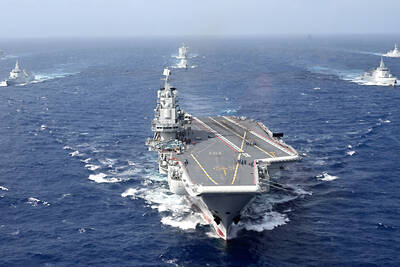
PROVOCATIVE: Chinese Deputy Ambassador to the UN Sun Lei accused Japan of sending military vessels to deliberately provoke tensions in the Taiwan Strait China denounced remarks by Japan and the EU about the South China Sea at a UN Security Council meeting on Monday, and accused Tokyo of provocative behavior in the Taiwan Strait and planning military expansion. Ayano Kunimitsu, a Japanese vice foreign minister, told the Council meeting on maritime security that Tokyo was seriously concerned about the situation in the East China and South China seas, and reiterated Japan’s opposition to any attempt to change the “status quo” by force, and obstruction of freedom of navigation and overflight. Stavros Lambrinidis, head of the EU delegation to the UN, also highlighted South China Sea
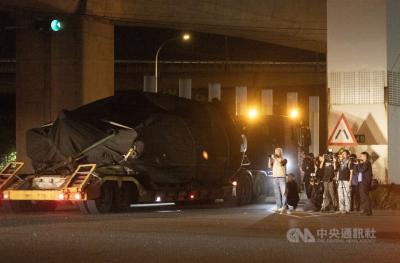
The final batch of 28 M1A2T Abrams tanks purchased from the US arrived at Taipei Port last night and were transported to the Armor Training Command in Hsinchu County’s Hukou Township (湖口), completing the military’s multi-year procurement of 108 of the tanks. Starting at 12:10am today, reporters observed more than a dozen civilian flatbed trailers departing from Taipei Port, each carrying an M1A2T tank covered with black waterproof tarps. Escorted by military vehicles, the convoy traveled via the West Coast Expressway to the Armor Training Command, with police implementing traffic control. The army operates about 1,000 tanks, including CM-11 Brave Tiger
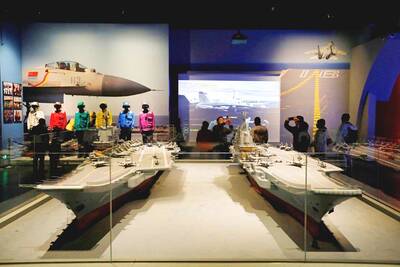
China on Wednesday teased in a video an aircraft carrier that could be its fourth, and the first using nuclear power, while making an allusion to Taiwan and vowing to further build up its islands, as it looks to boost maritime power, secure resources and bolster territorial claims. The video, issued on the eve of the 77th founding anniversary of the Chinese People’s Liberation Army Navy, featured fictional officers with names that are homophones of three commissioned aircraft carriers, the Liaoning (遼寧), Shandong (山東) and Fujian (福建). Titled Into the Deep, it showed a 19-year-old named “Hejian” (何劍) joining the group, sparking
Taiwan Semiconductor Manufacturing Co (TSMC, 台積電), the world’s largest contract chipmaker, said it expects its 2-nanometer (2nm) chip capacity to grow at a compound annual rate of 70 percent from this year to 2028. The projection comes as five fabs begin volume production of 2-nanometer chips this year — two in Hsinchu and three in Kaohsiung — TSMC senior vice president and deputy cochief operating officer Cliff Hou (侯永清) said at the company’s annual technology symposium in Silicon Valley, California, last week. Output in the first year of 2-nanometer production, which began in the fourth quarter of last year, is expected to


 RSS
RSS